115195
论文已发表
注册即可获取德孚的最新动态
IF 收录期刊
- 3.6 Breast Cancer (Dove Med Press)
- 4.3 Clin Epidemiol
- 2.6 Cancer Manag Res
- 3.2 Infect Drug Resist
- 4.1 Clin Interv Aging
- 6.1 Drug Des Dev Ther
- 4.1 Int J Chronic Obstr
- 8.7 Int J Nanomed
- 2.5 Int J Women's Health
- 3.2 Neuropsych Dis Treat
- 2.4 OncoTargets Ther
- 2.6 Patient Prefer Adher
- 2.6 Ther Clin Risk Manag
- 3.1 J Pain Res
- 3.5 Diabet Metab Synd Ob
- 4.5 Psychol Res Behav Ma
- 3.4 Nat Sci Sleep
- 2.4 Pharmgenomics Pers Med
- 2.6 Risk Manag Healthc Policy
- 4.6 J Inflamm Res
- 2.3 Int J Gen Med
- 3.9 J Hepatocell Carcinoma
- 3.3 J Asthma Allergy
- 2.5 Clin Cosmet Investig Dermatol
- 3.0 J Multidiscip Healthc

HIV 合并梅毒感染的年轻患者的脑功能变化:基于体素的度中心度分析
Authors Zhang XD, Liu GX, Wang XY, Huang XJ, Li JL, Li RL, Li HJ
Received 16 October 2019
Accepted for publication 25 February 2020
Published 11 March 2020 Volume 2020:13 Pages 823—833
DOI https://doi.org/10.2147/IDR.S234913
Checked for plagiarism Yes
Review by Single-blind
Peer reviewer comments 3
Editor who approved publication: Professor Suresh Antony
Objective: This study assessed the possible effect of syphilis co-infection in the brain function in young HIV patients by using voxel-wise degree centrality (DC) analysis.
Methods: Forty-four syphilis-co-infected HIV patients (HIV+/syphilis+), 45 HIV patients without syphilis history (HIV+/syphilis-) and 43 matched healthy controls (HC) underwent resting-state fMRI examinations. Laboratory tests and a battery of neuropsychological tests were performed before each MRI examination. One-way ANOVA was used to compare the differences of DC among the three groups. The correlations between MRI metrics and laboratory/neuropsychological tests in each patient’s group were performed by Pearson correlation analysis.
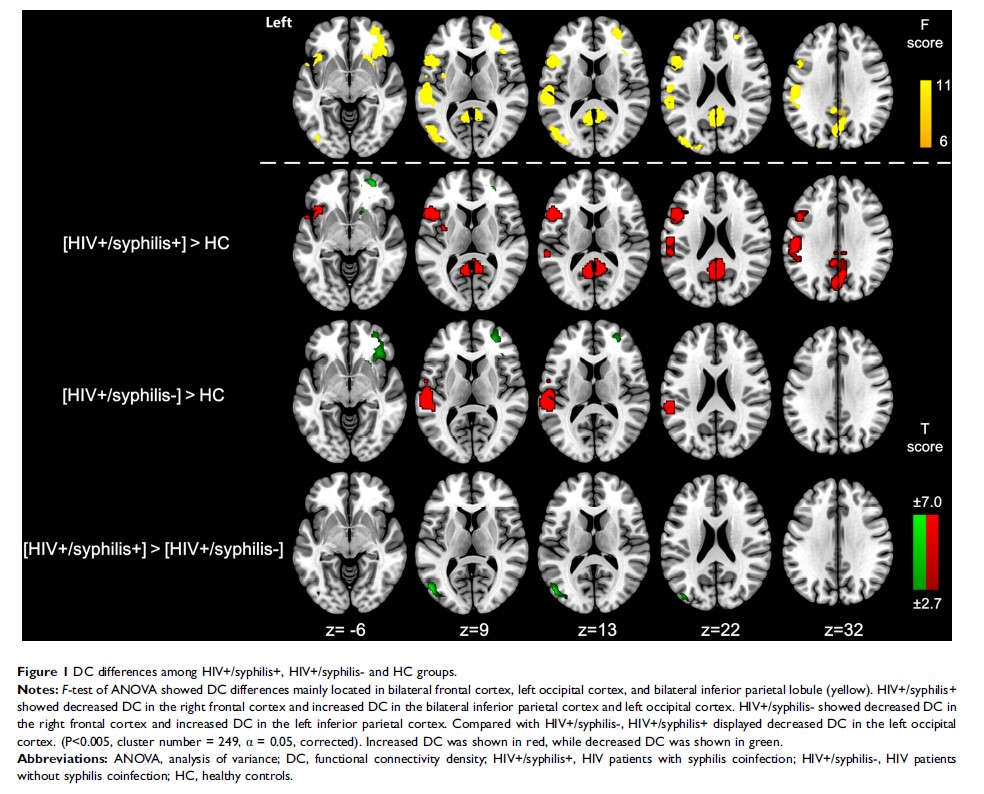
Results: Compared with HIV+/syphilis-, worse performance in complex motor skills was found in HIV+/syphilis+. Compared with HC, HIV+/syphilis+ and HIV+/syphilis- groups showed attenuated DC in the right orbital frontal cortex and increased DC in the left parietal/temporal cortex. Besides, we also found increased DC in the left inferior frontal cortex and bilateral posterior cingulated cortex/precuneus in HIV+/syphilis+ compared with HC. Moreover, compared with HIV+/syphilis-, HIV+/syphilis+ displayed decreased DC in the left middle occipital cortex. Additionally, in HIV+/syphilis+ group, the mean z value of DC was correlated to the CD4+ cell counts and the learning and delayed recall score.
Conclusion: Syphilis co-infection might be related to more brain functional reorganization in young HIV patients which could be reflected by DC value.
Keywords: syphilis, HIV, functional connectivity, fMRI, brain