115195
论文已发表
注册即可获取德孚的最新动态
IF 收录期刊
- 3.6 Breast Cancer (Dove Med Press)
- 4.3 Clin Epidemiol
- 2.6 Cancer Manag Res
- 3.2 Infect Drug Resist
- 4.1 Clin Interv Aging
- 6.1 Drug Des Dev Ther
- 4.1 Int J Chronic Obstr
- 8.7 Int J Nanomed
- 2.5 Int J Women's Health
- 3.2 Neuropsych Dis Treat
- 2.4 OncoTargets Ther
- 2.6 Patient Prefer Adher
- 2.6 Ther Clin Risk Manag
- 3.1 J Pain Res
- 3.5 Diabet Metab Synd Ob
- 4.5 Psychol Res Behav Ma
- 3.4 Nat Sci Sleep
- 2.4 Pharmgenomics Pers Med
- 2.6 Risk Manag Healthc Policy
- 4.6 J Inflamm Res
- 2.3 Int J Gen Med
- 3.9 J Hepatocell Carcinoma
- 3.3 J Asthma Allergy
- 2.5 Clin Cosmet Investig Dermatol
- 3.0 J Multidiscip Healthc

手术中使用右美托咪定与否及其剂量差异对接受非心脏类大手术的患者术后睡眠障碍的影响:一项真实世界队列研究
Authors Duan G, Wang K, Peng T, Wu Z, Li H
Received 22 November 2019
Accepted for publication 3 March 2020
Published 12 March 2020 Volume 2020:12 Pages 209—219
DOI https://doi.org/10.2147/NSS.S239706
Checked for plagiarism Yes
Review by Single-blind
Peer reviewer comments 2
Editor who approved publication: Professor Steven A Shea
Objective: The study aimed to investigate the effects of intraoperative dexmedetomidine on postoperative sleep disturbance for different surgical patients and compare such effects between different dose of dexmedetomidine.
Methods: A total of 7418 patients undergoing nine types of non-cardiac major surgeries were retrospectively studied. Patients were separated into DEX (dexmedetomidine) or Non-DEX (Non-dexmedetomidine) groups based on the use of dexmedetomidine during surgery. The patients who reported they could not fall asleep during the night or woke up repeatedly during the most of the night at the day of the surgery and whose NRS were > 6 were defined as cases with severe sleep disturbance. Propensity score matched analysis based on all preoperative baseline data was performed along with logistic regression analysis including different surgery types and dosage of dexmedetomidine use.
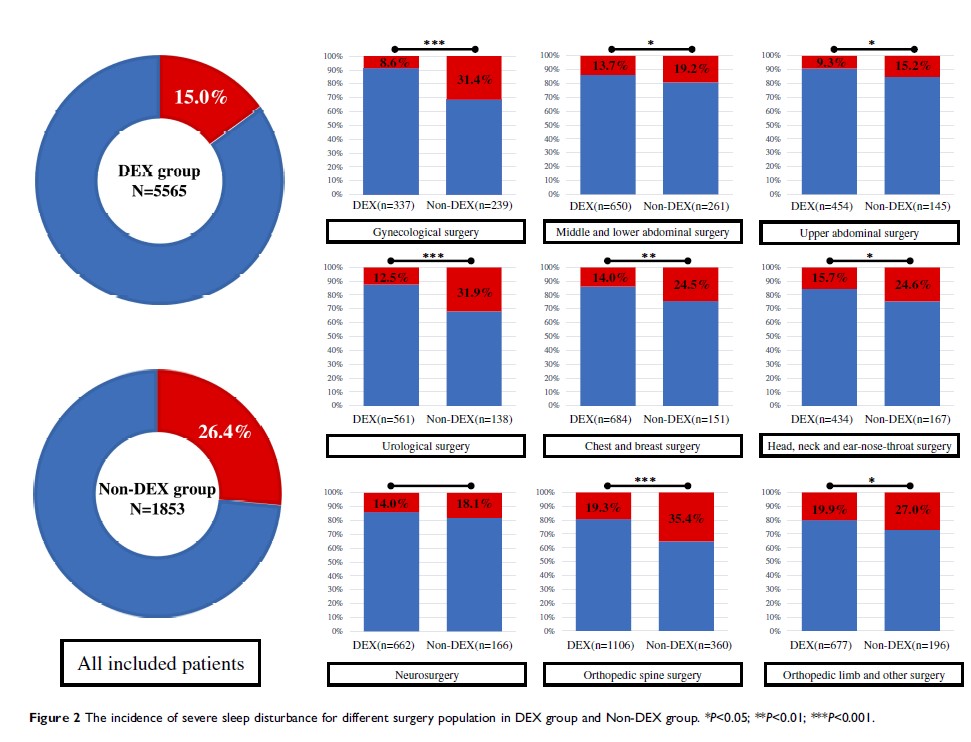
Results: In both of the unmatched cohort (OR, 0.49 [95% CI: 0.43– 0.56]) and matched cohort (0.49 [95% CI: 0.42– 0.58]), the DEX group had a significantly lower incidence of severe sleep disturbance than the Non-DEX group. In the subgroup analysis, for gynecological and urological surgery population, the ORs for DEX-group reached 0.21 (95% CI, 0.13– 0.33; P < 0.0001) and 0.30 (95% CI,0.19– 0.47; P < 0.0001), respectively. In addition, low-dose dexmedetomidine (0.2– 0.4 μg·kg− 1·h− 1) showed the greatest effect with an odds ratio of 0.38 (95% CI: 0.31– 0.44; P < 0.0001), and the incidence of severe sleep disturbance in the low-dose group was significantly lower (11.5% vs. 17.7% vs. 16.5%, P < 0.0001) than that in the medium- (0.4– 0.6 μg·kg− 1·h− 1) and high-dose (0.6– 0.8 μg·kg− 1·h− 1) groups.
Conclusion: Intraoperative dexmedetomidine use can significantly decrease the incidence of severe sleep disturbance on the day of surgery for patients undergoing non-cardiac major surgery, and the effects were most significant in patients receiving gynecological and urological surgery. Furthermore, low-dose dexmedetomidine (0.2– 0.4 μg·kg− 1·h− 1) is most effective for prevention of postoperative sleep disturbance.
Keywords: dexmedetomidine, intraoperative use, postoperative sleep disturbance