115195
论文已发表
注册即可获取德孚的最新动态
IF 收录期刊
- 3.6 Breast Cancer (Dove Med Press)
- 4.3 Clin Epidemiol
- 2.6 Cancer Manag Res
- 3.2 Infect Drug Resist
- 4.1 Clin Interv Aging
- 6.1 Drug Des Dev Ther
- 4.1 Int J Chronic Obstr
- 8.7 Int J Nanomed
- 2.5 Int J Women's Health
- 3.2 Neuropsych Dis Treat
- 2.4 OncoTargets Ther
- 2.6 Patient Prefer Adher
- 2.6 Ther Clin Risk Manag
- 3.1 J Pain Res
- 3.5 Diabet Metab Synd Ob
- 4.5 Psychol Res Behav Ma
- 3.4 Nat Sci Sleep
- 2.4 Pharmgenomics Pers Med
- 2.6 Risk Manag Healthc Policy
- 4.6 J Inflamm Res
- 2.3 Int J Gen Med
- 3.9 J Hepatocell Carcinoma
- 3.3 J Asthma Allergy
- 2.5 Clin Cosmet Investig Dermatol
- 3.0 J Multidiscip Healthc

在心脏骤停大鼠复苏后 48 小时,PD98059 可保护大脑皮质线粒体的结构和功能
Authors Zheng JH, Chen MH, Fu ZY, Li N, Xie L
Received 21 September 2019
Accepted for publication 29 January 2020
Published 12 March 2020 Volume 2020:14 Pages 1107—1115
DOI https://doi.org/10.2147/DDDT.S231980
Checked for plagiarism Yes
Review by Single-blind
Peer reviewer comments 2
Editor who approved publication: Professor Manfred Ogris
Background: Mitochondria play a critical role as effectors and targets of brain injury in the post-resuscitation period. Although we found previously that the extracellular signal-regulated kinase (ERK)1/2 inhibitor PD98059 (PD) protects the brain against mitochondrial-mediated cell death at 24 h post-resuscitation in rats subjected to cardiac arrest/cardiopulmonary resuscitation (CA/CPR), it is not clear whether PD also exerts mitochondrial protective effect for a lasting time. Therefore, we examined the effect of PD on brain mitochondria at 48 h post-resuscitation to evaluate the time-effect of PD in the current study.
Methods: Experimental rats were divided randomly into 5 groups: Sham, CA, dimethylsulfoxide (DMSO), 0.15mg/kg PD and 0.3mg/kg PD. Rats except for sham group were subjected to CA for 6 min followed by CPR. We detected survival rates and neurologic deficit scores, cerebral cortex mitochondrial function by evaluating adenosine triphosphate (ATP) levels, mitochondrial permeability transition pore (MPTP) opening, and the expression of mitofusin2 (Mfn2) and observing the ultrastructure by electron microscopy at 48 h post-resuscitation in a 6-min CA rat model.
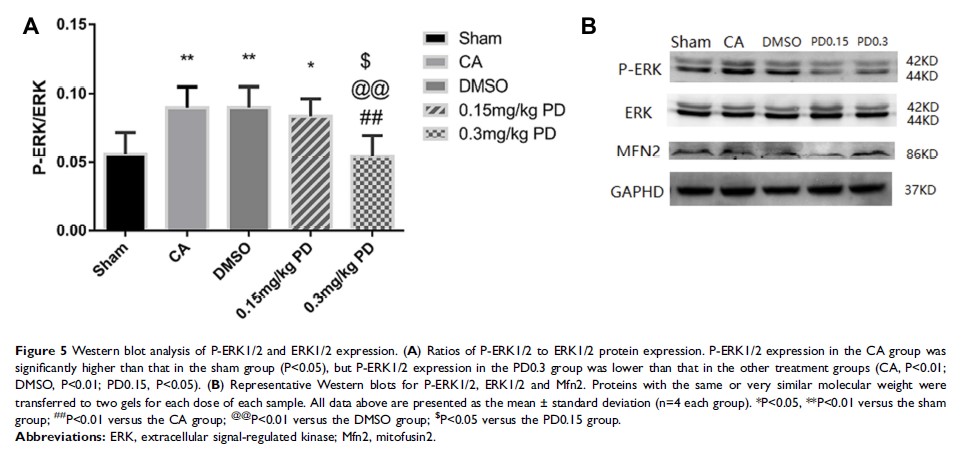
Results: PD improved survival rates and neurologic deficit scores, alleviated cerebral cortex mitochondrial damage by reducing MPTP opening and increasing Mfn2 production at 48 h post-resuscitation in a 6-min CA rat model.
Conclusion: A single dose of PD improved 48 h post-resuscitation outcome and mitochondrial function, indicating the potential of the use of ERK inhibitors for the treatment of brain injury resulting from CA in the future.
Keywords: cardiac arrest, extracellular signal-regulated kinase, mitochondria, mitofusin2, mitochondrial permeability transition pore