115195
论文已发表
注册即可获取德孚的最新动态
IF 收录期刊
- 3.6 Breast Cancer (Dove Med Press)
- 4.3 Clin Epidemiol
- 2.6 Cancer Manag Res
- 3.2 Infect Drug Resist
- 4.1 Clin Interv Aging
- 6.1 Drug Des Dev Ther
- 4.1 Int J Chronic Obstr
- 8.7 Int J Nanomed
- 2.5 Int J Women's Health
- 3.2 Neuropsych Dis Treat
- 2.4 OncoTargets Ther
- 2.6 Patient Prefer Adher
- 2.6 Ther Clin Risk Manag
- 3.1 J Pain Res
- 3.5 Diabet Metab Synd Ob
- 4.5 Psychol Res Behav Ma
- 3.4 Nat Sci Sleep
- 2.4 Pharmgenomics Pers Med
- 2.6 Risk Manag Healthc Policy
- 4.6 J Inflamm Res
- 2.3 Int J Gen Med
- 3.9 J Hepatocell Carcinoma
- 3.3 J Asthma Allergy
- 2.5 Clin Cosmet Investig Dermatol
- 3.0 J Multidiscip Healthc

姜黄素纳米颗粒对雄性小鼠精子质量和精子形成的急性损害
Authors Xia X, Wang L, Yang X, Hu Y, Liu Q
Received 7 November 2019
Accepted for publication 14 February 2020
Published 17 March 2020 Volume 2020:15 Pages 1853—1862
DOI https://doi.org/10.2147/IJN.S237254
Checked for plagiarism Yes
Review by Single-blind
Peer reviewer comments 4
Editor who approved publication: Dr Linlin Sun
Background: Curcumin has shown many pharmacological activities in both preclinical and clinical studies. Many technologies have been developed and applied to improve the solubility and bioavailability of curcumin, especially the nanotechnology-based delivery systems. However, there has been evidence that certain nanoparticles have potential reproductive toxicity in practice.
Methods: Curcumin-poly (lactic-co-glycolic acid) (PLGA)-PEG nanoparticles (Cur-PLGA-NPs for short) were prepared. The Cur-PLGA-NPs were evaluated with its effect on the proliferation of mouse testicular cell lines in vitro and spermatogenesis in vivo, while PLGA-NPs were used as control. For animal experiments, male BALB/c mice were treated with 20 mg/kg of Cur-PLGA-NPs for continuous 10 days via tail vein injection.
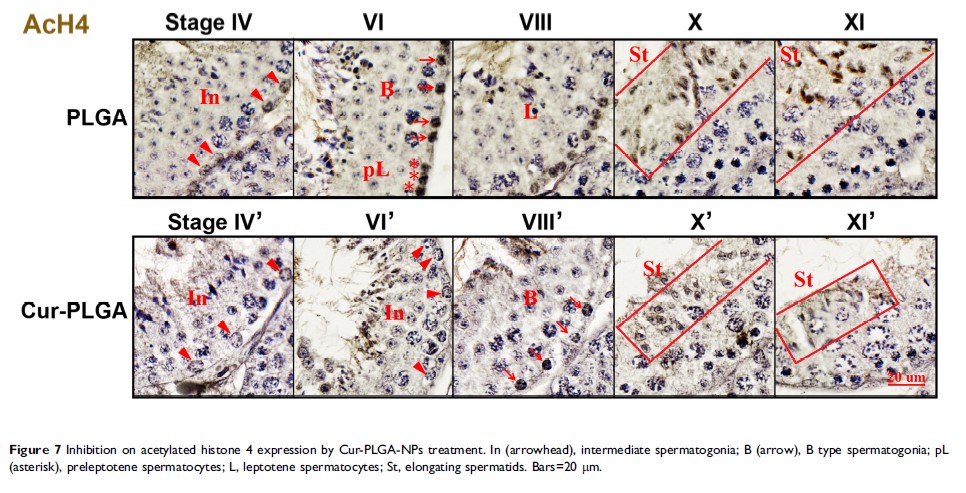
Results: We found the curcumin nanoparticles suppressed the proliferation of testicular cell lines in vitro. Furthermore, a short-term intravenous delivery of curcumin-loaded nanoparticles could be harmful to the differentiation of spermatogonia, the elongation of spermatids, as well as the motility of mature sperms.
Conclusion: In the present study, we disclosed the acute damage on mouse spermatogenesis and sperm parameters by curcumin-loaded nanoparticles. Our results suggested that the reproductive toxicity of nanoformulated curcumin needs to be prudently evaluated before its application.
Keywords: nano-curcumin, reproductive toxicity, Sertoli cell, sperm motility, spermatogenesis