115195
论文已发表
注册即可获取德孚的最新动态
IF 收录期刊
- 3.6 Breast Cancer (Dove Med Press)
- 4.3 Clin Epidemiol
- 2.6 Cancer Manag Res
- 3.2 Infect Drug Resist
- 4.1 Clin Interv Aging
- 6.1 Drug Des Dev Ther
- 4.1 Int J Chronic Obstr
- 8.7 Int J Nanomed
- 2.5 Int J Women's Health
- 3.2 Neuropsych Dis Treat
- 2.4 OncoTargets Ther
- 2.6 Patient Prefer Adher
- 2.6 Ther Clin Risk Manag
- 3.1 J Pain Res
- 3.5 Diabet Metab Synd Ob
- 4.5 Psychol Res Behav Ma
- 3.4 Nat Sci Sleep
- 2.4 Pharmgenomics Pers Med
- 2.6 Risk Manag Healthc Policy
- 4.6 J Inflamm Res
- 2.3 Int J Gen Med
- 3.9 J Hepatocell Carcinoma
- 3.3 J Asthma Allergy
- 2.5 Clin Cosmet Investig Dermatol
- 3.0 J Multidiscip Healthc

COPD-OSA 重叠综合征患者的支气管扩张
Authors Yang X, Tang X, Cao Y, Dong L, Wang Y, Zhang J, Cao J
Received 26 December 2019
Accepted for publication 6 March 2020
Published 18 March 2020 Volume 2020:15 Pages 605—611
DOI https://doi.org/10.2147/COPD.S243429
Checked for plagiarism Yes
Review by Single-blind
Peer reviewer comments 2
Editor who approved publication: Prof. Dr. Chunxue Bai
Purpose: COPD-OSA (chronic obstructive pulmonary disease–obstructive sleep apnea) overlap syndrome is associated with more frequent COPD acute exacerbations than COPD without OSA. With the application of high-resolution computed tomography (HRCT) in COPD, bronchiectasis is commonly detected and is associated with disease severity. Sleep respiratory disease is also associated with bronchiectasis; however, the correlation between OSA and coexisted bronchiectasis in COPD (COPD-Bx) has not been reported yet.
Patients and Methods: A total of 124 consecutive patients with stable COPD were enrolled. All subjects completed the chest HRCT and nocturnal polysomnography (PSG). The scores of extent and severity in bronchiectasis were assessed based on the Smith method and the Bhalla scoring system. Clinical data, questionnaire, routine blood test data, blood levels of C-reactive protein (CRP) and Immunoglobulin E, and the lymphocyte subtype were collected.
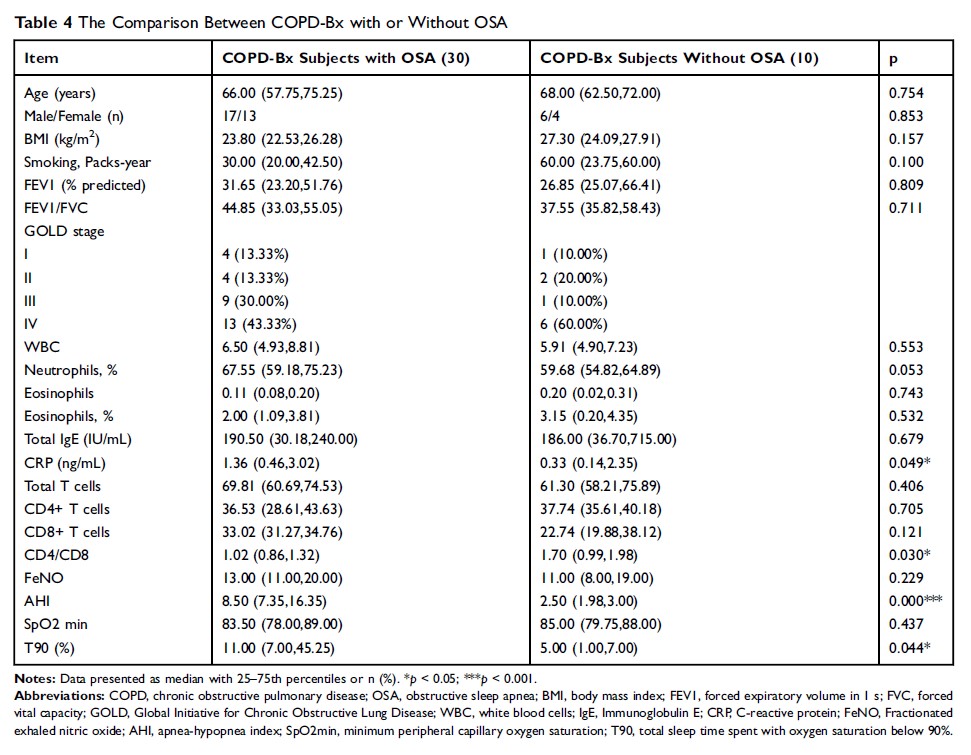
Results: Among all enrolled patients, 56.45% (70/124) were diagnosed as COPD-OSA based on the results of PSG screening. Bronchiectasis was detected in 42.86% (30/70) of the patients with COPD-OSA, but in 18.52% (10/54) of the patients without OSA (χ 2=8.264, p=0.004). PSG screening revealed that COPD with OSA had a significantly higher apnea-hypopnea index and percent of time spent with oxygen saturation below 90% (T90). Higher values of CRP, T90, and lower CD4/CD8 in the COPD-Bx with OSA were detected compared to COPD-Bx without OSA. Correlation analysis showed that the Bhalla severity score was related to CD8 cell count (r=0.446, p < 0.05) and CD4/CD8 (r=− 0.357, p < 0.05) in all the COPD-Bx patients. The Smith extent score was also associated with the values of CD8 count (r=0.388, p < 0.05) and CD4/CD8 (r=− 0.381, p < 0.05).
Conclusion: The comorbid bronchiectasis was more common in COPD-OSA overlap syndrome patient and may be related to more severe hypoxia and increased systemic inflammation.
Keywords: chronic obstructive pulmonary disease, bronchiectasis, obstructive sleep apnea