115195
论文已发表
注册即可获取德孚的最新动态
IF 收录期刊
- 3.6 Breast Cancer (Dove Med Press)
- 4.3 Clin Epidemiol
- 2.6 Cancer Manag Res
- 3.2 Infect Drug Resist
- 4.1 Clin Interv Aging
- 6.1 Drug Des Dev Ther
- 4.1 Int J Chronic Obstr
- 8.7 Int J Nanomed
- 2.5 Int J Women's Health
- 3.2 Neuropsych Dis Treat
- 2.4 OncoTargets Ther
- 2.6 Patient Prefer Adher
- 2.6 Ther Clin Risk Manag
- 3.1 J Pain Res
- 3.5 Diabet Metab Synd Ob
- 4.5 Psychol Res Behav Ma
- 3.4 Nat Sci Sleep
- 2.4 Pharmgenomics Pers Med
- 2.6 Risk Manag Healthc Policy
- 4.6 J Inflamm Res
- 2.3 Int J Gen Med
- 3.9 J Hepatocell Carcinoma
- 3.3 J Asthma Allergy
- 2.5 Clin Cosmet Investig Dermatol
- 3.0 J Multidiscip Healthc

超声引导下腹横肌平面阻滞用于剖宫产:注射部位疼痛成为新的并发症及使用地塞米松降低发病率
Authors Liu HL, Zhou RH, Luo LL, Yuan X, Ye L, Luo HG
Received 11 July 2019
Accepted for publication 7 March 2020
Published 19 March 2020 Volume 2020:13 Pages 565—573
DOI https://doi.org/10.2147/JPR.S222767
Checked for plagiarism Yes
Review by Single-blind
Peer reviewer comments 2
Editor who approved publication: Dr E Alfonso Romero-Sandoval
Background: Although ultrasound-guided transversus abdominis plane block (TAPB) is widely used in multimodal analgesia after cesarean delivery (CD), the complications of TAPB during analgesia after CD have rarely been reported.
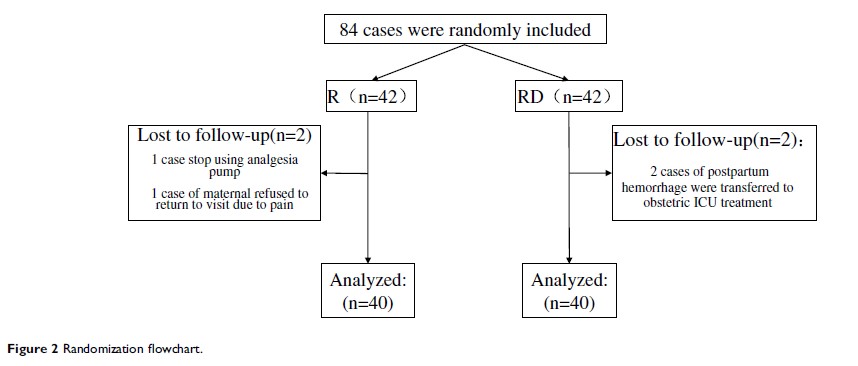
Methods: A total of 84 cases of CD were randomly assigned to either a ropivacaine group (R group) or ropivacaine + dexamethasone group (RD group) in this double-blind trial. The pain site and pain degree at rest and during activity at 2 h, 6 h, 10 h, 12 h, 14 h, 16 h, 20 h, and 24 h after maternal surgery were recorded. The consumption of opioids at 24h, postoperative nausea, vomiting, exhaustion, and other adverse reactions were recorded.
Results: A total of 80 patients were included in the analysis of results. A total of 19 patients developed ISP, 14 in the R group and 5 in the RD group. The incidence of ISP in the R and RD groups was 35% and 12.5%, respectively. The results described above showed that combining dexamethasone with ropivacaine reduced the incidence of ISP, and the difference was statistically significant (P< 0.05). Two groups of women with positive ISP had higher values of opioid consumption than women with negative ISP, but the difference was not significant.
Conclusion: Dexamethasone as an adjuvant for ropivacaine can effectively relieve the ISP of ultrasound-guided TAPB after CD, and can enhance the analgesic effect of ropivacaine.
Keywords: dexamethasone, ropivacaine, cesarean delivery, transversus abdominis plane block, postoperative analgesia, injection site pain