115195
论文已发表
注册即可获取德孚的最新动态
IF 收录期刊
- 3.6 Breast Cancer (Dove Med Press)
- 4.3 Clin Epidemiol
- 2.6 Cancer Manag Res
- 3.2 Infect Drug Resist
- 4.1 Clin Interv Aging
- 6.1 Drug Des Dev Ther
- 4.1 Int J Chronic Obstr
- 8.7 Int J Nanomed
- 2.5 Int J Women's Health
- 3.2 Neuropsych Dis Treat
- 2.4 OncoTargets Ther
- 2.6 Patient Prefer Adher
- 2.6 Ther Clin Risk Manag
- 3.1 J Pain Res
- 3.5 Diabet Metab Synd Ob
- 4.5 Psychol Res Behav Ma
- 3.4 Nat Sci Sleep
- 2.4 Pharmgenomics Pers Med
- 2.6 Risk Manag Healthc Policy
- 4.6 J Inflamm Res
- 2.3 Int J Gen Med
- 3.9 J Hepatocell Carcinoma
- 3.3 J Asthma Allergy
- 2.5 Clin Cosmet Investig Dermatol
- 3.0 J Multidiscip Healthc

不同 BMI 类别对代谢健康的中国成年人代谢异常发展的影响:一项为期七年的前瞻性研究
Authors Liu X, Zhang J, Wu J, Xu X, Tao L, Sun Y, Chen S, Han Y, Luo Y, Yang X, Guo X
Received 8 November 2019
Accepted for publication 6 March 2020
Published 19 March 2020 Volume 2020:13 Pages 819—834
DOI https://doi.org/10.2147/DMSO.S237550
Checked for plagiarism Yes
Review by Single-blind
Peer reviewer comments 2
Editor who approved publication: Professor Ming-Hui Zou
Purpose: To determine what metabolic abnormalities develop frequently among metabolically healthy adults over time according to different baseline body mass index (BMI) categories.
Patients and Methods: A prospective cohort study was performed on 10,805 adults, who were metabolically healthy at the time of the 2008 survey. Participants were divided into four groups: metabolically healthy obese (MHO), metabolically healthy overweight (MHOW), metabolically healthy normal-weight (MHN), and metabolically healthy underweight (MHU). Modified Poisson regression models were used to evaluate the relationship of BMI with the development of metabolic abnormalities. Association rule mining was used to identify the most frequent abnormalities that developed over time.
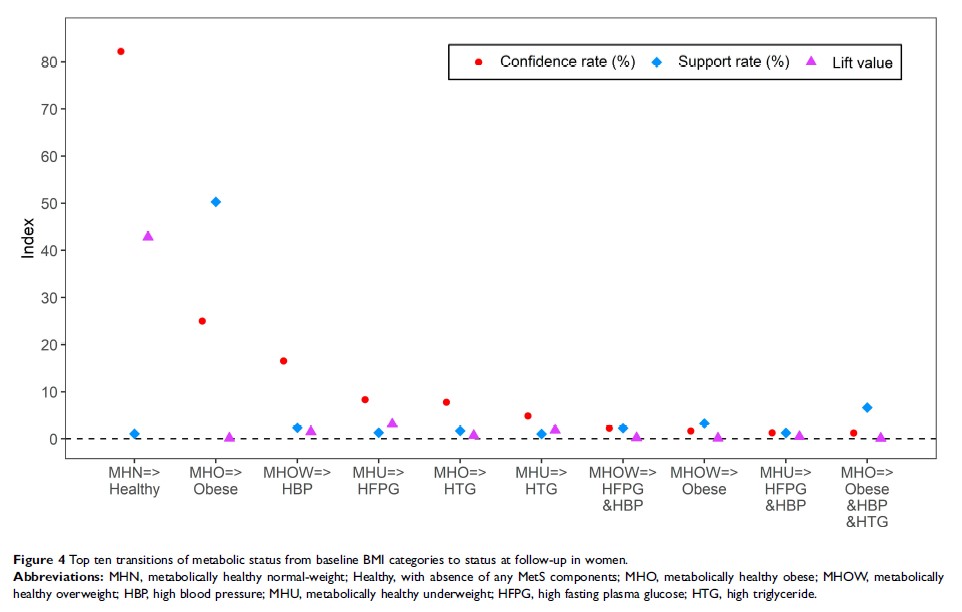
Results: Compared with the MHN group, the adjusted relative risks of the MHO group were 1.57 (95% CI: 1.09– 2.27) and 2.08 (95% CI: 1.59– 2.73) for developing elevated fasting glucose and elevated blood pressure, respectively, after adjusting for lifestyle behaviours and dietary factors. At the end of follow-up, 33 (19.1%) MHO subjects and 342 (16.6%) MHOW subjects had elevated blood pressure as the predominant metabolic syndrome component, whereas 236 (9.0%) MHU subjects had elevated plasma glucose. The results were similar after stratification by sex.
Conclusion: MHO and MHOW subjects developed elevated blood pressure most frequently, and MHU subjects developed elevated blood glucose most commonly, regardless of sex.
Keywords: metabolic diseases, diabetes, hypertension, risk factors