117333
论文已发表
注册即可获取德孚的最新动态
IF 收录期刊
- 3.6 Breast Cancer (Dove Med Press)
- 4.3 Clin Epidemiol
- 2.6 Cancer Manag Res
- 3.2 Infect Drug Resist
- 4.1 Clin Interv Aging
- 6.1 Drug Des Dev Ther
- 4.1 Int J Chronic Obstr
- 8.7 Int J Nanomed
- 2.5 Int J Women's Health
- 3.2 Neuropsych Dis Treat
- 2.4 OncoTargets Ther
- 2.6 Patient Prefer Adher
- 2.6 Ther Clin Risk Manag
- 3.1 J Pain Res
- 3.5 Diabet Metab Synd Ob
- 4.5 Psychol Res Behav Ma
- 3.4 Nat Sci Sleep
- 2.4 Pharmgenomics Pers Med
- 2.6 Risk Manag Healthc Policy
- 4.6 J Inflamm Res
- 2.3 Int J Gen Med
- 3.9 J Hepatocell Carcinoma
- 3.3 J Asthma Allergy
- 2.5 Clin Cosmet Investig Dermatol
- 3.0 J Multidiscip Healthc

DUSP14 的上调可能通过上皮-间充质转化影响增殖、侵袭和转移,并且与胰腺癌的不良预后有关
Authors Wei Y, Wang G, Wang C, Zhou Y, Zhang J, Xu K
Received 26 November 2019
Accepted for publication 27 February 2020
Published 20 March 2020 Volume 2020:12 Pages 2097—2108
DOI https://doi.org/10.2147/CMAR.S240040
Checked for plagiarism Yes
Review by Single-blind
Peer reviewer comments 2
Editor who approved publication: Dr Chien-Feng Li
Background: There is a growing number of evidence which report the relationship of the dual-specificity phosphatases 14 (DUSP14) with physiological and pathological mechanisms in the human body. However, it is still not known what if any role DUSP14 plays in pancreatic cancer.
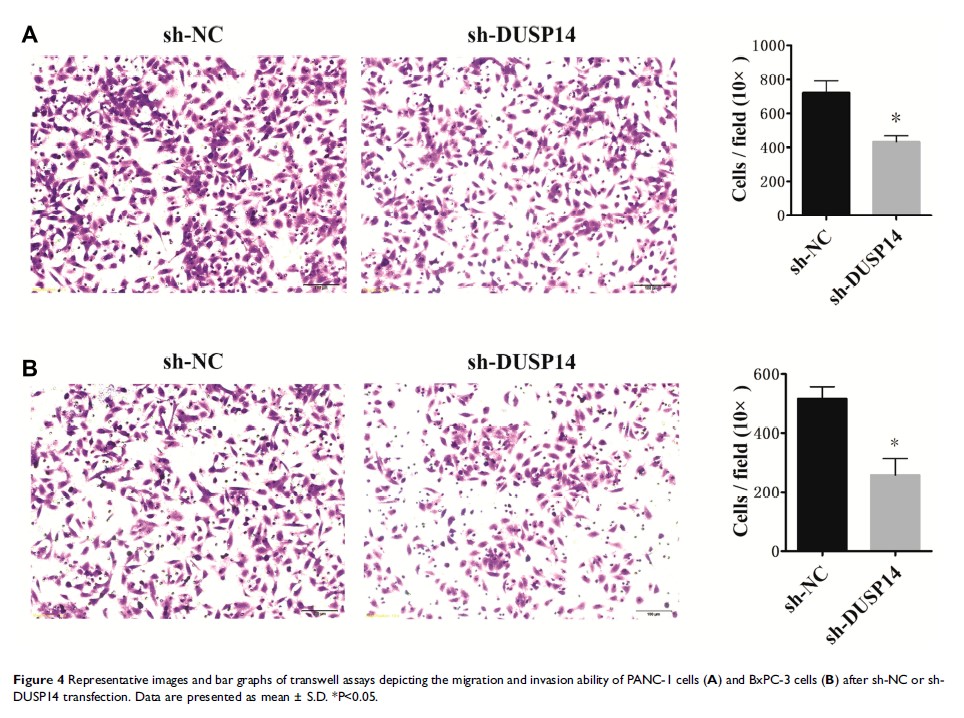
Materials and Methods: The study evaluates the levels of DUSP14 in the pancreatic cancer tissues and cell lines using Western blotting and qRT-PCR to assess the levels of the DUSP14 and epithelial–mesenchymal transition (EMT) biomarkers. After the DUSP14 was blocked, the following assays were performed: colony formation, assessments of scratch wound and transwell to examine the effects of DUSP14 on the proliferation, migration and invasion of the pancreatic cancer.
Results: Results showed that there was a significant increase in the level of DUSP14 expression both in the pancreatic cancer tissues and cell lines. Experimental downregulation of DUSP14 induced the inhibition of the capacity of proliferation, migration and invasion of the pancreatic cancer cells. Western blotting analyses showed changes in the levels of expression of the EMT biomarkers, which helped to determine the function of DUSP14 in EMT.
Conclusion: In conclusion, we suggest that DUSP14 is a novel molecular target that can be used for the treatment of pancreatic cancer.
Keywords: pancreatic cancer, DUSP14, migration, invasion, epithelial-mesenchymal transition