115195
论文已发表
注册即可获取德孚的最新动态
IF 收录期刊
- 3.6 Breast Cancer (Dove Med Press)
- 4.3 Clin Epidemiol
- 2.6 Cancer Manag Res
- 3.2 Infect Drug Resist
- 4.1 Clin Interv Aging
- 6.1 Drug Des Dev Ther
- 4.1 Int J Chronic Obstr
- 8.7 Int J Nanomed
- 2.5 Int J Women's Health
- 3.2 Neuropsych Dis Treat
- 2.4 OncoTargets Ther
- 2.6 Patient Prefer Adher
- 2.6 Ther Clin Risk Manag
- 3.1 J Pain Res
- 3.5 Diabet Metab Synd Ob
- 4.5 Psychol Res Behav Ma
- 3.4 Nat Sci Sleep
- 2.4 Pharmgenomics Pers Med
- 2.6 Risk Manag Healthc Policy
- 4.6 J Inflamm Res
- 2.3 Int J Gen Med
- 3.9 J Hepatocell Carcinoma
- 3.3 J Asthma Allergy
- 2.5 Clin Cosmet Investig Dermatol
- 3.0 J Multidiscip Healthc

在线评级和产品价格对购买决策的联合影响:一项脑电图研究
Authors Sun L, Zhao Y, Ling B
Received 13 November 2019
Accepted for publication 31 January 2020
Published 24 March 2020 Volume 2020:13 Pages 291—301
DOI https://doi.org/10.2147/PRBM.S238063
Checked for plagiarism Yes
Review by Single-blind
Peer reviewer comments 2
Editor who approved publication: Professor Mei-chun Cheung
Background: Consumers had to encounter and consider product-oriented and review-oriented cues before making an online purchasing decision. It was important to resolve how these cues influenced consumers’ online purchasing decision. We also knew little about how the human brain processed these cues simultaneously, and which cue would occupy a dominant position in neural activity. The purpose of the present study was to investigate the neural correlates of online shopping decisions and how online rating and product price jointly influenced such purchase decisions.
Research Method: Eighteen undergraduates were recruited to participate in this research. Each participant was exposed to all four experimental conditions combining 2 (product price: high vs. low) × 2 (online rating: positive vs. negative) with a total of 192 trials. They were required to rate the degree of willingness-to-pay. EEG data were obtained with 64 electrodes placed on the Easy Cap according to the International 10– 20 system. We conducted both the event-related potentials analysis and the time-frequency analysis for the EEG data.
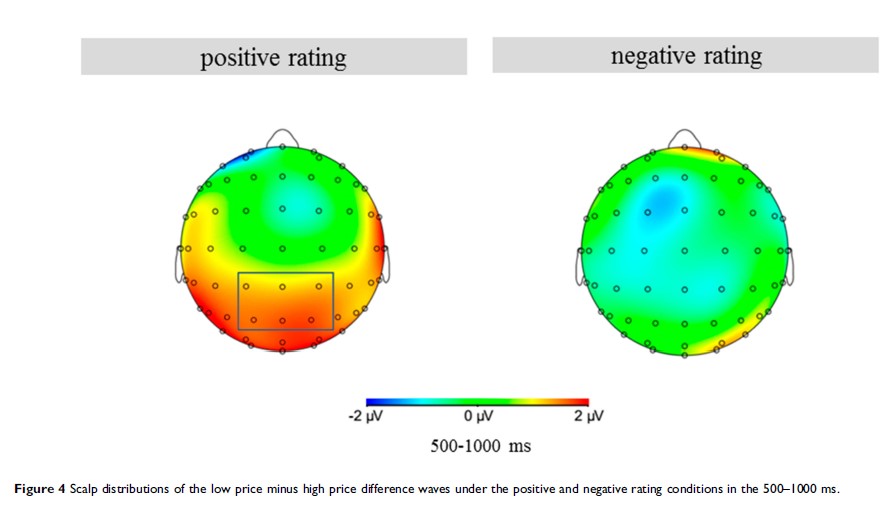
Results: The behavioral findings indicated that products with positive rating and low price increased the willingness-to-pay. The EEG results showed that larger late positive potentials were elicited by products with low price compared with high price under positive rating condition, but not under negative rating condition, reflecting the modulated effect of online rating on the emotional arousal elicited by product price. Furthermore, we found larger alpha event related desynchronization elicited by products with positive rating compared with negative rating, indicating that more cognitive resources were allocated for products with a positive rating.
Conclusion: Combined with behavioral and EEG analysis, our results emphasized the more important position of product rating compared with price. The findings deepened the understanding of the neural mechanisms underlying the online shopping decision process. More attention should be paid to online ratings on the webpage of the electronic store, because negative ratings made a product less appealing for prospective consumers regardless of price. Thus, the owners should build good reputations for their online products, which were fundamental to the consumers’ online purchasing decisions.
Keywords: online rating, product price, neural mechanism, LPP, alpha-ERD