117333
论文已发表
注册即可获取德孚的最新动态
IF 收录期刊
- 3.6 Breast Cancer (Dove Med Press)
- 4.3 Clin Epidemiol
- 2.6 Cancer Manag Res
- 3.2 Infect Drug Resist
- 4.1 Clin Interv Aging
- 6.1 Drug Des Dev Ther
- 4.1 Int J Chronic Obstr
- 8.7 Int J Nanomed
- 2.5 Int J Women's Health
- 3.2 Neuropsych Dis Treat
- 2.4 OncoTargets Ther
- 2.6 Patient Prefer Adher
- 2.6 Ther Clin Risk Manag
- 3.1 J Pain Res
- 3.5 Diabet Metab Synd Ob
- 4.5 Psychol Res Behav Ma
- 3.4 Nat Sci Sleep
- 2.4 Pharmgenomics Pers Med
- 2.6 Risk Manag Healthc Policy
- 4.6 J Inflamm Res
- 2.3 Int J Gen Med
- 3.9 J Hepatocell Carcinoma
- 3.3 J Asthma Allergy
- 2.5 Clin Cosmet Investig Dermatol
- 3.0 J Multidiscip Healthc

长非编码 RNA BCAR4 与 miR-644a 结合并靶向 TLX1 以促进膀胱癌的进展
Authors Wang X, He H, Rui W, Xie X, Wang D, Zhu Y
Received 30 September 2019
Accepted for publication 25 February 2020
Published 24 March 2020 Volume 2020:13 Pages 2483—2490
DOI https://doi.org/10.2147/OTT.S232965
Checked for plagiarism Yes
Review by Single-blind
Peer reviewer comments 2
Editor who approved publication: Prof. Dr. Geoffrey Pietersz
Background: Bladder cancer is a serious threat to human health. It is meaningful to study the pathogenesis of bladder cancer. Long non-coding RNAs (lncRNAs) are reported to promote or inhibit bladder cancer development. However, the role of lncRNA BCAR4 in the regulation of bladder cancer remains unclear.
Purpose: This study was to explore the role of lncRNA BCAR4 in the progression of bladder cancer cell.
Methods: RT-PCR was used to examine the expression of BCAR4 and miR-644a. CCK8 assay, colony formation assay, Transwell assay were used to detect the progression of bladder cancer cells after transfecting of indicated plasmids.
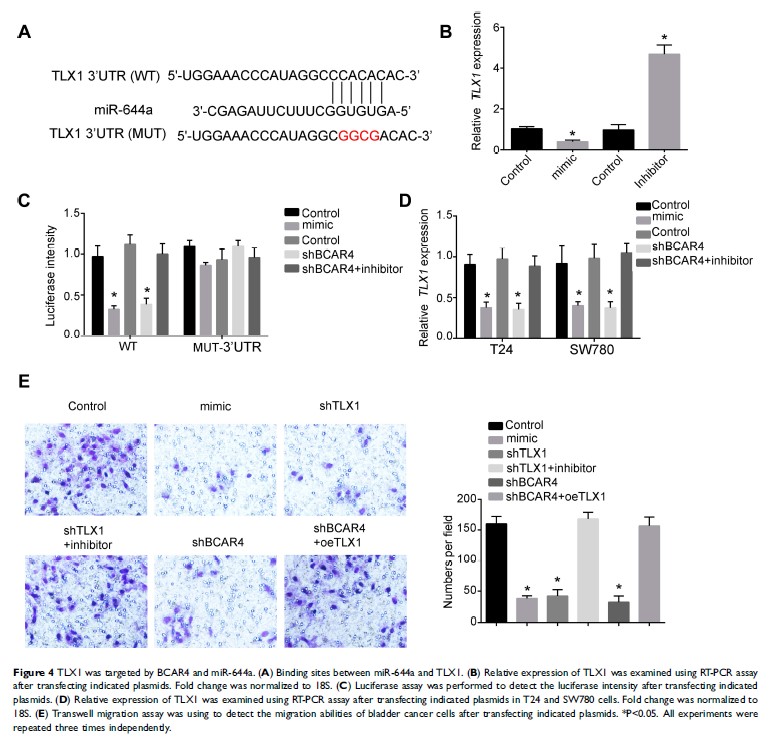
Results: The expression of BCAR4 was higher in bladder cancer cell lines than normal urothelial cell line. Moreover, the expression of BCAR4 was associated with the advanced stage and metastasis of bladder cancer. Through knockdown of BCAR4, we discovered that knockdown of BCAR4 significantly decreased the proliferation, migration and invasive abilities of bladder cancer cells. Mechanically, we showed that BCAR4 can bind to miR-644a directly and targets TLX1. Moreover, we also showed that miR-644a was also highly expressed in bladder cancer cells and inhibition of miR-644a or overexpression of TLX1 can increased the migration abilities of bladder cancer caused by knockdown of BCAR4.
Conclusion: We showed that BCAR4 sponged miR-644a to modulate the expression of TLX1 and promote bladder cancer development.
Keywords: BCAR4, miR-644a, TLX1, bladder cancer, proliferation and migration