117333
论文已发表
注册即可获取德孚的最新动态
IF 收录期刊
- 3.6 Breast Cancer (Dove Med Press)
- 4.3 Clin Epidemiol
- 2.6 Cancer Manag Res
- 3.2 Infect Drug Resist
- 4.1 Clin Interv Aging
- 6.1 Drug Des Dev Ther
- 4.1 Int J Chronic Obstr
- 8.7 Int J Nanomed
- 2.5 Int J Women's Health
- 3.2 Neuropsych Dis Treat
- 2.4 OncoTargets Ther
- 2.6 Patient Prefer Adher
- 2.6 Ther Clin Risk Manag
- 3.1 J Pain Res
- 3.5 Diabet Metab Synd Ob
- 4.5 Psychol Res Behav Ma
- 3.4 Nat Sci Sleep
- 2.4 Pharmgenomics Pers Med
- 2.6 Risk Manag Healthc Policy
- 4.6 J Inflamm Res
- 2.3 Int J Gen Med
- 3.9 J Hepatocell Carcinoma
- 3.3 J Asthma Allergy
- 2.5 Clin Cosmet Investig Dermatol
- 3.0 J Multidiscip Healthc

对于接受化疗的血液系统恶性肿瘤患者,发热性嗜中性白血球低下症合并革兰氏阴性细菌感染的流行病学:对来自单中心的 10 年数据的回顾性研究
Authors Zhang Y, Zheng Y, Dong F, Ma H, Zhu L, Shi D, Li X, Li J, Hu J
Received 5 December 2019
Accepted for publication 7 February 2020
Published 26 March 2020 Volume 2020:13 Pages 903—910
DOI https://doi.org/10.2147/IDR.S241263
Checked for plagiarism Yes
Review by Single-blind
Peer reviewer comments 2
Editor who approved publication: Dr Joachim Wink
Background: The epidemiology of Gram-negative bacteria in patients with febrile neutropenia (FN) and their susceptibility to initial empirical antibiotic therapy is key to successful treatment during the treatment of hematologic malignancies.
Methods: A retrospective study was conducted. Patients with FN and confirmed laboratory results of Gram-negative bacteria infections were included. If no direct sensitivity of the identified pathogen to the initially prescribed antibiotic regimen was confirmed, it was defined as inappropriate initial antibiotic treatment (IIAT).
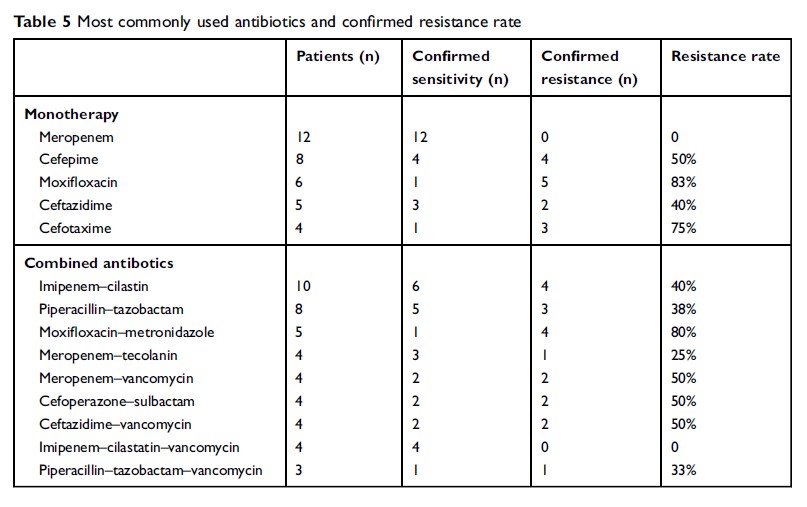
Results: A total of 247 patients with FN were proven to be infected with Gram-negative bacteria, and 200 were diagnosed with acute leukemia. The most commonly detected bacteria were Escherichia coli (40%), Klebsiella pneumoniae (20%), and Pseudomonas aeruginosa (11%). In sum, 176 patients were classified as IIAT. The mortality rate in the IIAT group was significantly higher (37.7% vs 23.9%, P =0.038). With monotherapy as empirical treatment, high possibility of IIAT with fluoroquinolones (52%) and cephalosporins (35%) was detected, while more sensitivity to carbapenems (16%) and glycopeptides antibiotics (19%) was noticed. With combined treatment, cephalosporins/carbapenems had with the lowest percentage of IIAT (18%).
Conclusion: In conclusion, inappropriate initial empirical antibiotic treatments were associated with higher mortality in patients with hematologic malignancies. The current empirical antibiotic regimen needs to be further optimized.
Keywords: febrile neutropenia, Gram-negative bacteria, hematologic malignancy, empirical antibiotic treatment, inappropriate initial antibiotic treatment