117333
论文已发表
注册即可获取德孚的最新动态
IF 收录期刊
- 3.6 Breast Cancer (Dove Med Press)
- 4.3 Clin Epidemiol
- 2.6 Cancer Manag Res
- 3.2 Infect Drug Resist
- 4.1 Clin Interv Aging
- 6.1 Drug Des Dev Ther
- 4.1 Int J Chronic Obstr
- 8.7 Int J Nanomed
- 2.5 Int J Women's Health
- 3.2 Neuropsych Dis Treat
- 2.4 OncoTargets Ther
- 2.6 Patient Prefer Adher
- 2.6 Ther Clin Risk Manag
- 3.1 J Pain Res
- 3.5 Diabet Metab Synd Ob
- 4.5 Psychol Res Behav Ma
- 3.4 Nat Sci Sleep
- 2.4 Pharmgenomics Pers Med
- 2.6 Risk Manag Healthc Policy
- 4.6 J Inflamm Res
- 2.3 Int J Gen Med
- 3.9 J Hepatocell Carcinoma
- 3.3 J Asthma Allergy
- 2.5 Clin Cosmet Investig Dermatol
- 3.0 J Multidiscip Healthc

改良版的慢性阻塞性肺疾病患者报告临床结局量表(mCOPD-PRO)的开发和验证
Authors Li J, Wang J, Xie Y, Feng Z
Received 3 December 2019
Accepted for publication 6 March 2020
Published 27 March 2020 Volume 2020:15 Pages 661—669
DOI https://doi.org/10.2147/COPD.S240842
Checked for plagiarism Yes
Review by Single-blind
Peer reviewer comments 2
Editor who approved publication: Prof. Dr. Chunxue Bai
Purpose: The present study aimed to develop and validate the modified patient-reported outcome scale for chronic obstructive pulmonary disease (mCOPD-PRO) for measuring the health status in COPD using both classical test theory and item response theory.
Methods: A working group was initially established. The conceptual framework of COPD-PRO was modified. Subsequently, items related to COPD were gathered and selected through expert consultation, patient cognitive interviewing, classical test theory methods, as well as the item response theory method. Finally, the formed mCOPD-PRO was evaluated in terms of reliability, content validity, construct validity, criterion validity, known groups validity, and feasibility.
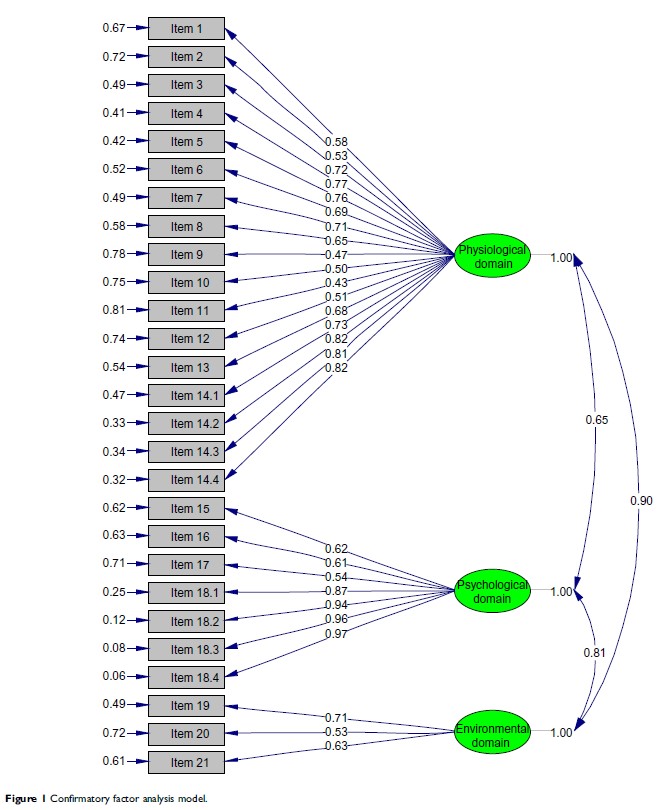
Results: A total of 155 items were gathered in the item bank, and two rounds of expert consultation, interviews with patients and field survey were conducted. The mCOPD-PRO included 27 items in the physiological, psychological, and environmental domains. The Cronbach’s alpha of the instrument was 0.954. The correlation coefficients between the scores of each item and its domain scores ranged from 0.429 to 0.902. Confirmatory factor analysis showed that the comparative fit index, incremental fit index, non-normed fit index, standardized root-mean-square residual, and root-mean-square error of approximate were 0.91, 0.91, 0.90, 0.11, and 0.16, respectively. The correlation coefficient between mCOPD-PRO total scores and COPD assessment test scores and the modified Medical Research Council dyspnea scale scores was 0.771 and 0.651, respectively. The differences in mCOPD-PRO total scores and domain scores between the mild/moderate group and severe/extremely severe group of patients with COPD were both statistically significant (P < 0.01). The acceptance and completion rates of mCOPD-PRO were both 99.5%, and the median completion time was 5 min (IQR, 4– 11 min).
Conclusion: The 27-item mCOPD-PRO is well developed and has good reliability, validity, and feasibility. It may provide a scientific and effective instrument for the clinical evaluation of COPD.
Keywords: chronic obstructive pulmonary disease, patient-reported outcome, classical test theory, item response theory, instrument