115195
论文已发表
注册即可获取德孚的最新动态
IF 收录期刊
- 3.6 Breast Cancer (Dove Med Press)
- 4.3 Clin Epidemiol
- 2.6 Cancer Manag Res
- 3.2 Infect Drug Resist
- 4.1 Clin Interv Aging
- 6.1 Drug Des Dev Ther
- 4.1 Int J Chronic Obstr
- 8.7 Int J Nanomed
- 2.5 Int J Women's Health
- 3.2 Neuropsych Dis Treat
- 2.4 OncoTargets Ther
- 2.6 Patient Prefer Adher
- 2.6 Ther Clin Risk Manag
- 3.1 J Pain Res
- 3.5 Diabet Metab Synd Ob
- 4.5 Psychol Res Behav Ma
- 3.4 Nat Sci Sleep
- 2.4 Pharmgenomics Pers Med
- 2.6 Risk Manag Healthc Policy
- 4.6 J Inflamm Res
- 2.3 Int J Gen Med
- 3.9 J Hepatocell Carcinoma
- 3.3 J Asthma Allergy
- 2.5 Clin Cosmet Investig Dermatol
- 3.0 J Multidiscip Healthc

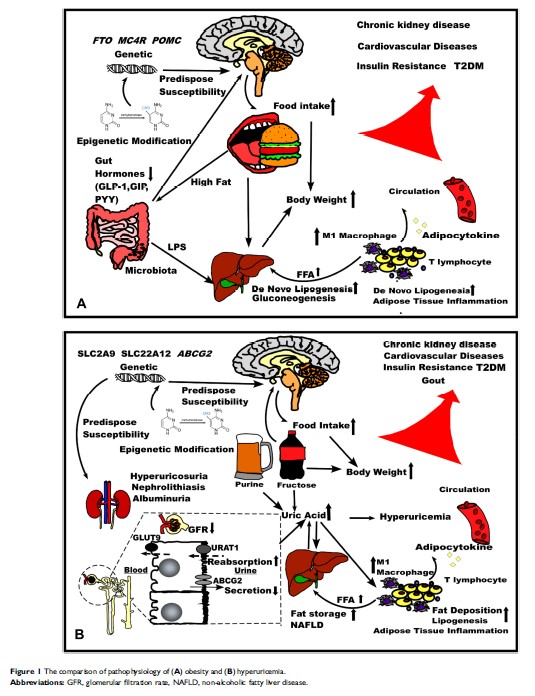
肥胖与高尿酸血症之间的趋同关系,特别是对代谢性疾病和合理治疗的意义
Authors Gong M, Wen S, Nguyen T, Wang C, Jin J, Zhou L
Received 25 September 2019
Accepted for publication 9 March 2020
Published 30 March 2020 Volume 2020:13 Pages 943—962
DOI https://doi.org/10.2147/DMSO.S232377
Checked for plagiarism Yes
Review by Single-blind
Peer reviewer comments 2
Editor who approved publication: Prof. Dr. Muthuswamy Balasubramanyam
Background: Obesity and hyperuricemia mutually influence metabolic syndrome. This study discusses the metabolic relationships between obesity and hyperuricemia in terms of pathophysiology, complications, and treatments.
Methods: We searched for preclinical or clinical studies on the pathophysiology, complications, and therapy of obesity and hyperuricemia on the PubMed database.
Results: In this systemic review, we summarized our searching results on topics of pathophysiology, complications and therapeutic strategy. In pathophysiology, we firstly introduce genetic variations for obesity, hyperuricemia and their relationships by genetic studies. Secondly, we talk about the epigenetic influences on obesity and hyperuricemia. Thirdly, we describe the central metabolic regulation and the role of hyperuricemia. Then, we refer to the character of adipose tissue inflammation and oxidative stress in the obesity and hyperuricemia. In the last part of this topic, we reviewed the critical links of gut microbiota in the obesity and hyperuricemia. In the following part, we review the pathophysiology of major complications in obesity and hyperuricemia including insulin resistance and type 2 diabetes mellitus, chronic kidney disease, cardiovascular diseases, and cancers. Finally, we recapitulate the therapeutic strategies especially the novel pharmaceutic interventions for obesity and hyperuricemia, which concurrently show the mutual metabolic influences between two diseases.
Conclusion: The data reviewed here delineate the metabolic relationships between obesity and hyperuricemia, and provide a comprehensive overview of the therapeutic targets for the management of metabolic syndromes.
Keywords: obesity, hyperuricemia, pathophysiology, complication, pharmacotherapy