117333
论文已发表
注册即可获取德孚的最新动态
IF 收录期刊
- 3.6 Breast Cancer (Dove Med Press)
- 4.3 Clin Epidemiol
- 2.6 Cancer Manag Res
- 3.2 Infect Drug Resist
- 4.1 Clin Interv Aging
- 6.1 Drug Des Dev Ther
- 4.1 Int J Chronic Obstr
- 8.7 Int J Nanomed
- 2.5 Int J Women's Health
- 3.2 Neuropsych Dis Treat
- 2.4 OncoTargets Ther
- 2.6 Patient Prefer Adher
- 2.6 Ther Clin Risk Manag
- 3.1 J Pain Res
- 3.5 Diabet Metab Synd Ob
- 4.5 Psychol Res Behav Ma
- 3.4 Nat Sci Sleep
- 2.4 Pharmgenomics Pers Med
- 2.6 Risk Manag Healthc Policy
- 4.6 J Inflamm Res
- 2.3 Int J Gen Med
- 3.9 J Hepatocell Carcinoma
- 3.3 J Asthma Allergy
- 2.5 Clin Cosmet Investig Dermatol
- 3.0 J Multidiscip Healthc

肠道菌群通过神经内分泌-免疫-线粒体信号通路调节大鼠的抑郁样行为
Authors Liu S, Guo R, Liu F, Yuan Q, Yu Y, Ren F
Received 27 December 2019
Accepted for publication 1 March 2020
Published 31 March 2020 Volume 2020:16 Pages 859—869
DOI https://doi.org/10.2147/NDT.S243551
Checked for plagiarism Yes
Review by Single-blind
Peer reviewer comments 2
Editor who approved publication: Professor Jun Chen
Purpose: Gut microbiota affects various physiological functions in the host and has crucial effects on the nervous system. There is increasing evidence of a correlation between gut microbiota and depression; however, the mechanisms underlying the regulation of depression-like behavior by gut microbiota remain unclear. In this study, we assessed the regulatory mechanism of gut microbiota on depression-like behavior in rats.
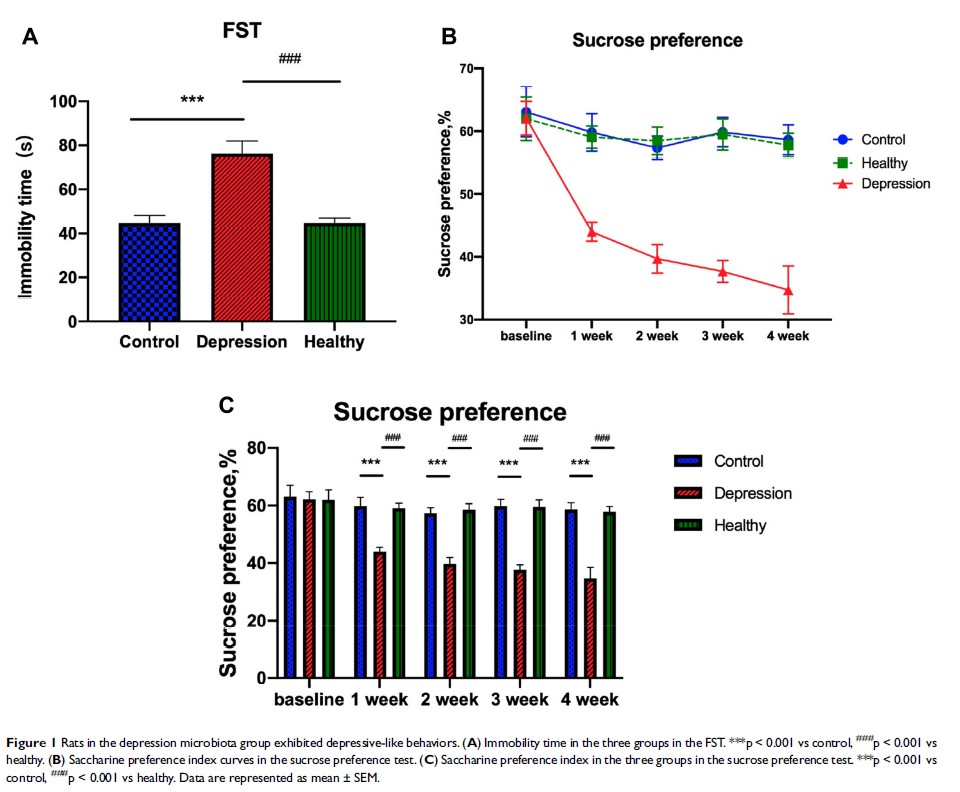
Methods: We transplanted fecal microbiota obtained from patients with depression and healthy individuals into germ-free (GF) rats (n=18) through fecal microbiota transplantation technology. Next, we assessed the affective behavior in the rats using the forced swimming test and a sucrose preference test. We used enzyme-linked immunosorbent assay (ELISA) to determine the hippocampal levels of 5-hydroxytryptamine (5-HT), dopamine (DA), and noradrenaline (NE) and the serum levels of corticosterone (CORT), adrenocorticotropic hormone (ACTH), corticotropin-releasing hormone (CRH), tumor necrosis factor-α (TNF-α), interferon-γ (IFN-γ), interleukin-6 (IL-6), interleukin-1 (IL-1), interleukin-1 (IL-4), and interleukin-1 (IL-10). The mitochondrial morphology of small intestinal epithelial cells was observed through transmission electron microscopy.
Results: Rats that received fecal microbiota from patients with depression (depression microbiota) exhibited depression-like behavior. They presented decreased levels of hippocampal neurotransmitters, serum CORT levels, and anti-inflammatory cytokine levels, as well as increased ACTH, CRH, and serum levels of multiple pro-inflammatory cytokines. Observation of the mitochondria ultrastructure showed damaged mitochondria in the intestinal epithelial cells, significant endoplasmic reticulum expansion, and border aggregation of nuclear chromatin.
Conclusion: Our findings suggested that the depression-like behaviors induced by the depression microbiota through the neuroendocrine-immune-mitochondrial pathway, which were associated with neuroendocrine disorders, inflammatory responses, and mitochondrial damage.
Keywords: gut microbiota, depression, neurotransmitter, HPA axis, immune, mitochondrial