117333
论文已发表
注册即可获取德孚的最新动态
IF 收录期刊
- 3.6 Breast Cancer (Dove Med Press)
- 4.3 Clin Epidemiol
- 2.6 Cancer Manag Res
- 3.2 Infect Drug Resist
- 4.1 Clin Interv Aging
- 6.1 Drug Des Dev Ther
- 4.1 Int J Chronic Obstr
- 8.7 Int J Nanomed
- 2.5 Int J Women's Health
- 3.2 Neuropsych Dis Treat
- 2.4 OncoTargets Ther
- 2.6 Patient Prefer Adher
- 2.6 Ther Clin Risk Manag
- 3.1 J Pain Res
- 3.5 Diabet Metab Synd Ob
- 4.5 Psychol Res Behav Ma
- 3.4 Nat Sci Sleep
- 2.4 Pharmgenomics Pers Med
- 2.6 Risk Manag Healthc Policy
- 4.6 J Inflamm Res
- 2.3 Int J Gen Med
- 3.9 J Hepatocell Carcinoma
- 3.3 J Asthma Allergy
- 2.5 Clin Cosmet Investig Dermatol
- 3.0 J Multidiscip Healthc

由香蕉皮衍生的树突状金纳米材料,对肿瘤的生长和迁移具有双重抑制作用
Authors Liu Y, Song X, Cao F, Li F, Wang M, Yang Y, Liu M, Liu A, Xin H, Wang X
Received 3 April 2019
Accepted for publication 21 February 2020
Published 1 April 2020 Volume 2020:15 Pages 2315—2322
DOI https://doi.org/10.2147/IJN.S211076
Checked for plagiarism Yes
Review by Single-blind
Peer reviewer comments 3
Editor who approved publication: Dr Linlin Sun
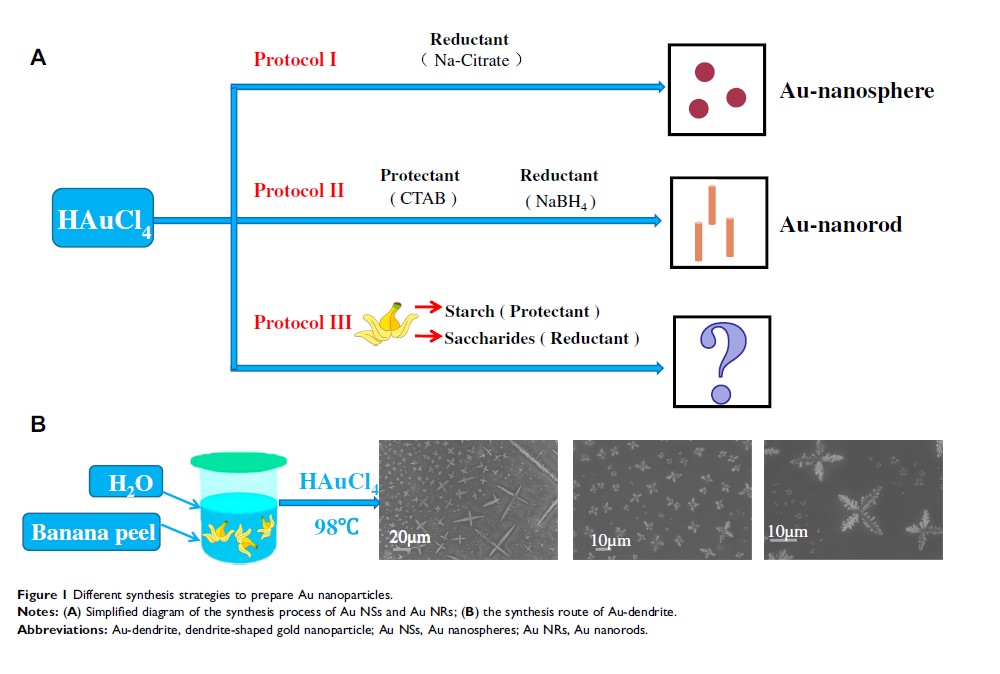
Purpose: In order to prepare functional Au nanoparticles with low toxicity and high antitumor properties, we have used fruit waste (banana peel) to synthesize a new dendrite-shaped gold nanoparticle and used it for the treatment of tumors.
Methods: Dendrite-shaped gold nanoparticle (Au-dendrite) was synthesized through a facile hydrothermal process. The banana peel was used as both the reducing agent and the protective agent for reducing chloroauric acid to obtain Au-dendrite. The safety assessment of the Au-dendrite was conducted by H&E staining of the mouse’s eyelid skin and CCK-8 assay. The antitumor effects were evaluated through in vitro tumor cytotoxicity experiments and in vivo treatment of animal tumors.
Results: In this work, a new type of gold nanomaterial (Au-dendrite) was synthesized by using a common agricultural waste (banana peel) through a facile hydrothermal process without any extra chemical reducing agent or protective agent. Subsequent experiments showed that, compared with some classical Au nanomaterials, the as-synthesized gold nanocomposites have superior biocompatibility and impressive characteristics of dual inhibition toward tumor growth and migration.
Conclusion: We successfully synthesized a dendrite-shaped gold nanocomposite which was derived from a common agricultural waste (banana peel). A facile and environmentally friendly synthetic process was proposed accordingly without regular chemical additives. The as-prepared Au-dendrite nanocomposites not only had better biocompatibility than some classical gold nanoparticles but also exhibited unique advantages in tumor inhibition.
Keywords: nanomaterials, Au nanoparticles, biocompatibility