117333
论文已发表
注册即可获取德孚的最新动态
IF 收录期刊
- 3.6 Breast Cancer (Dove Med Press)
- 4.3 Clin Epidemiol
- 2.6 Cancer Manag Res
- 3.2 Infect Drug Resist
- 4.1 Clin Interv Aging
- 6.1 Drug Des Dev Ther
- 4.1 Int J Chronic Obstr
- 8.7 Int J Nanomed
- 2.5 Int J Women's Health
- 3.2 Neuropsych Dis Treat
- 2.4 OncoTargets Ther
- 2.6 Patient Prefer Adher
- 2.6 Ther Clin Risk Manag
- 3.1 J Pain Res
- 3.5 Diabet Metab Synd Ob
- 4.5 Psychol Res Behav Ma
- 3.4 Nat Sci Sleep
- 2.4 Pharmgenomics Pers Med
- 2.6 Risk Manag Healthc Policy
- 4.6 J Inflamm Res
- 2.3 Int J Gen Med
- 3.9 J Hepatocell Carcinoma
- 3.3 J Asthma Allergy
- 2.5 Clin Cosmet Investig Dermatol
- 3.0 J Multidiscip Healthc

Low-Magnitude High-Frequency Vibration Decreases Body Weight Gain and Increases Muscle Strength by Enhancing the p38 and AMPK Pathways in db/db Mice
Authors Ren Z, Lan Q, Chen Y, Chan YWJ, Mahady GB, Lee SMY
Received 26 August 2019
Accepted for publication 10 January 2020
Published 1 April 2020 Volume 2020:13 Pages 979—989
DOI https://doi.org/10.2147/DMSO.S228674
Checked for plagiarism Yes
Review by Single-blind
Peer reviewer comments 4
Editor who approved publication: Dr Antonio Brunetti
Objective: To evaluate the effect LMHFV on body weight gain, NAFLD and muscle strength and explore effect in mitochondrial biogenesis, AMPKα and p38 pathways.
Methods: Vibration platform used in this study provides specific whole-body cyclic mechanical stimulation at low magnitude (0.3 g) and high frequency (50 Hz). Diabetic mice (8– 9 mice per group) (C57BL/KsJ-m+/+Leprdb) were randomly divided into untreated group (no vibration) and two vibration groups. Lean mice (8 mice) were used as non-diabetic control for both groups. Two diabetic vibration groups received LMHFV every day for 20 min/day and 40 min/day separately.
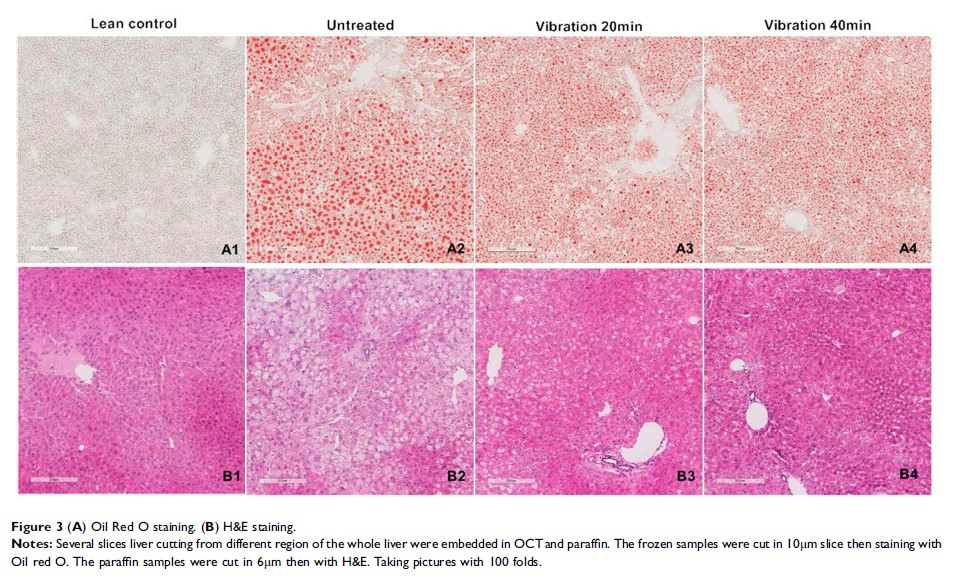
Results: After 8 weeks of treatment, results showed that body weight, liver weight, fat pad weight, glucose level and insulin level were lower in vibration group when compared with the untreated group. The ratio of fat in liver was significantly decreased after vibration treatment. Muscle strength was significantly increased after vibration. Mitochondrial biogenesis-related gene expression was increased in soleus, gastrocnemius and liver. AMPKα mRNA expression level was increased in soleus and gastrocnemius after vibration treatment. p38 and AMPKα mRNA expression level and protein expression level in liver were enhanced with vibration treatment. Moreover, phosphorylation of p38 and AMPKα was enhanced in liver.
Conclusion: LMHFV applied in our study decreases body weight gain and improves muscle strength and NAFLD in diabetic mice which were partly through improving mitochondrial biogenesis by enhancing p38 and AMPKα pathway.
Keywords: type 2 diabetes mellitus, low-magnitude high-frequency vibration, mitochondrial biogenesis, AMPKα, p38