117333
论文已发表
注册即可获取德孚的最新动态
IF 收录期刊
- 3.6 Breast Cancer (Dove Med Press)
- 4.3 Clin Epidemiol
- 2.6 Cancer Manag Res
- 3.2 Infect Drug Resist
- 4.1 Clin Interv Aging
- 6.1 Drug Des Dev Ther
- 4.1 Int J Chronic Obstr
- 8.7 Int J Nanomed
- 2.5 Int J Women's Health
- 3.2 Neuropsych Dis Treat
- 2.4 OncoTargets Ther
- 2.6 Patient Prefer Adher
- 2.6 Ther Clin Risk Manag
- 3.1 J Pain Res
- 3.5 Diabet Metab Synd Ob
- 4.5 Psychol Res Behav Ma
- 3.4 Nat Sci Sleep
- 2.4 Pharmgenomics Pers Med
- 2.6 Risk Manag Healthc Policy
- 4.6 J Inflamm Res
- 2.3 Int J Gen Med
- 3.9 J Hepatocell Carcinoma
- 3.3 J Asthma Allergy
- 2.5 Clin Cosmet Investig Dermatol
- 3.0 J Multidiscip Healthc

放射性核素骨显像中呈现的软组织肿瘤中 99mTc-亚甲基二膦酸盐摄取量在小儿和成人患者中的差异与肿瘤分化有关
Authors Liu S, Xie J, Yu F, Cai H, Wu F, Zheng H, Ma C, Lv Z, Wang H
Received 9 December 2019
Accepted for publication 21 March 2020
Published 3 April 2020 Volume 2020:12 Pages 2449—2457
DOI https://doi.org/10.2147/CMAR.S241636
Checked for plagiarism Yes
Review by Single-blind
Peer reviewer comments 2
Editor who approved publication: Dr Chien-Feng Li
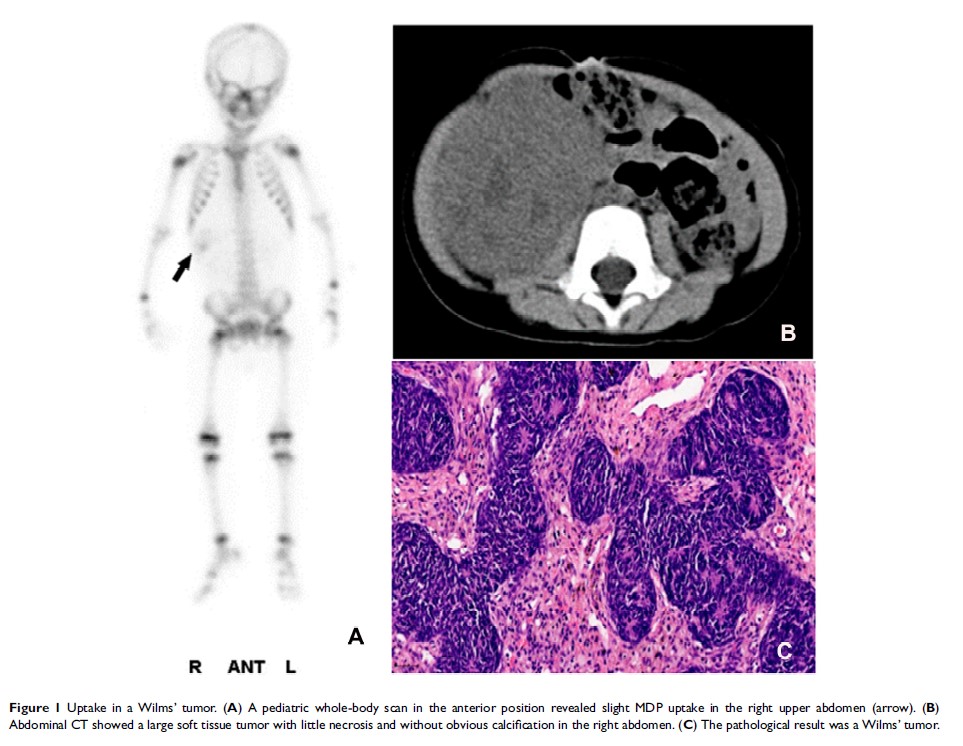
Objective: To analyze the difference in 99mTc-methylene diphosphonate (MDP) uptake on bone scintigraphy in extraosseous soft tissue tumors between children and adults and the correlation between tracer uptake and tumor differentiation and histopathology.
Methods: Patients with neoplasms with MDP uptake were retrospectively identified. Based on histopathology, tumors were categorized as epithelial malignant tumors, mesenchymal tumors, blastomas and germ cell tumors. The degree of radioactivity accumulation in lesions relative to the uptake in ribs and sternum or spine was classified as “+”, “++” and “+++”. The results were compared between children and adults. The correlations between MDP uptake in soft tumors and tumor differentiation and pathology were investigated.
Results: Extraossessue
tumors that accumulated MDP were found in 33 children and 31 adults. In
children, neuroblastoma was the most common extraosseous soft tissue
tumor that accumulated MDP; in adults, MDP uptake was mostly found in
lung cancer. MDP uptake in pediatric soft tissue tumors was ous soft tihigher than that in adults. MDP uptake in extraosseous soft tissue tumors with different histopathologic classifications was significantly different among 64 patients. In 41 patients with available tumor differentiation data from histopathology, MDP uptake in low or poorly differentiated soft tumors was higher than that in the moderately or well-differentiated lesions. Necrosis and/or calcifications were showed in most of pediatric and adult neoplasms.
Conclusion: Significant elevations in MDP uptake in extraosseous soft tissue tumors are associated with poorly differentiated tumors in both children and adults. The mechanism of bone tracer uptake in pediatric and adult neoplasms was mostly related to necrosis and/or necrosis and calcification. The extraosseous soft tissue tumors with MDP uptake in pediatric patients were different from those in adults. In addition, consistent with the inherent degree of tumor malignancy, MDP uptake in children was higher than that in adults.
Keywords: pediatric, adult, extraosseous soft tissue tumor, differentiation, bone scintigraphy, MDP