117333
论文已发表
注册即可获取德孚的最新动态
IF 收录期刊
- 3.6 Breast Cancer (Dove Med Press)
- 4.3 Clin Epidemiol
- 2.6 Cancer Manag Res
- 3.2 Infect Drug Resist
- 4.1 Clin Interv Aging
- 6.1 Drug Des Dev Ther
- 4.1 Int J Chronic Obstr
- 8.7 Int J Nanomed
- 2.5 Int J Women's Health
- 3.2 Neuropsych Dis Treat
- 2.4 OncoTargets Ther
- 2.6 Patient Prefer Adher
- 2.6 Ther Clin Risk Manag
- 3.1 J Pain Res
- 3.5 Diabet Metab Synd Ob
- 4.5 Psychol Res Behav Ma
- 3.4 Nat Sci Sleep
- 2.4 Pharmgenomics Pers Med
- 2.6 Risk Manag Healthc Policy
- 4.6 J Inflamm Res
- 2.3 Int J Gen Med
- 3.9 J Hepatocell Carcinoma
- 3.3 J Asthma Allergy
- 2.5 Clin Cosmet Investig Dermatol
- 3.0 J Multidiscip Healthc

连翘脂素是 MELK 抑制剂可抑制胰腺癌细胞的细胞存活和上皮-间质转化
Authors Li H, Chen M, Yang Z, Wang Q, Wang J, Jin D, Yang X, Chen F, Zhou X, Luo K
Received 17 November 2019
Accepted for publication 24 March 2020
Published 3 April 2020 Volume 2020:13 Pages 2833—2842
DOI https://doi.org/10.2147/OTT.S238958
Checked for plagiarism Yes
Review by Single-blind
Peer reviewer comments 2
Editor who approved publication: Dr Leo Jen-Liang Su
Introduction: Pancreatic cancer (PC) is one of the leading causes of cancer, with the lowest 5-year survival rate of all cancer types. Given the fast metastasis of PC and its resistance to surgery, radiotherapy, chemotherapy, and combinations thereof, it is imperative to develop more effective anti-PC drugs. Phillygenin (PHI) has been reported to exert anti-cancer, anti-bacterial, and anti‐inflammatory properties. However, the mechanism of PHI in the development of PC is still unclear.
Methods: The cytotoxicity of PHI in pancreatic cancer cells was evaluated by MTT assay, and clonogenic assay was used to test the anti-proliferation of PHI. The pro-apoptotic effect of PHI was detected by flow cytometry analysis. The changes of epithelial–mesenchymal transition (EMT) in pancreatic cancer cells treated with PHI were determined by Western blot. Transwell assay was used to test the migration and invasion of PC cells after treatment with PHI. Molecular docking was used to predict the potential binding site of candidate target with PHI.
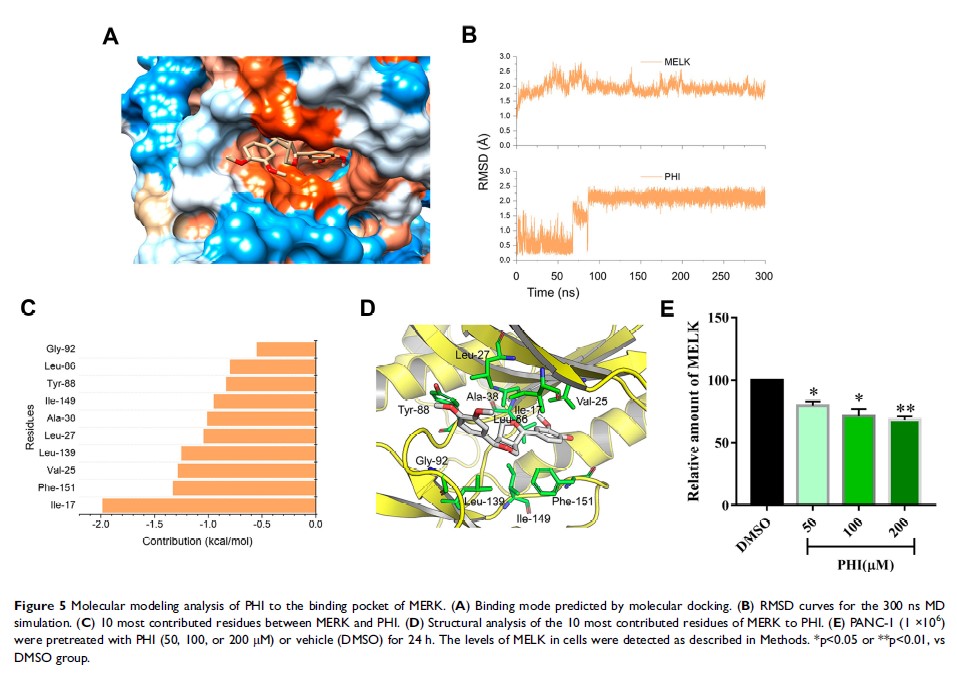
Results: PHI could inhibit the proliferation, migration, and EMT of PC cells (PANC-1 and SW1990) and induce its apoptosis. Analysis of the Cancer Genome Atlas database indicated that elevated MELK levels correlated with poor overall survival (OS) and disease-free survival (DFS) of PC patients. In addition, molecular modeling showed that PHI may potentially target the catalytic domain of maternal embryonic leucine zipper kinase (MELK). Overexpression of MELK muted the anti-PC effects of PHI.
Conclusion: PHI holds promise as a potent candidate drug for the treatment of PC via targeted MELK.
Keywords: pancreatic cancer, phillygenin, MELK, proliferation, EMT, apoptosis