117333
论文已发表
注册即可获取德孚的最新动态
IF 收录期刊
- 3.6 Breast Cancer (Dove Med Press)
- 4.3 Clin Epidemiol
- 2.6 Cancer Manag Res
- 3.2 Infect Drug Resist
- 4.1 Clin Interv Aging
- 6.1 Drug Des Dev Ther
- 4.1 Int J Chronic Obstr
- 8.7 Int J Nanomed
- 2.5 Int J Women's Health
- 3.2 Neuropsych Dis Treat
- 2.4 OncoTargets Ther
- 2.6 Patient Prefer Adher
- 2.6 Ther Clin Risk Manag
- 3.1 J Pain Res
- 3.5 Diabet Metab Synd Ob
- 4.5 Psychol Res Behav Ma
- 3.4 Nat Sci Sleep
- 2.4 Pharmgenomics Pers Med
- 2.6 Risk Manag Healthc Policy
- 4.6 J Inflamm Res
- 2.3 Int J Gen Med
- 3.9 J Hepatocell Carcinoma
- 3.3 J Asthma Allergy
- 2.5 Clin Cosmet Investig Dermatol
- 3.0 J Multidiscip Healthc

汶川地震发生十年后,重灾区幸存者创伤后应激障碍的患病率及其影响因素:一个横断面研究
Authors Lu B, Zeng W, Li Z, Wen J
Received 28 January 2020
Accepted for publication 25 March 2020
Published 8 April 2020 Volume 2020:16 Pages 933—941
DOI https://doi.org/10.2147/NDT.S247527
Checked for plagiarism Yes
Review by Single-blind
Peer reviewer comments 2
Editor who approved publication: Professor Jun Chen
Background: Post-traumatic stress disorder (PTSD) is common psychological distress after natural disasters, which is persistent. Chronic PTSD leads to a heavy disease burden. The purpose of this study is to explore the prevalence and influencing factors of chronic PTSD among survivors in the hard-hit areas ten years after the Wenchuan earthquake.
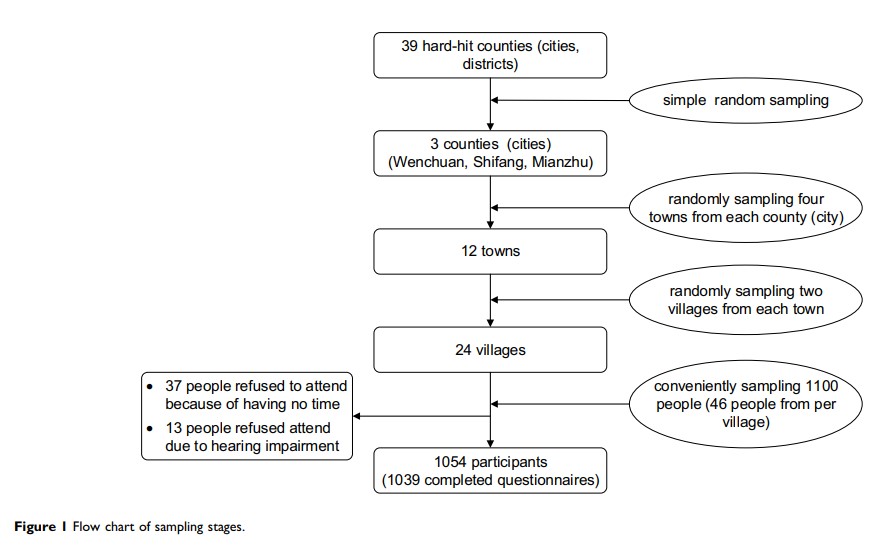
Materials and Methods: A cross-sectional survey was conducted on residents aged 16 or above in hard-hit areas through a multi-stage sampling approach ten years after the Wenchuan earthquake. The items of the questionnaire included demographic characteristics and earthquake exposure factors, and the PTSD Checklist-Civilian Version (PCL-C) was used to evaluate the PTSD of the respondents.
Results: A total of 1039 complete questionnaires were obtained. The median age of 1039 respondents was 60 years, 63.2% of whom were female, 70.2% were illiterate or had received primary education, and 58% had an annual household income of less than 20,000 yuan (US$ 2871.3). The rate of PTSD was 9.1% (95/1039). After controlling for confounding factors, it was found that higher income level and education level, and moving to concentrated rural settlement (CRS) after the earthquake might be protective factors for the long-term mental health of survivors in the hard-hit areas, and the loss of immediate families in the earthquake was an important risk factor.
Conclusion: Even though ten years have passed since the Wenchuan earthquake, the survivors in the hard-hit areas still have a serious mental disorder. The local government and health-care institutions should take appropriate measures to improve the mental health of residents.
Keywords: Wenchuan earthquake, natural disaster, mental health, post-traumatic stress disorder, PTSD