117333
论文已发表
注册即可获取德孚的最新动态
IF 收录期刊
- 3.6 Breast Cancer (Dove Med Press)
- 4.3 Clin Epidemiol
- 2.6 Cancer Manag Res
- 3.2 Infect Drug Resist
- 4.1 Clin Interv Aging
- 6.1 Drug Des Dev Ther
- 4.1 Int J Chronic Obstr
- 8.7 Int J Nanomed
- 2.5 Int J Women's Health
- 3.2 Neuropsych Dis Treat
- 2.4 OncoTargets Ther
- 2.6 Patient Prefer Adher
- 2.6 Ther Clin Risk Manag
- 3.1 J Pain Res
- 3.5 Diabet Metab Synd Ob
- 4.5 Psychol Res Behav Ma
- 3.4 Nat Sci Sleep
- 2.4 Pharmgenomics Pers Med
- 2.6 Risk Manag Healthc Policy
- 4.6 J Inflamm Res
- 2.3 Int J Gen Med
- 3.9 J Hepatocell Carcinoma
- 3.3 J Asthma Allergy
- 2.5 Clin Cosmet Investig Dermatol
- 3.0 J Multidiscip Healthc

外伤性硬膜下积液演变成慢性硬膜下血肿的危险因素预测
Authors Chen S, Peng H, Shao X, Yao L, Liu J, Tian J, Sun L, Dai Y, Jiang X, Cheng L
Received 13 January 2020
Accepted for publication 29 March 2020
Published 9 April 2020 Volume 2020:16 Pages 943—948
DOI https://doi.org/10.2147/NDT.S245857
Checked for plagiarism Yes
Review by Single-blind
Peer reviewer comments 2
Editor who approved publication: Professor Jun Chen
Purpose: To explore the risk factors of the evolution of traumatic subdural effusion (TSE) into chronic subdural hematoma (CSDH).
Materials and Methods: The 70 patients’ gender, age, location of effusion, unilateral and bilateral, Glasgow coma score (GCS) at admission, presence or absence of brain contusion, the time of effusion appeared, daily amount of mannitol, mannitol number of days used, with or without atorvastatin calcium tablets, with or without antiplatelet aggregation drugs, with or without anticoagulant drugs, with or without abnormalities in blood coagulation routines, computed tomography (CT) layer height, the thickness, and CT value of the first effusion were analyzed by single factor. Logistic multivariate regression analysis was performed on the statistically significant indicators. Power of the regression model was evaluated using receiver operating characteristic (ROC) curve.
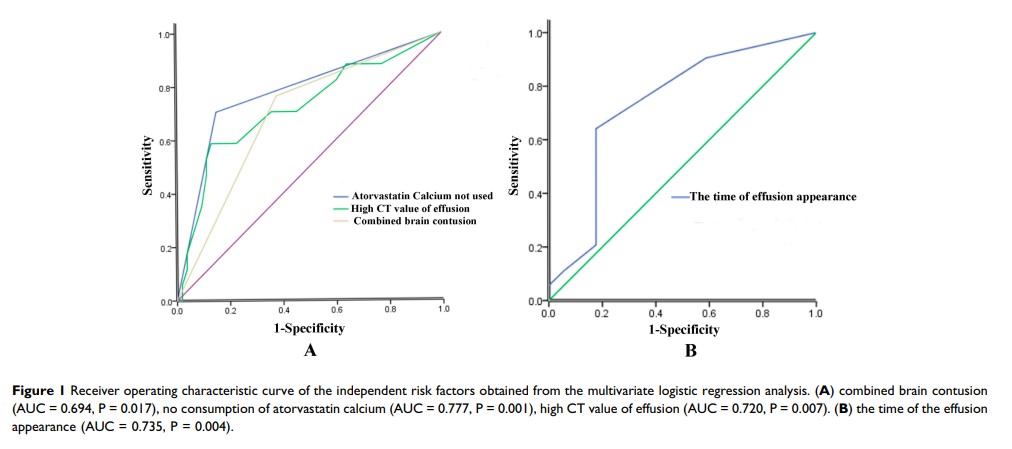
Results: Univariate analysis showed that the presence or absence of brain contusion, the time of effusion appeared, atorvastatin calcium tablets use or not, the CT value of the effusion, and TSE into CSDH evolution varied significantly compared to the non-evolved group (P< 0.05). Logistic multivariate regression analysis showed that combined brain contusion (odds ratio (OR)=16.247, 95% confidence interval (CI), 1.831– 144.157, P = 0.012), early onset of effusion (OR = 0.573, 95% CI: 0.349– 0.941, P = 0.028), atorvastatin calcium tablets not used after effusion (OR = 60.028, 95% CI: 6.103– 590.399, P = 0.0001), and high CT value (OR = 1.285, 95% CI: 1.067– 1.547, P = 0.008) were risk factors for the evolution of TSE into CSDH. The ROC model suggested that the prediction of these risk factors had high diagnostic accuracy.
Conclusion: TSE patients with brain contusion, early onset of effusion, without the usage of atorvastatin calcium tablets after effusion, and high CT value of the first effusion are at a risk of evolving into CSDH.
Keywords: TSE, CSDH, evolution, risk factors