117333
论文已发表
注册即可获取德孚的最新动态
IF 收录期刊
- 3.6 Breast Cancer (Dove Med Press)
- 4.3 Clin Epidemiol
- 2.6 Cancer Manag Res
- 3.2 Infect Drug Resist
- 4.1 Clin Interv Aging
- 6.1 Drug Des Dev Ther
- 4.1 Int J Chronic Obstr
- 8.7 Int J Nanomed
- 2.5 Int J Women's Health
- 3.2 Neuropsych Dis Treat
- 2.4 OncoTargets Ther
- 2.6 Patient Prefer Adher
- 2.6 Ther Clin Risk Manag
- 3.1 J Pain Res
- 3.5 Diabet Metab Synd Ob
- 4.5 Psychol Res Behav Ma
- 3.4 Nat Sci Sleep
- 2.4 Pharmgenomics Pers Med
- 2.6 Risk Manag Healthc Policy
- 4.6 J Inflamm Res
- 2.3 Int J Gen Med
- 3.9 J Hepatocell Carcinoma
- 3.3 J Asthma Allergy
- 2.5 Clin Cosmet Investig Dermatol
- 3.0 J Multidiscip Healthc

甲状腺乳头状癌颈部淋巴结转移危险因素的临床分析:对 3,686 名患者的回顾性研究
Authors Song J, Yan T, Qiu W, Fan Y, Yang Z
Received 17 February 2020
Accepted for publication 24 March 2020
Published 9 April 2020 Volume 2020:12 Pages 2523—2530
DOI https://doi.org/10.2147/CMAR.S250163
Checked for plagiarism Yes
Review by Single-blind
Peer reviewer comments 2
Editor who approved publication: Dr Yong Teng
Purpose: To investigate the risk factors for cervical lymph node metastasis (LNM) in papillary thyroid microcarcinoma (PTMC).
Patients and Methods: In total, 3686 patients with PTMC who underwent initial surgery in Shanghai Jiao Tong University affiliated Sixth People’s Hospital from January 2010 to December 2019 were retrospectively analyzed. Univariate and multivariate analyses were conducted to identify risk factors associated with cervical LNM.
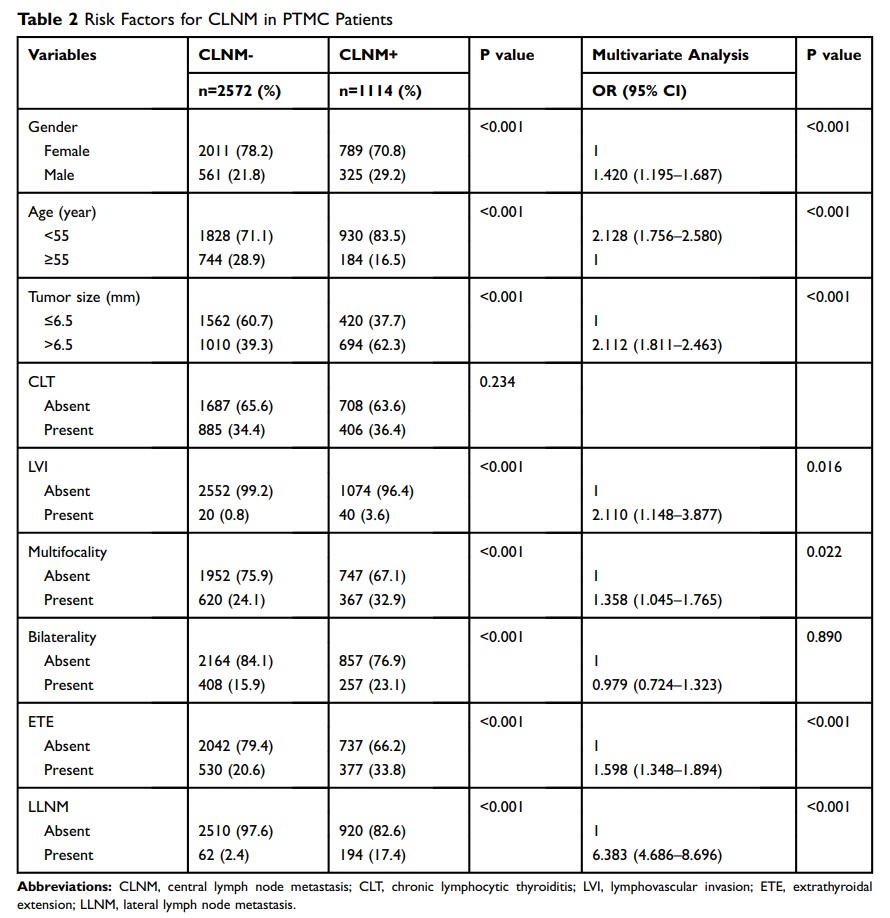
Results: Male gender [odds ratio (OR) =1.420, P < 0.001], age < 55 years (OR =2.128, P < 0.001), tumor size > 6.5 mm (OR =2.112, P < 0.001), lymphovascular invasion (LVI) (OR =2.110, P =0.016), multifocality (OR =1.358, P =0.022), extrathyroidal extension (ETE) (OR =1.598, P < 0.001), and lateral LNM (LLNM) (OR =6.383, P < 0.001) served as independent risk factors for central LNM (CLNM). Moreover, male gender (OR =1.668, P =0.001), tumor size > 6.5 mm (OR =2.223, P < 0.001), chronic lymphocytic thyroiditis (OR =1.402, P =0.021), LVI (OR =4.582, P < 0.001), ETE (OR =1.393, P=0.023), and CLNM (OR =6.212, P < 0.001) served as independent risk factors for LLNM. Furthermore, solitary PTMC with lesions in the upper third of the thyroid gland were more associated with LLNM than lesions in the other regions.
Conclusion: This study suggests that meticulous evaluation of risk factors associated with LNM is required in order to guide the surgical treatment of PTMC patients in clinical practice.
Keywords: papillary thyroid microcarcinoma, predictors, central lymph node metastasis, lateral lymph node metastasis, extrathyroidal extension