117333
论文已发表
注册即可获取德孚的最新动态
IF 收录期刊
- 3.6 Breast Cancer (Dove Med Press)
- 4.3 Clin Epidemiol
- 2.6 Cancer Manag Res
- 3.2 Infect Drug Resist
- 4.1 Clin Interv Aging
- 6.1 Drug Des Dev Ther
- 4.1 Int J Chronic Obstr
- 8.7 Int J Nanomed
- 2.5 Int J Women's Health
- 3.2 Neuropsych Dis Treat
- 2.4 OncoTargets Ther
- 2.6 Patient Prefer Adher
- 2.6 Ther Clin Risk Manag
- 3.1 J Pain Res
- 3.5 Diabet Metab Synd Ob
- 4.5 Psychol Res Behav Ma
- 3.4 Nat Sci Sleep
- 2.4 Pharmgenomics Pers Med
- 2.6 Risk Manag Healthc Policy
- 4.6 J Inflamm Res
- 2.3 Int J Gen Med
- 3.9 J Hepatocell Carcinoma
- 3.3 J Asthma Allergy
- 2.5 Clin Cosmet Investig Dermatol
- 3.0 J Multidiscip Healthc

异甘草素通过抑制 Mincle/Syk/NF-Kappa B 信号通路来减轻 UUO 诱导的肾脏炎症和纤维化
Authors Liao Y, Tan R, Li J, Liu T, Zhong X, Yan Y, Yang J, Lin X, Fan J, Wang L
Received 25 December 2019
Accepted for publication 31 March 2020
Published 14 April 2020 Volume 2020:14 Pages 1455—1468
DOI https://doi.org/10.2147/DDDT.S243420
Checked for plagiarism Yes
Review by Single-blind
Peer reviewer comments 2
Editor who approved publication: Dr Qiongyu Guo
Purpose: Chronic kidney disease (CKD) is a global nephrotic syndrome characterized by chronic inflammation, oxidative stress and fibrosis in the kidney. Isoliquiritigenin (ISL), a flavonoid from licorice, has historically been reported to inhibit innate immune responses to inflammation and fibrosis in vivo. However, the effect of ISL on CKD progression is largely unknown.
Materials and Methods: In this study, we employed the inflammatory and fibrotic models of LPS/TGF-β-induced bone marrow-derived macrophages (BMDM) in vitro and unilateral ureteral obstruction (UUO) model in vivo to explore the potential effects and mechanism of ISL on renal inflammation and fibrosis.
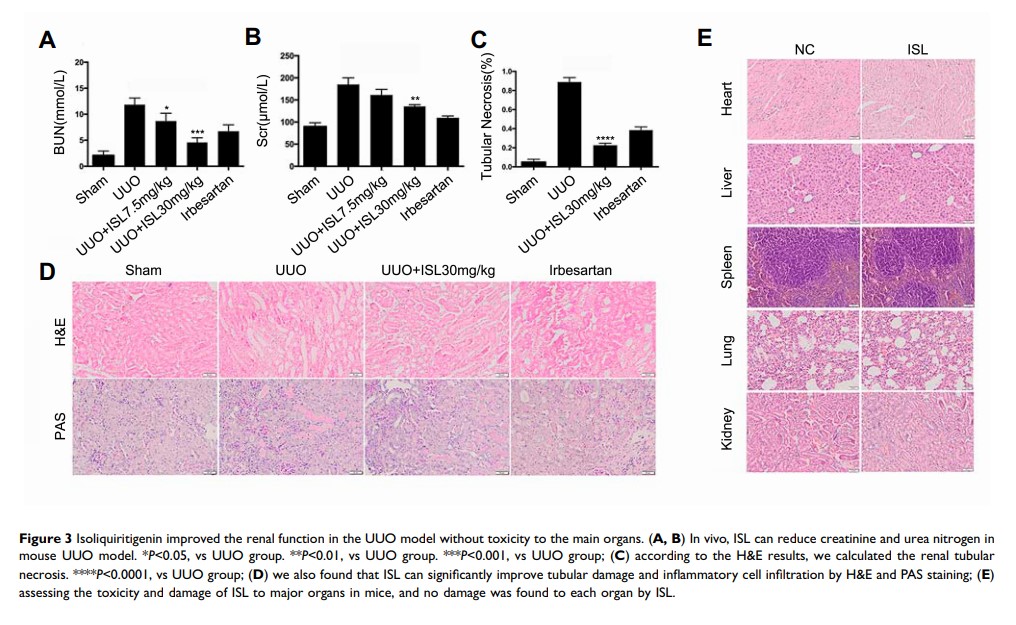
Results: Our results manifest that ISL improved UUO-induced renal dysfunction and reduced tubular damage with a significantly downregulated mRNA expression and secretion of IL-1β, IL-6, TNF-α and MCP-1 in vitro and in vivo. It is worth noting that ISL can strongly inhibit the mRNA and protein expression of Mincle (macrophage-induced c-type lectin) in BMDM and UUO. ISL inhibited the phosphorylation of Syk and NF-kappa B and simultaneously reduced the expression of α-SMA and Col III in vivo and in vitro. More interestingly, when dealing with TDB, a ligand of Mincle, it revealed significant reversal of protein expression levels as that observed with ISL. The expressions of IL-1β, IL-6, TNF-α, iNOS, p-Syk, p-NF-kappa B, α-SMA and FN in BMDM inflammatory model were significantly upregulated with TDB treatment. This confirms that ISL inhibits inflammation and fibrosis of macrophage by suppressing Mincle/Syk/NF-kappa B signaling pathway.
Conclusion: To conclude, ISL protects UUO-induced CKD by inhibiting Mincle-induced inflammation and suppressing renal fibrosis, which might be a specific renal protective mechanism of ISL, making it a novel drug to ameliorate CKD.
Keywords: Isoliquiritigenin, Mincle, macrophage, CKD, inflammation, fibrosis