118473
论文已发表
注册即可获取德孚的最新动态
IF 收录期刊
- 3.6 Breast Cancer (Dove Med Press)
- 4.3 Clin Epidemiol
- 2.6 Cancer Manag Res
- 3.2 Infect Drug Resist
- 4.1 Clin Interv Aging
- 6.1 Drug Des Dev Ther
- 4.1 Int J Chronic Obstr
- 8.7 Int J Nanomed
- 2.5 Int J Women's Health
- 3.2 Neuropsych Dis Treat
- 2.4 OncoTargets Ther
- 2.6 Patient Prefer Adher
- 2.6 Ther Clin Risk Manag
- 3.1 J Pain Res
- 3.5 Diabet Metab Synd Ob
- 4.5 Psychol Res Behav Ma
- 3.4 Nat Sci Sleep
- 2.4 Pharmgenomics Pers Med
- 2.6 Risk Manag Healthc Policy
- 4.6 J Inflamm Res
- 2.3 Int J Gen Med
- 3.9 J Hepatocell Carcinoma
- 3.3 J Asthma Allergy
- 2.5 Clin Cosmet Investig Dermatol
- 3.0 J Multidiscip Healthc

补充性私人健康保险与中国自付医疗费用的负担之间的关联:使用面板数据预估具有随机效应的两部分模型的新方法
Authors Jiang Y, Ni W
Received 13 July 2019
Accepted for publication 21 January 2020
Published 14 April 2020 Volume 2020:13 Pages 323—334
DOI https://doi.org/10.2147/RMHP.S223045
Checked for plagiarism Yes
Review by Single-blind
Peer reviewer comments 2
Editor who approved publication: Dr Kent Rondeau
Introduction: Private health insurance (PHI) is an important supplement to the basic health insurance schemes in the Chinese healthcare system. However, there is an absence of evidence on whether the strategy of engaging PHI to reduce burden is effective in China. As such, we aimed to investigate the association between supplemental PHI and the out-of-pocket (OOP) burden of household healthcare expenditure in China.
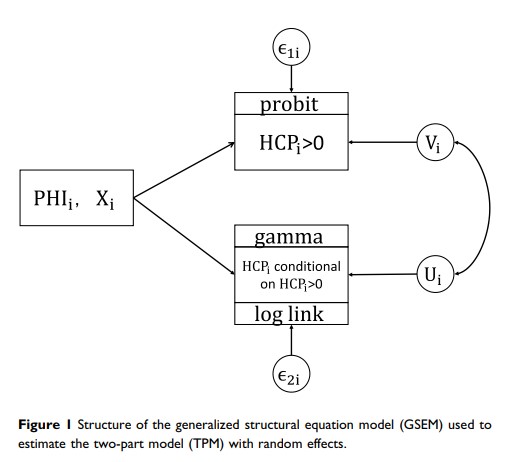
Methods: We conducted a panel data analysis using data from three waves of China Health and Retirement Longitudinal Study (CHARLS). Specifically, a two-part model (TPM) with a first-stage probit and second-stage generalized linear model (GLM) framework was used to analyze the data. To account for individual-level random effects in both stages and their correlation in the TPM analysis, we proposed a generalized structural equation modeling (GSEM) approach to implement the estimation. The proposed approach allowed us to simultaneously analyze the association of PHI with the probability of having any healthcare and the OOP burden conditional on having any healthcare expenditure.
Results: Using the GSEM estimates, we found that supplemental PHI was significantly associated with a higher probability (4.29 percentage points) of having any OOP healthcare expenditure but a lower OOP burden conditional on having any expenditure (− 2.37 percentage points). Overall, supplemental PHI was insignificantly associated with a lower OOP burden (− 1.05 percentage points).
Discussion: Our findings suggested that supplemental PHI in China may be able to effectively improve access to healthcare while keeping the OOP healthcare expenditure burden flat. Also, GSEM is a feasible method to estimate random-effect TPMs.
Keywords: private, health insurance, China, out-of-pocket, burden