118473
论文已发表
注册即可获取德孚的最新动态
IF 收录期刊
- 3.6 Breast Cancer (Dove Med Press)
- 4.3 Clin Epidemiol
- 2.6 Cancer Manag Res
- 3.2 Infect Drug Resist
- 4.1 Clin Interv Aging
- 6.1 Drug Des Dev Ther
- 4.1 Int J Chronic Obstr
- 8.7 Int J Nanomed
- 2.5 Int J Women's Health
- 3.2 Neuropsych Dis Treat
- 2.4 OncoTargets Ther
- 2.6 Patient Prefer Adher
- 2.6 Ther Clin Risk Manag
- 3.1 J Pain Res
- 3.5 Diabet Metab Synd Ob
- 4.5 Psychol Res Behav Ma
- 3.4 Nat Sci Sleep
- 2.4 Pharmgenomics Pers Med
- 2.6 Risk Manag Healthc Policy
- 4.6 J Inflamm Res
- 2.3 Int J Gen Med
- 3.9 J Hepatocell Carcinoma
- 3.3 J Asthma Allergy
- 2.5 Clin Cosmet Investig Dermatol
- 3.0 J Multidiscip Healthc

外科手术与格林-巴利综合症:一项针对临床和电生理亚型的单中心回顾性研究
Authors Bao L, Chen X, Li Q, Zhang R, Shi H, Cui G
Received 4 December 2019
Accepted for publication 22 March 2020
Published 15 April 2020 Volume 2020:16 Pages 969—974
DOI https://doi.org/10.2147/NDT.S241128
Checked for plagiarism Yes
Review by Single-blind
Peer reviewer comments 3
Editor who approved publication: Prof. Dr. Yuping Ning
Background: Surgery-related Guillain-Barré syndrome (GBS) is often underestimated and sometimes difficult to diagnose. This study aimed to elucidate the clinical features and electrophysiological subtypes of post-surgical GBS.
Methods: We retrospectively reviewed 17 patients who developed post-surgical GBS after a recent surgery between 2015 and 2019. Clinical characteristics, electrophysiological examinations, lumbar puncture results and prognosis were assessed. As controls, we selected 66 patients hospitalized with non-surgical GBS.
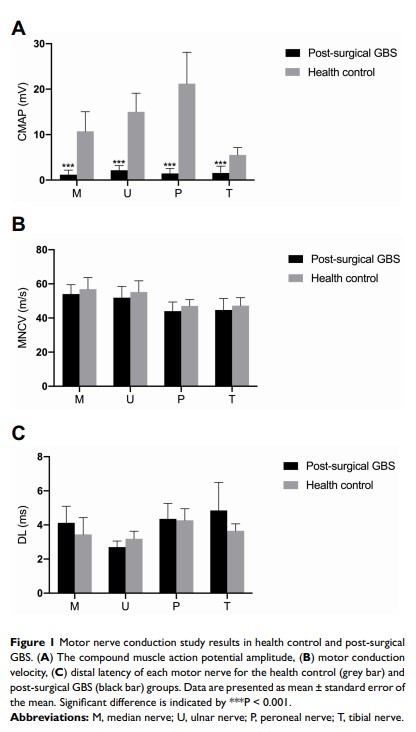
Results: The median duration from the surgery to the onset of GBS symptoms was 16.0 days. The main types of surgeries preceding GBS were orthopedic, gastrointestinal and neurosurgery. Symmetrical distal limbs weakness was present in all 17 post-surgical GBS patients. The incidence of respiratory failure, autonomic dysfunction and muscle atrophy in post-surgical GBS patients was significantly higher than that in non-surgical GBS patients. Hughes Functional Grading Scale (HFGS) scores were also higher in the post-surgical GBS group both at the time of peak disease and 6 months after discharge. Electrophysiological studies revealed significant motor amplitudes reduction with relative preserved nerve conduction velocities and distal latencies, suggesting axonal subtypes of GBS.
Conclusion: GBS should be considered in patients with rapidly progressive muscle weakness after surgery. Such patients often exhibit axonal subtypes of GBS with severe motor dysfunction, high risk of respiratory failure, and poor prognosis.
Keywords: Guillain-Barre syndrome, post-surgical GBS, surgery, electrophysiology, axonal neuropathy