115195
论文已发表
注册即可获取德孚的最新动态
IF 收录期刊
- 3.6 Breast Cancer (Dove Med Press)
- 4.3 Clin Epidemiol
- 2.6 Cancer Manag Res
- 3.2 Infect Drug Resist
- 4.1 Clin Interv Aging
- 6.1 Drug Des Dev Ther
- 4.1 Int J Chronic Obstr
- 8.7 Int J Nanomed
- 2.5 Int J Women's Health
- 3.2 Neuropsych Dis Treat
- 2.4 OncoTargets Ther
- 2.6 Patient Prefer Adher
- 2.6 Ther Clin Risk Manag
- 3.1 J Pain Res
- 3.5 Diabet Metab Synd Ob
- 4.5 Psychol Res Behav Ma
- 3.4 Nat Sci Sleep
- 2.4 Pharmgenomics Pers Med
- 2.6 Risk Manag Healthc Policy
- 4.6 J Inflamm Res
- 2.3 Int J Gen Med
- 3.9 J Hepatocell Carcinoma
- 3.3 J Asthma Allergy
- 2.5 Clin Cosmet Investig Dermatol
- 3.0 J Multidiscip Healthc

基于问卷调查和生化指标做出的 2 型糖尿病患者糖尿病肾病或糖尿病视网膜病变风险诺模图:一项横断面研究
Authors Shi R, Niu Z, Wu B, Zhang T, Cai D, Sun H, Hu Y, Mo R, Hu F
Received 31 December 2019
Accepted for publication 8 April 2020
Published 20 April 2020 Volume 2020:13 Pages 1215—1229
DOI https://doi.org/10.2147/DMSO.S244061
Checked for plagiarism Yes
Review by Single-blind
Peer reviewer comments 2
Editor who approved publication: Dr Konstantinos Tziomalos
Purpose: This study aimed to develop a diabetic nephropathy (DN) or diabetic retinopathy (DR) incidence risk nomogram in China’s population with type 2 diabetes mellitus (T2DM) based on a community-based sample.
Methods: We carried out questionnaire evaluations, physical examinations and biochemical tests among 4219 T2DM patients in Shanghai. According to the incidence of DN and DR, 4219 patients in our study were divided into groups of T2DM patients with DN or DR, patients with both, and patients without any complications. We successively used least absolute shrinkage and selection operator regression analysis and logistic regression analysis to optimize the feature selection for DN and DR. To ensure the accuracy of the results, we carried out multivariable logistic regression analysis of the above significant risk factors on the sample data for both DN and DR. The selected features were included to establish a prediction model. The C-index, calibration plot, curve analysis and internal validation were used to validate the distinction, calibration, and clinical practicality of the model.
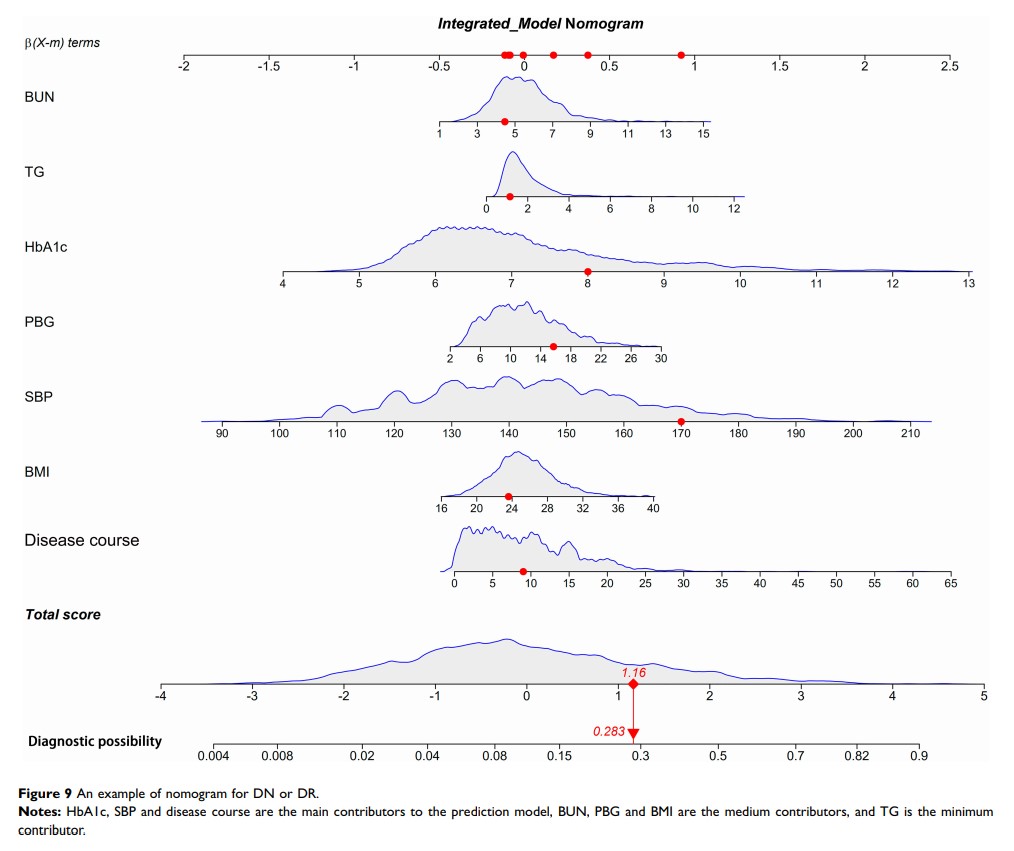
Results: The predictors in the prediction model included disease course, body mass index (BMI), total triglycerides (TGs), systolic blood pressure (SBP), postprandial blood glucose (PBG), haemoglobin A1C (HbA1c) and blood urea nitrogen (BUN). The model displayed moderate predictive power with a C-index of 0.807 and an area under the receiver operating characteristic curve of 0.807. In internal verification, the C-index reached 0.804. The risk threshold was 16– 75% according to the analysis of the decision curve, and the nomogram could be applied in clinical practice.
Conclusion: This DN or DR incidence risk nomogram incorporating disease course, BMI, TGs, SBP, PBG, HbA1c and BUN can be used to predict DN or DR incidence risk in T2DM patients. The research team has developed an online app based on a clinical prediction model incorporating risk factors for rapid and simple prediction.
Keywords: diabetic nephropathy, diabetic retinopathy, predictors, nomogram, type 2 diabetes mellitus