117333
论文已发表
注册即可获取德孚的最新动态
IF 收录期刊
- 3.6 Breast Cancer (Dove Med Press)
- 4.3 Clin Epidemiol
- 2.6 Cancer Manag Res
- 3.2 Infect Drug Resist
- 4.1 Clin Interv Aging
- 6.1 Drug Des Dev Ther
- 4.1 Int J Chronic Obstr
- 8.7 Int J Nanomed
- 2.5 Int J Women's Health
- 3.2 Neuropsych Dis Treat
- 2.4 OncoTargets Ther
- 2.6 Patient Prefer Adher
- 2.6 Ther Clin Risk Manag
- 3.1 J Pain Res
- 3.5 Diabet Metab Synd Ob
- 4.5 Psychol Res Behav Ma
- 3.4 Nat Sci Sleep
- 2.4 Pharmgenomics Pers Med
- 2.6 Risk Manag Healthc Policy
- 4.6 J Inflamm Res
- 2.3 Int J Gen Med
- 3.9 J Hepatocell Carcinoma
- 3.3 J Asthma Allergy
- 2.5 Clin Cosmet Investig Dermatol
- 3.0 J Multidiscip Healthc

心肌梗死患者冠状动脉血清衍生的外泌体通过 miRNA-143/IGF-IR 信号通路促进血管生成
Authors Geng T, Song ZY, Xing JX, Wang BX, Dai SP, Xu ZS
Received 18 December 2019
Accepted for publication 6 April 2020
Published 21 April 2020 Volume 2020:15 Pages 2647—2658
DOI https://doi.org/10.2147/IJN.S242908
Checked for plagiarism Yes
Review by Single-blind
Peer reviewer comments 2
Editor who approved publication: Dr Mian Wang
Purpose: Myocardial ischemia-reperfusion injury primarily causes myocardial infarction (MI), which is manifested by cell death. Angiogenesis is essential for repair and regeneration in cardiac tissue after MI. In this study, we aimed to investigate the effect of exosomes derived from the serum of MI patients in angiogenesis and its related mechanism.
Patients and Methods: Exosomes, isolated from serum, were collected from MI (MI-exosome) and control (Con-exosome) patients. After coculturing with human umbilical vein endothelial cells, MI-exosome promoted cell proliferation, migration, and tube formation.
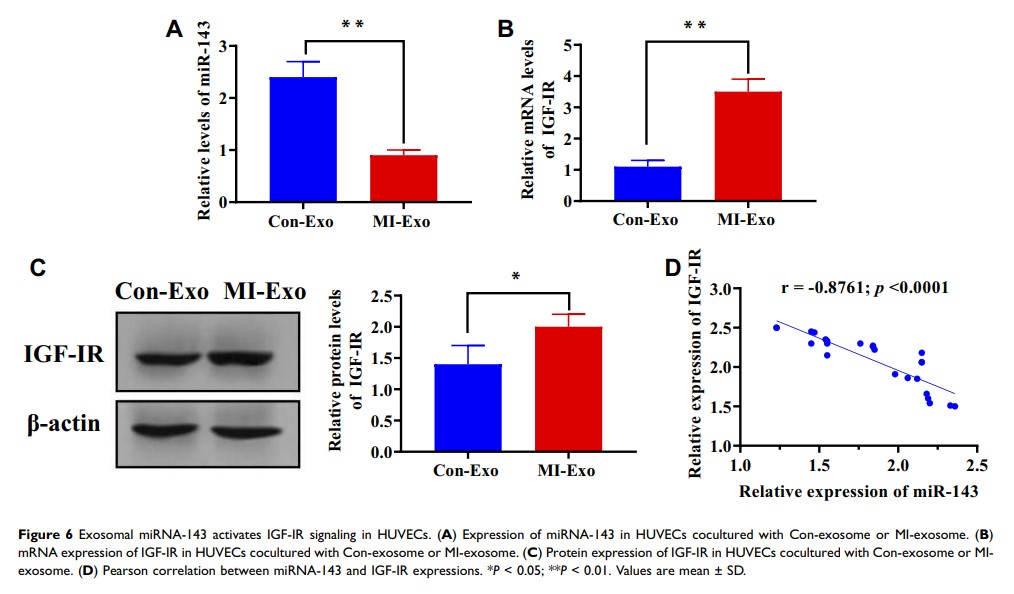
Results: The results revealed that the production and release of MI-exosome were associated with cardiomyocytes. Moreover, microarray assays demonstrated that miRNA-143 was significantly decreased in MI-exosome. Meanwhile, the overexpression and knockdown of miRNA-143 could inhibit and enhance angiogenesis, respectively. Furthermore, the effect of exosomal miRNA-143 on angiogenesis was mediated by its targeting gene, insulin-like growth factor 1 receptor (IGF-IR), and was associated with the production of nitric oxide (NO).
Conclusion: Taken together, exosomes derived from the serum of patients with MI promoted angiogenesis through the IGF-IR/NO signaling pathway. The results provide novel understanding of the function of exosomes in MI.
Keywords: myocardial ischemia, exosome, miRNA-143, insulin-like growth factor 1 receptor, angiogenesis