117333
论文已发表
注册即可获取德孚的最新动态
IF 收录期刊
- 3.6 Breast Cancer (Dove Med Press)
- 4.3 Clin Epidemiol
- 2.6 Cancer Manag Res
- 3.2 Infect Drug Resist
- 4.1 Clin Interv Aging
- 6.1 Drug Des Dev Ther
- 4.1 Int J Chronic Obstr
- 8.7 Int J Nanomed
- 2.5 Int J Women's Health
- 3.2 Neuropsych Dis Treat
- 2.4 OncoTargets Ther
- 2.6 Patient Prefer Adher
- 2.6 Ther Clin Risk Manag
- 3.1 J Pain Res
- 3.5 Diabet Metab Synd Ob
- 4.5 Psychol Res Behav Ma
- 3.4 Nat Sci Sleep
- 2.4 Pharmgenomics Pers Med
- 2.6 Risk Manag Healthc Policy
- 4.6 J Inflamm Res
- 2.3 Int J Gen Med
- 3.9 J Hepatocell Carcinoma
- 3.3 J Asthma Allergy
- 2.5 Clin Cosmet Investig Dermatol
- 3.0 J Multidiscip Healthc

LINC01272 通过 EMT 促进胃癌细胞的迁移和侵袭
Authors Leng X, Liu G, Wang S, Song J, Zhang W, Zhang X, Rong L, Ma Y, Song F
Received 12 December 2019
Accepted for publication 27 March 2020
Published 22 April 2020 Volume 2020:13 Pages 3401—3410
DOI https://doi.org/10.2147/OTT.S242073
Checked for plagiarism Yes
Review by Single-blind
Peer reviewer comments 2
Editor who approved publication: Dr Carlos E Vigil
Purpose: Gastric cancer (GC) is the fifth most common tumor in the world, and most patients with GC have a poor prognosis. This study aimed to explore the biological influence and mechanism of LINC01272 in GC.
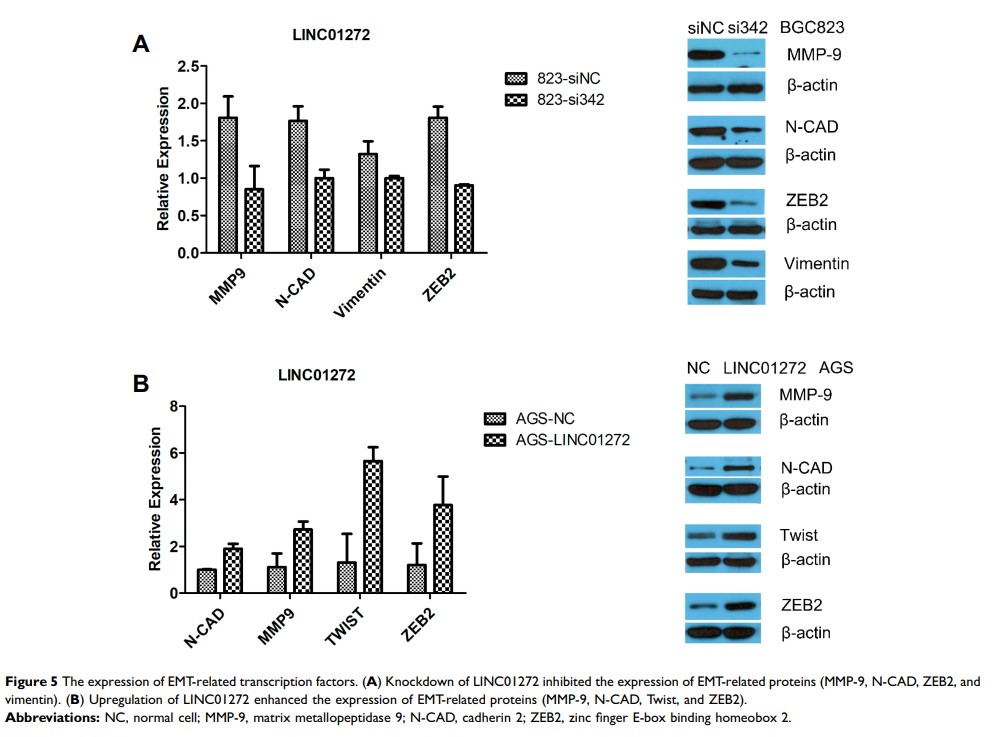
Materials and Methods: Using bioinformatic analyses, we investigated the expression of LINC01272 in TCGA database and predicted the biological functions and mechanism of LINC01272 in GC. Then, we detected the expression of LINC01272 in GC cell lines, GC tissues, and corresponding normal tissues using real-time polymerase chain reaction (RT-PCR). Finally, we explored the migration and invasion ability of LINC01272 by wound-healing and Transwell assays and examined the expression of epithelial-mesenchymal transition (EMT)-related proteins through Western blotting.
Results: We found that LINC01272 was upregulated in GC and was associated with GC staging and lymph node metastasis. The results of wound-healing and Transwell assays revealed that the LINC01272 was closely related to GC cell migration and invasion. LINC01272 knockdown inhibited the migration and invasion ability of GC cells by reducing the expression of EMT-related proteins. Overexpression of LINC01272 had the opposite effect.
Conclusion: Together, our results showed that LINC01272 promoted GC metastasis ability by regulating the expression of EMT-related proteins and could serve as a potential diagnostic biomarker for GC.
Keywords: gastric cancer, long non-coding RNA, migration, invasion, LINC01272