115195
论文已发表
注册即可获取德孚的最新动态
IF 收录期刊
- 3.6 Breast Cancer (Dove Med Press)
- 4.3 Clin Epidemiol
- 2.6 Cancer Manag Res
- 3.2 Infect Drug Resist
- 4.1 Clin Interv Aging
- 6.1 Drug Des Dev Ther
- 4.1 Int J Chronic Obstr
- 8.7 Int J Nanomed
- 2.5 Int J Women's Health
- 3.2 Neuropsych Dis Treat
- 2.4 OncoTargets Ther
- 2.6 Patient Prefer Adher
- 2.6 Ther Clin Risk Manag
- 3.1 J Pain Res
- 3.5 Diabet Metab Synd Ob
- 4.5 Psychol Res Behav Ma
- 3.4 Nat Sci Sleep
- 2.4 Pharmgenomics Pers Med
- 2.6 Risk Manag Healthc Policy
- 4.6 J Inflamm Res
- 2.3 Int J Gen Med
- 3.9 J Hepatocell Carcinoma
- 3.3 J Asthma Allergy
- 2.5 Clin Cosmet Investig Dermatol
- 3.0 J Multidiscip Healthc

中国浙江省 2016-2018 年,导致妊娠相关李斯特菌病的单核细胞增多性李斯特氏菌的基因组和表型多样性
Authors Li A, Xu H, Li X, Ye H, Shan D, Feng N, Qian Y, Huang X, Hao D, Zhang X, Zhu B, Zheng B
Received 8 January 2020
Accepted for publication 7 April 2020
Published 23 April 2020 Volume 2020:13 Pages 1179—1184
DOI https://doi.org/10.2147/IDR.S245305
Checked for plagiarism Yes
Review by Single-blind
Peer reviewer comments 3
Editor who approved publication: Professor Suresh Antony
Introduction: There are few investigations describing the pregnancy-associated listeriosis in China, and the molecular characteristics of Listeria monocytogenes causing such infections remain largely unknown. We aim to investigate the phenotypic and genomic profiles of pregnancy-associated L. monocytogenes isolates and their association with isolates recovered from human and non-human in China.
Materials and Methods: In this study, we conducted a 3-year surveillance of listeriosis in a women’s hospital in Zhejiang province, using whole genome sequencing and bioinformatics tools.
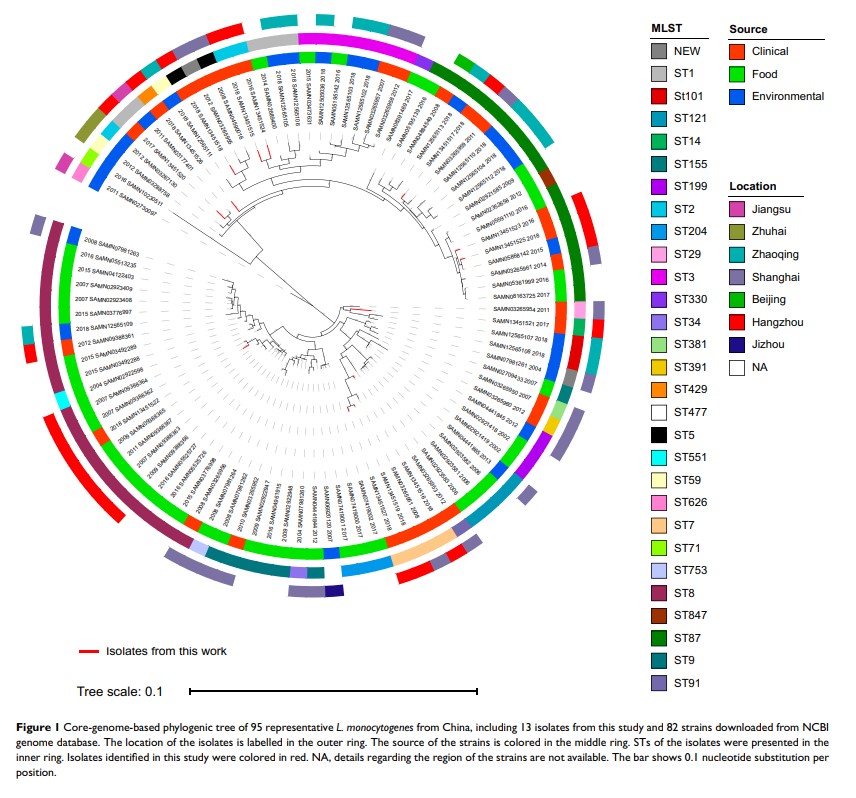
Results: From 2016 to 2018, we identified 13 clinical L. monocytogenes isolates. Among these pregnancy-associated isolates, we found seven sequence types (STs), with the prevalent STs of ST87 and ST7. Serotyping divided the strains into four serotypes, including serotype 1/2a, 1/2b, 3a, and 4b. Antimicrobial resistance testing showed that all the isolates were susceptible to 10 antibiotics. Comparative genomics analysis clearly classified our genome collection into four distinct evolutionary lineages with most isolates grouping into lineages I and II. Interestingly, we found three pairs of isolates with high identity, although no evident epidemiological association was observed.
Conclusion: This study reports for the first time the surveillance of pregnancy-associated listeriosis in Zhejiang province, China, which indicates that the infection rate is low in this region. Our findings provide insight into the evolution and genetic diversity of pregnancy-associated L. monocytogenes from Zhejiang province. Additional investigations involving more human and non-human isolates with a “one health” strategy are needed for prediction of the listeriosis risk associated with a typical prevalent clone in Zhejiang province, such as ST87.
Keywords: Listeria monocytogenses , pregnancy-associated, ST87, whole genome sequencing, comparative genomics analysis