117333
论文已发表
注册即可获取德孚的最新动态
IF 收录期刊
- 3.6 Breast Cancer (Dove Med Press)
- 4.3 Clin Epidemiol
- 2.6 Cancer Manag Res
- 3.2 Infect Drug Resist
- 4.1 Clin Interv Aging
- 6.1 Drug Des Dev Ther
- 4.1 Int J Chronic Obstr
- 8.7 Int J Nanomed
- 2.5 Int J Women's Health
- 3.2 Neuropsych Dis Treat
- 2.4 OncoTargets Ther
- 2.6 Patient Prefer Adher
- 2.6 Ther Clin Risk Manag
- 3.1 J Pain Res
- 3.5 Diabet Metab Synd Ob
- 4.5 Psychol Res Behav Ma
- 3.4 Nat Sci Sleep
- 2.4 Pharmgenomics Pers Med
- 2.6 Risk Manag Healthc Policy
- 4.6 J Inflamm Res
- 2.3 Int J Gen Med
- 3.9 J Hepatocell Carcinoma
- 3.3 J Asthma Allergy
- 2.5 Clin Cosmet Investig Dermatol
- 3.0 J Multidiscip Healthc

肺癌中的肿瘤气腔播散(STAS):多角度和最新进展回顾
Authors Jia M, Yu S, Gao H, Sun PL
Received 18 February 2020
Accepted for publication 9 April 2020
Published 23 April 2020 Volume 2020:12 Pages 2743—2752
DOI https://doi.org/10.2147/CMAR.S249790
Checked for plagiarism Yes
Review by Single-blind
Peer reviewer comments 3
Editor who approved publication: Professor Bilikere Dwarakanath
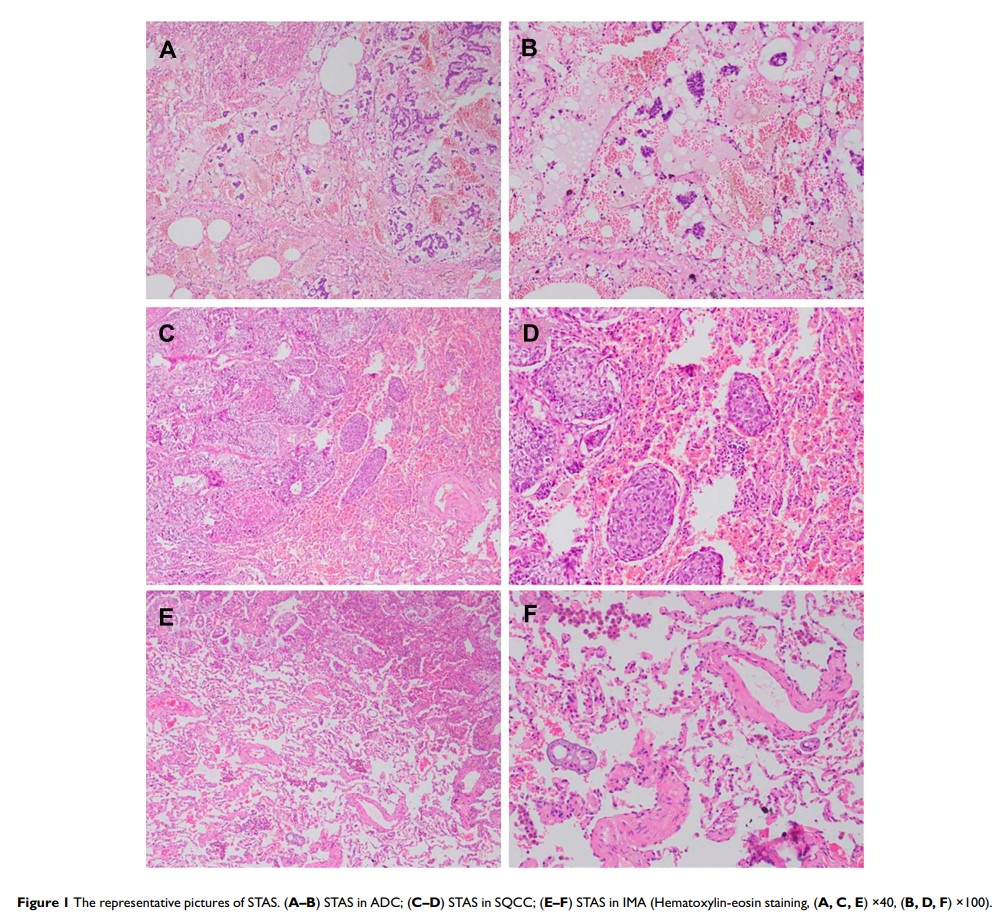
Background: Spread through air spaces (STAS) is a spreading phenomenon of lung cancers, which is defined as tumor cells within air spaces in the lung parenchyma beyond the edge of the main tumor. To date, several articles have reviewed the studies concerning the significance of STAS; however, most articles focused on the prognosis without summarizing the significance of STAS on other aspects. In this review, we comprehensively summarized the current literature related to STAS, so as to explore the clinical significance of STAS from multiple perspectives.
Main Body: This section provided a comprehensive overview of the significance of STAS from multiple perspectives and summarized current controversies and challenges in the diagnosis and clinical application.
Conclusion: STAS is a conspicuous spreading phenomenon of lung cancers indicating worse prognosis; nevertheless, the treatment strategy for patients with STAS remains to be discussed. Further studies are needed to elaborate whether a STAS-positive patient who underwent limited resection needs a second operation or postoperative adjuvant treatment. Meanwhile, the internal mechanism of STAS formation is largely undiscovered. Whether the capability of detachment-migration-reattachment in STAS tumor cells is achieved at the time of primary tumorigenesis or in the progress of tumor development needs to be studied, and the related signal pathways or genetic alterations need to be explored. With this information, it may be possible to improve the prognosis of patients with STAS-positive lung cancers.
Keywords: spread through air spaces, non-small cell lung cancer, adenocarcinoma, squamous cell carcinoma