117333
论文已发表
注册即可获取德孚的最新动态
IF 收录期刊
- 3.6 Breast Cancer (Dove Med Press)
- 4.3 Clin Epidemiol
- 2.6 Cancer Manag Res
- 3.2 Infect Drug Resist
- 4.1 Clin Interv Aging
- 6.1 Drug Des Dev Ther
- 4.1 Int J Chronic Obstr
- 8.7 Int J Nanomed
- 2.5 Int J Women's Health
- 3.2 Neuropsych Dis Treat
- 2.4 OncoTargets Ther
- 2.6 Patient Prefer Adher
- 2.6 Ther Clin Risk Manag
- 3.1 J Pain Res
- 3.5 Diabet Metab Synd Ob
- 4.5 Psychol Res Behav Ma
- 3.4 Nat Sci Sleep
- 2.4 Pharmgenomics Pers Med
- 2.6 Risk Manag Healthc Policy
- 4.6 J Inflamm Res
- 2.3 Int J Gen Med
- 3.9 J Hepatocell Carcinoma
- 3.3 J Asthma Allergy
- 2.5 Clin Cosmet Investig Dermatol
- 3.0 J Multidiscip Healthc

甘草酸通过诱导细胞周期阻滞和细胞凋亡来抑制胃癌细胞的增殖
Authors Wang H, Ge X, Qu H, Wang N, Zhou J, Xu W, Xie J, Zhou Y, Shi L, Qin Z, Jiang Z, Yin W, Xia J
Received 2 January 2020
Accepted for publication 1 April 2020
Published 24 April 2020 Volume 2020:12 Pages 2853—2861
DOI https://doi.org/10.2147/CMAR.S244481
Checked for plagiarism Yes
Review by Single-blind
Peer reviewer comments 2
Editor who approved publication: Dr Sanjeev Srivastava
Purpose: Glycyrrhizic acid (GA) is the main active ingredient extracted from Chinese herb licorice root, and it shows anti-tumor effects in many cancer types, while its role in gastric cancer (GC) is still unknown. In this study, we evaluated the effects of GA on GC cells and explored the underlying mechanisms.
Methods: The anti-proliferation effect of GA on GC cells was assessed by CCK-8, colony formation, and EdU assay. The effects of GA on cell cycle and apoptosis were detected by flow cytometer. Western blotting was performed to explore the underlying mechanisms.
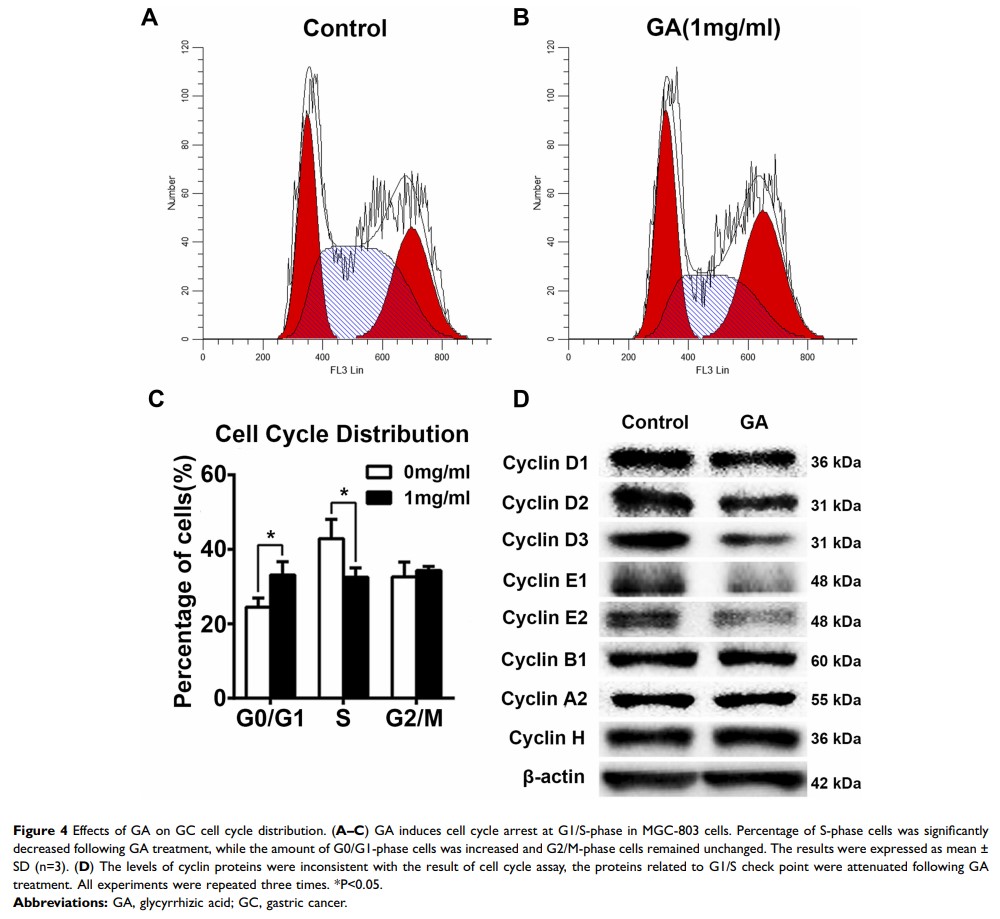
Results: Our results showed that GA had a time- and dose-dependent inhibitory effect on proliferation of GC cells. Flow cytometer analysis demonstrated that GA would lead to G1/S-phase arrest and apoptosis. GA treatment down-regulated the levels of G1 phase-related proteins, including cyclin D1, D2, D3, E1, and E2. In terms of apoptosis, GA treatment up-regulated the levels of Bax, cleaved PARP, and pro-caspase-3, -8, -9, but did not influence their cleavage patterns. The expression of Bcl-2, survivin and p65 was attenuated after treatment. Besides, GA would down-regulate the phosphorylation of PI3K/AKT pathway.
Conclusion: This study focused on inhibitory effect of GA on GC cells by inducing cell cycle arrest and apoptosis. Several important cyclins- and apoptosis-related proteins were involved in the regulation of GA to GC cells, and phosphorylated PI3K and AKT were attenuated. The results of this study indicated that GA is a potential and promising anti-cancer drug for GC.
Keywords: glycyrrhizic acid, gastric cancer, cell cycle, apoptosis, PI3K/AKT pathway