117333
论文已发表
注册即可获取德孚的最新动态
IF 收录期刊
- 3.6 Breast Cancer (Dove Med Press)
- 4.3 Clin Epidemiol
- 2.6 Cancer Manag Res
- 3.2 Infect Drug Resist
- 4.1 Clin Interv Aging
- 6.1 Drug Des Dev Ther
- 4.1 Int J Chronic Obstr
- 8.7 Int J Nanomed
- 2.5 Int J Women's Health
- 3.2 Neuropsych Dis Treat
- 2.4 OncoTargets Ther
- 2.6 Patient Prefer Adher
- 2.6 Ther Clin Risk Manag
- 3.1 J Pain Res
- 3.5 Diabet Metab Synd Ob
- 4.5 Psychol Res Behav Ma
- 3.4 Nat Sci Sleep
- 2.4 Pharmgenomics Pers Med
- 2.6 Risk Manag Healthc Policy
- 4.6 J Inflamm Res
- 2.3 Int J Gen Med
- 3.9 J Hepatocell Carcinoma
- 3.3 J Asthma Allergy
- 2.5 Clin Cosmet Investig Dermatol
- 3.0 J Multidiscip Healthc

赤道几内亚比奥科岛恶性疟原虫分离株中,与磺胺多辛-乙胺嘧啶(SP)耐药性相关的分子标记物的趋势:2011–2017
Authors Lin LY, Li J, Huang HY, Liang XY, Jiang TT, Chen JT, Ehapo CS, Eyi UM, Zheng YZ, Zha GC, Xie DD, Wang YL, Chen WZ, Liu XZ, Lin M
Received 1 November 2019
Accepted for publication 19 March 2020
Published 28 April 2020 Volume 2020:13 Pages 1203—1212
DOI https://doi.org/10.2147/IDR.S236898
Checked for plagiarism Yes
Review by Single-blind
Peer reviewer comments 2
Editor who approved publication: Dr Joachim Wink
Purpose: Antimalarial drug resistance is one of the major challenges in global efforts to control and eliminate malaria. In 2006, sulfadoxine-pyrimethamine (SP) replaced with artemisinin-based combination therapy (ACT) on Bioko Island, Equatorial Guinea, in response to increasing SP resistance, which is associated with mutations in the dihydrofolate reductase (Pfdhfr ) and dihydropteroate synthase (Pfdhps ) genes.
Patients and Methods: To evaluate the trend of molecular markers associated with SP resistance on Bioko Island from 2011 to 2017, 179 samples collected during active case detection were analysed by PCR and DNA sequencing.
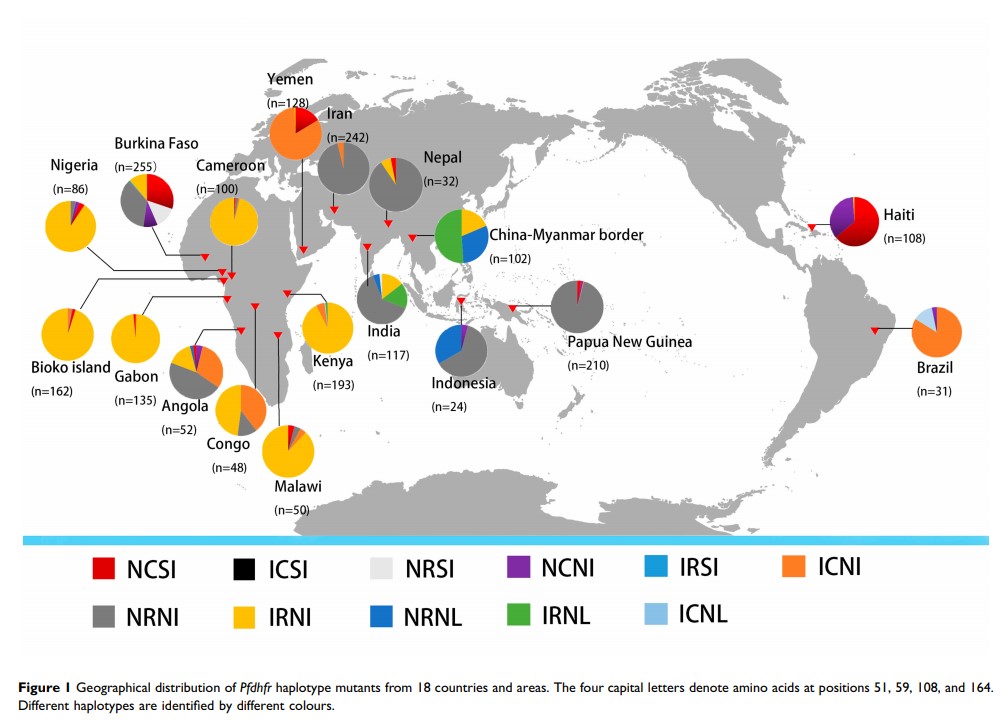
Results: Pfdhfr and Pfdhps gene sequences were obtained for 90.5% (162/179) and 77.1% (138/179) of the samples, respectively. For Pfdhfr , 97.5% (158/162), 95.7% (155/162) and 98.1% (159/162) of the samples contained N51I, C59R and S108N mutant alleles, respectively. And Pfdhps S436A, A437G, K540E, A581G, and A613S mutations were observed in 25.4% (35/138), 88.4% (122/138), 5.1% (7/138), 1.4% (2/138), and 7.2% (10/138) of the samples, respectively. Two classes of previously described Pfdhfr-Pfdhps haplotypes associated with SP resistance and their frequencies were identified: partial (IRNI-SGKAA, 59.4%) and full (IRNI-SGEAA, 5.5%) resistance. Although no significant difference was observed in different time periods (p > 0.05), our study confirmed a slowly increasing trend of the frequencies of these SP-resistance markers in Bioko parasites over the 7 years investigated.
Conclusion: The findings reveal the general existence of SP-resistance markers on Bioko Island even after the replacement of SP as a first-line treatment for uncomplicated malaria. Continuous molecular monitoring and additional control efforts in the region are urgently needed.
Keywords: malaria, drug resistance, dihydrofolate reductase, dihydropteroate synthase, sulfadoxine-pyrimethamine