117333
论文已发表
注册即可获取德孚的最新动态
IF 收录期刊
- 3.6 Breast Cancer (Dove Med Press)
- 4.3 Clin Epidemiol
- 2.6 Cancer Manag Res
- 3.2 Infect Drug Resist
- 4.1 Clin Interv Aging
- 6.1 Drug Des Dev Ther
- 4.1 Int J Chronic Obstr
- 8.7 Int J Nanomed
- 2.5 Int J Women's Health
- 3.2 Neuropsych Dis Treat
- 2.4 OncoTargets Ther
- 2.6 Patient Prefer Adher
- 2.6 Ther Clin Risk Manag
- 3.1 J Pain Res
- 3.5 Diabet Metab Synd Ob
- 4.5 Psychol Res Behav Ma
- 3.4 Nat Sci Sleep
- 2.4 Pharmgenomics Pers Med
- 2.6 Risk Manag Healthc Policy
- 4.6 J Inflamm Res
- 2.3 Int J Gen Med
- 3.9 J Hepatocell Carcinoma
- 3.3 J Asthma Allergy
- 2.5 Clin Cosmet Investig Dermatol
- 3.0 J Multidiscip Healthc

患者对医患者关系共情的理解对克罗恩病患者炎症标记物的影响:焦虑、自我效能和睡眠质量的中介作用
Authors Xu X, Zhang Y, Wang W, Zhang Y, Yang N
Received 1 July 2019
Accepted for publication 11 February 2020
Published 29 April 2020 Volume 2020:13 Pages 363—371
DOI https://doi.org/10.2147/PRBM.S221435
Checked for plagiarism Yes
Review by Single-blind
Peer reviewer comments 2
Editor who approved publication: Professor Igor Elman
Background: Physician–patient empathy is inextricably linked with outcomes of patients. The purpose of this study was to test whether anxiety, self-efficacy, and sleep quality played intermediary roles in relationships between patients’ perceptions of physician–patient relational empathy and an inflammation marker in Crohn’s disease patients.
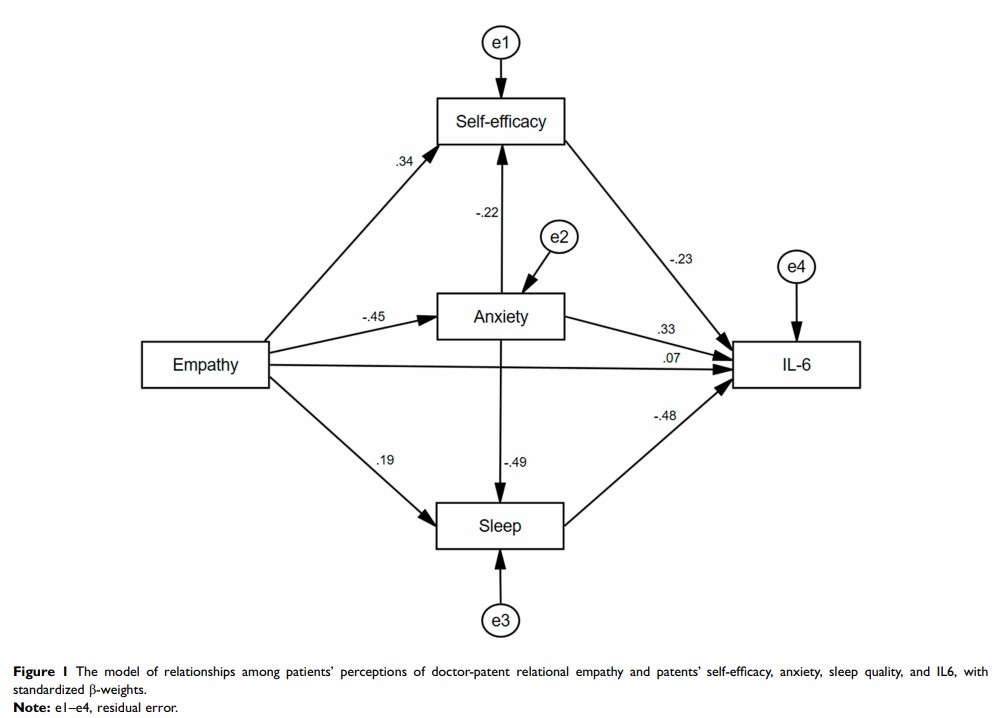
Methods: The study included 187 patients. At admission (T1) and 3 months after admission (T2), anxiety, self-efficacy, sleep, and the inflammatory marker IL6 of patients were tested and compared. Patients’ perceptions of physician–patient relational empathy (CARE scale) was measured at T2. Correlations among patients’ anxiety, self-efficacy, sleep quality, IL6, and CARE scores were explored by Pearson’s correlation analysis and a structural equation model.
Results: Compared with T1, patients showed higher self-efficacy and sleep quality and lower anxiety and IL6 at T2. Patients’ perceptions of physician–patient relational empathy were negatively related to anxiety and IL6 and connected to self-efficacy and sleep quality positively. Patients’ anxiety, self-efficacy, and sleep quality played intermediary roles incorrelations between empathy and IL6.
Conclusion: In correlations of patients’ perceptions of physician–patient relational empathy and IL6 in patients with Crohn’s disease, patients’ anxiety, self-efficacy, and sleep quality acted as intermediary effects. Therefore, medical staff should empathize with patients.
Keywords: empathy, Crohn’s disease, physician–patient communication, mental health