117333
论文已发表
注册即可获取德孚的最新动态
IF 收录期刊
- 3.6 Breast Cancer (Dove Med Press)
- 4.3 Clin Epidemiol
- 2.6 Cancer Manag Res
- 3.2 Infect Drug Resist
- 4.1 Clin Interv Aging
- 6.1 Drug Des Dev Ther
- 4.1 Int J Chronic Obstr
- 8.7 Int J Nanomed
- 2.5 Int J Women's Health
- 3.2 Neuropsych Dis Treat
- 2.4 OncoTargets Ther
- 2.6 Patient Prefer Adher
- 2.6 Ther Clin Risk Manag
- 3.1 J Pain Res
- 3.5 Diabet Metab Synd Ob
- 4.5 Psychol Res Behav Ma
- 3.4 Nat Sci Sleep
- 2.4 Pharmgenomics Pers Med
- 2.6 Risk Manag Healthc Policy
- 4.6 J Inflamm Res
- 2.3 Int J Gen Med
- 3.9 J Hepatocell Carcinoma
- 3.3 J Asthma Allergy
- 2.5 Clin Cosmet Investig Dermatol
- 3.0 J Multidiscip Healthc

山莨菪碱通过抑制 NLRP3 炎症小体的激活来抑制肝癌细胞的生长、诱导细胞凋亡并调节炎性因子的水平
Authors Li P, Liu Y, He Q
Received 22 December 2019
Accepted for publication 17 March 2020
Published 29 April 2020 Volume 2020:14 Pages 1609—1620
DOI https://doi.org/10.2147/DDDT.S243383
Checked for plagiarism Yes
Review by Single-blind
Peer reviewer comments 2
Editor who approved publication: Dr Tin Wui Wong
Introduction: Hepatocellular carcinoma (HCC) is a primary liver cancer with a 5-year incidence of over 70%. Anisodamine (ANI), an alkaloid extracted from Anisodus, has a good therapeutic effect in septic shock and morphine addiction. Our study designed to investigate the anticancer effect of anisodamine (ANI) on HCC.
Materials and Methods: HepG2 cells were subcutaneously injected into BALB/C nude mice and the tumor tissue was subcutaneously inoculated to construct the transplanted tumor. Mice were randomly divided into 10 groups (n = 5): control group, ANI-10 group, ANI-50 group, ANI-200 group, ANI-200+pcDNA-NLRP3 group, ANI-200+EV group, sh-NLRP3 group, ANI-200 + sh-NLRP3 group, normal group and normal+ANI-200 group.
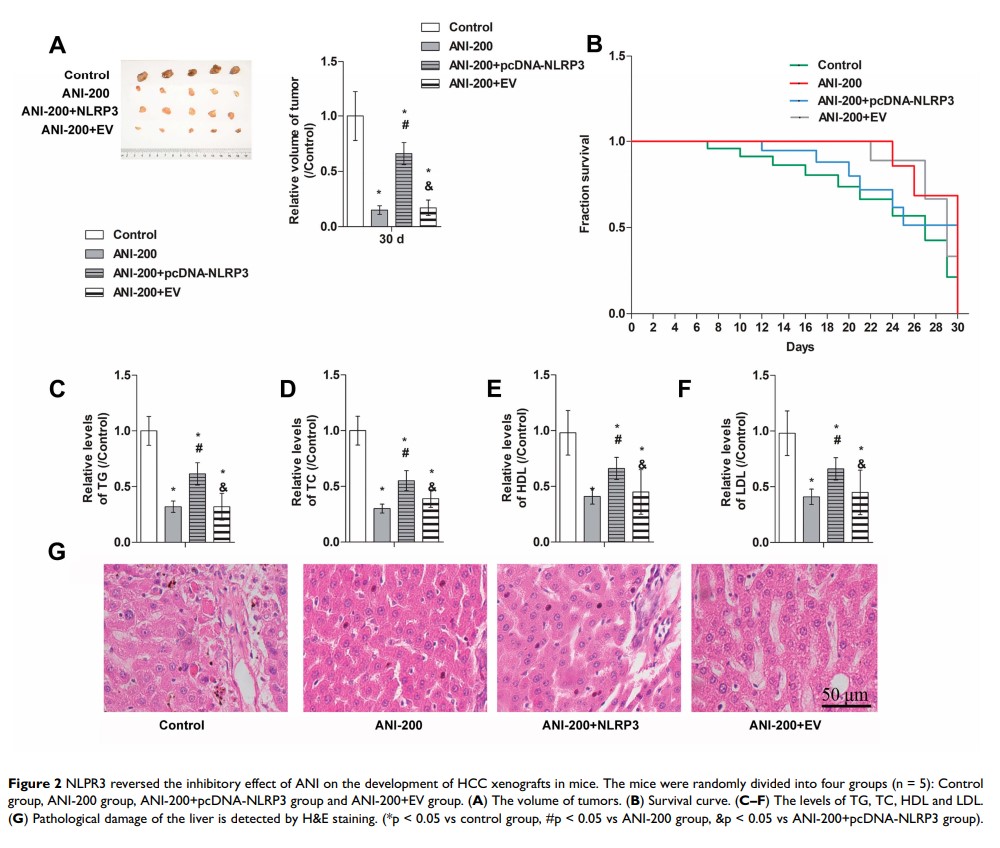
Results: Studies indicated that ANI inhibited the growth of HCC xenografts and reduced liver damage in a dose-dependent manner. Besides, ANI increased the survival rate of tumor-bearing mice and suppressed the expression of NLRP3 in a dose-dependent manner. It is worth noting that NLRP3 overexpression reversed the inhibitory effect of ANI on HCC xenografts. In addition, TUNEL analysis showed that ANI-induced apoptosis of tumor cells, and NLRP3 overexpression reversed the inhibitory effect of ANI on HCC. Moreover, ANI further regulated the levels of IFN-γ, TNF-α, IL-4 and IL-27. Notably, low expression of NLRP3 enhanced the inhibitory effect of ANI on the development of HCC xenografts in mice.
Discussion: These findings indicate that ANI suppressed the growth of HCC cells, induced apoptosis and regulated the levels of inflammatory factors by inhibiting NLRP3 inflammasome activation.
Keywords: hepatocellular carcinoma, anisodamine, NOD-like receptor family pyrin domain containing 3, NLRP3, inflammatory factors, anticancer