115195
论文已发表
注册即可获取德孚的最新动态
IF 收录期刊
- 3.6 Breast Cancer (Dove Med Press)
- 4.3 Clin Epidemiol
- 2.6 Cancer Manag Res
- 3.2 Infect Drug Resist
- 4.1 Clin Interv Aging
- 6.1 Drug Des Dev Ther
- 4.1 Int J Chronic Obstr
- 8.7 Int J Nanomed
- 2.5 Int J Women's Health
- 3.2 Neuropsych Dis Treat
- 2.4 OncoTargets Ther
- 2.6 Patient Prefer Adher
- 2.6 Ther Clin Risk Manag
- 3.1 J Pain Res
- 3.5 Diabet Metab Synd Ob
- 4.5 Psychol Res Behav Ma
- 3.4 Nat Sci Sleep
- 2.4 Pharmgenomics Pers Med
- 2.6 Risk Manag Healthc Policy
- 4.6 J Inflamm Res
- 2.3 Int J Gen Med
- 3.9 J Hepatocell Carcinoma
- 3.3 J Asthma Allergy
- 2.5 Clin Cosmet Investig Dermatol
- 3.0 J Multidiscip Healthc

中国人群中成人 T 细胞淋巴母细胞淋巴瘤的临床病理特征和突变分析
Authors Chen F, Pang D, Guo H, Jiang X, Liu S, Huang L, Wei X, Liang Z, Wang X, Li W
Received 19 December 2019
Accepted for publication 9 April 2020
Published 30 April 2020 Volume 2020:12 Pages 3003—3012
DOI https://doi.org/10.2147/CMAR.S242903
Checked for plagiarism Yes
Review by Single-blind
Peer reviewer comments 3
Editor who approved publication: Dr Kenan Onel
Purpose: The purpose of this study is to perform a retrospective analysis of disease outcomes and mutational profiles in patients with adult T-cell lymphoblastic lymphoma (T-LBL).
Patients and Methods: A total of 43 patients were treated over a 9-year period at a single institution. The study examined treatment outcomes, clinical characteristics, and the use of circulating tumor DNA (ctDNA) and mutational profiling for patient diagnosis.
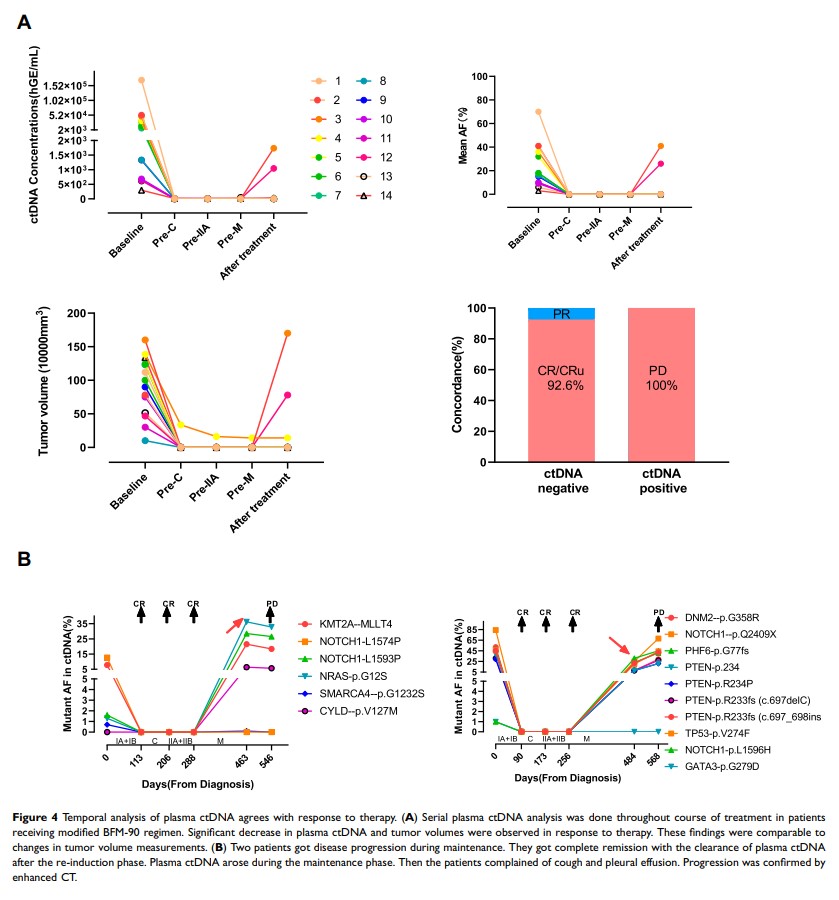
Results: The estimated overall survival (OS) and progression-free survival (PFS) time for all patients was 37.0 (95% CI: 17.7– 56.2) and 28.1 (95% CI: 0.9– 55.4) months, respectively. Chidamide maintenance was used in five patients exhibiting unfavorable genetic alterations, with no evidence of relapse. Next-generation sequencing of pretreatment tumor tissue was undertaken for 15 patients. NOTCH1 mutations were the most frequent genetic alterations, followed by mutations in PHF6, TP53, JAK1, JAK3, PTEN , and DNM2 . The genetic profile of the blood was similar to that of the tumor. Kappa coefficient analysis (14 patients, 56 time points, kappa = 1.0, p = 0.00) indicated a 92.6% agreement between ctDNA response and tumor volume measurements at post treatment when compared with baseline. Detection of ctDNA predicted disease relapse in two patients.
Conclusion: The prognosis of patients with adult T-LBL remains very poor. Detection of tumor-associated sequences in ctDNA may be an effective method for diagnosing T-LBL and measuring treatment efficacy. Incorporation of new drugs such as histone deacetylase inhibitors (HDACi)has the potential to improve outcomes in these patients.
Keywords: lymphoblastic lymphoma, gene mutations, HDACi, circulating tumor DNA