115195
论文已发表
注册即可获取德孚的最新动态
IF 收录期刊
- 3.6 Breast Cancer (Dove Med Press)
- 4.3 Clin Epidemiol
- 2.6 Cancer Manag Res
- 3.2 Infect Drug Resist
- 4.1 Clin Interv Aging
- 6.1 Drug Des Dev Ther
- 4.1 Int J Chronic Obstr
- 8.7 Int J Nanomed
- 2.5 Int J Women's Health
- 3.2 Neuropsych Dis Treat
- 2.4 OncoTargets Ther
- 2.6 Patient Prefer Adher
- 2.6 Ther Clin Risk Manag
- 3.1 J Pain Res
- 3.5 Diabet Metab Synd Ob
- 4.5 Psychol Res Behav Ma
- 3.4 Nat Sci Sleep
- 2.4 Pharmgenomics Pers Med
- 2.6 Risk Manag Healthc Policy
- 4.6 J Inflamm Res
- 2.3 Int J Gen Med
- 3.9 J Hepatocell Carcinoma
- 3.3 J Asthma Allergy
- 2.5 Clin Cosmet Investig Dermatol
- 3.0 J Multidiscip Healthc

16 项负面症状评估中文版的验证
Authors Huang B, Wang Y, Miao Q, Yu X, Pu C, Shi C
Received 25 February 2020
Accepted for publication 8 April 2020
Published 4 May 2020 Volume 2020:16 Pages 1113—1120
DOI https://doi.org/10.2147/NDT.S251182
Checked for plagiarism Yes
Review by Single-blind
Peer reviewer comments 2
Editor who approved publication: Prof. Dr. Yuping Ning
Purpose: The Negative Symptom Assessment-16 (NSA-16) is an instrument with significant validity and utility for assessing negative symptoms associated with schizophrenia. This study aimed to validate the Chinese version of the NSA-16.
Patients and Methods: A total of 172 participants with schizophrenia were assessed with the NSA-16, Scale for Assessment of Negative Symptoms (SANS), Positive and Negative Syndrome Scale (PANSS), Calgary Depression Scale for Schizophrenia (CDSS) and Rating Scale for Extrapyramidal Side Effects (RSESE). The factor structure of the NSA-16 was evaluated via exploratory and confirmatory factor analysis. Cronbach’s α and intraclass correlation coefficients were computed. Correlations were evaluated via Spearman correlation coefficient.
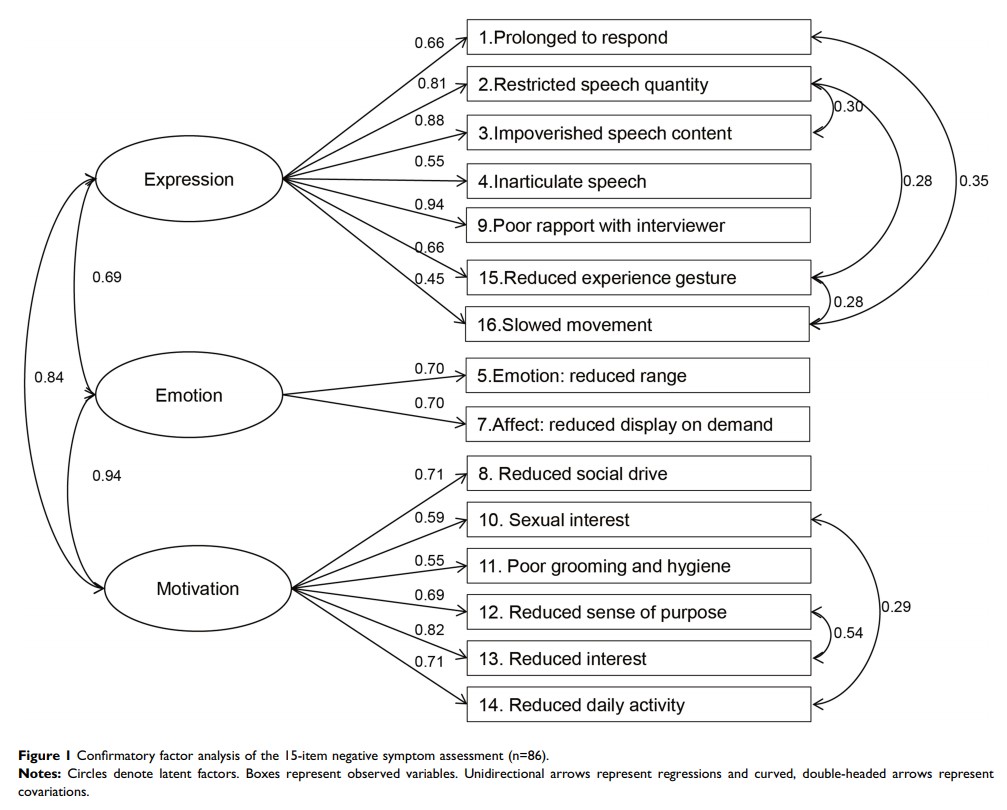
Results: The original five-factor model of the NSA-16 did not fit our sample. Exploratory factor analysis followed by confirmatory factor analysis suggested a three-factor structure, consisting of communication, emotion and motivation, with 15 items. The NSA with 15 items was termed as the NSA-15. The NSA-15 showed excellent convergent validity by high correlations with the SANS and PANSS total and negative factor scores and good divergent validity by independence from the PANSS positive factor, CDSS and RSESE. The NSA-15 showed good internal consistency, interrater reliability and test–retest reliability.
Conclusion: The NSA-15 is best characterized by a three-factor structure and is valid for assessing negative symptoms of schizophrenia in Chinese individuals.
Keywords: negative symptoms, schizophrenia, NSA, reliability, validity