115195
论文已发表
注册即可获取德孚的最新动态
IF 收录期刊
- 3.6 Breast Cancer (Dove Med Press)
- 4.3 Clin Epidemiol
- 2.6 Cancer Manag Res
- 3.2 Infect Drug Resist
- 4.1 Clin Interv Aging
- 6.1 Drug Des Dev Ther
- 4.1 Int J Chronic Obstr
- 8.7 Int J Nanomed
- 2.5 Int J Women's Health
- 3.2 Neuropsych Dis Treat
- 2.4 OncoTargets Ther
- 2.6 Patient Prefer Adher
- 2.6 Ther Clin Risk Manag
- 3.1 J Pain Res
- 3.5 Diabet Metab Synd Ob
- 4.5 Psychol Res Behav Ma
- 3.4 Nat Sci Sleep
- 2.4 Pharmgenomics Pers Med
- 2.6 Risk Manag Healthc Policy
- 4.6 J Inflamm Res
- 2.3 Int J Gen Med
- 3.9 J Hepatocell Carcinoma
- 3.3 J Asthma Allergy
- 2.5 Clin Cosmet Investig Dermatol
- 3.0 J Multidiscip Healthc

非霍奇金淋巴瘤患者的主要死亡原因:一项回顾性队列研究
Authors Mei M, Wang Y, Song W, Zhang M
Received 24 December 2019
Accepted for publication 8 April 2020
Published 6 May 2020 Volume 2020:12 Pages 3155—3162
DOI https://doi.org/10.2147/CMAR.S243672
Checked for plagiarism Yes
Review by Single-blind
Peer reviewer comments 2
Editor who approved publication: Dr Eileen O'Reilly
Purpose: Non-Hodgkin’s lymphoma (NHL) comprises many serious hematologic malignancies from lymphocytes. The incidence of NHL is 5.1 per 100,000, with a mortality rate of 2.5 per 100,000 worldwide. However, the causes of death among patients with NHL vary. This retrospective cohort study aimed to elucidate the primary causes and specific risk factors for NHL.
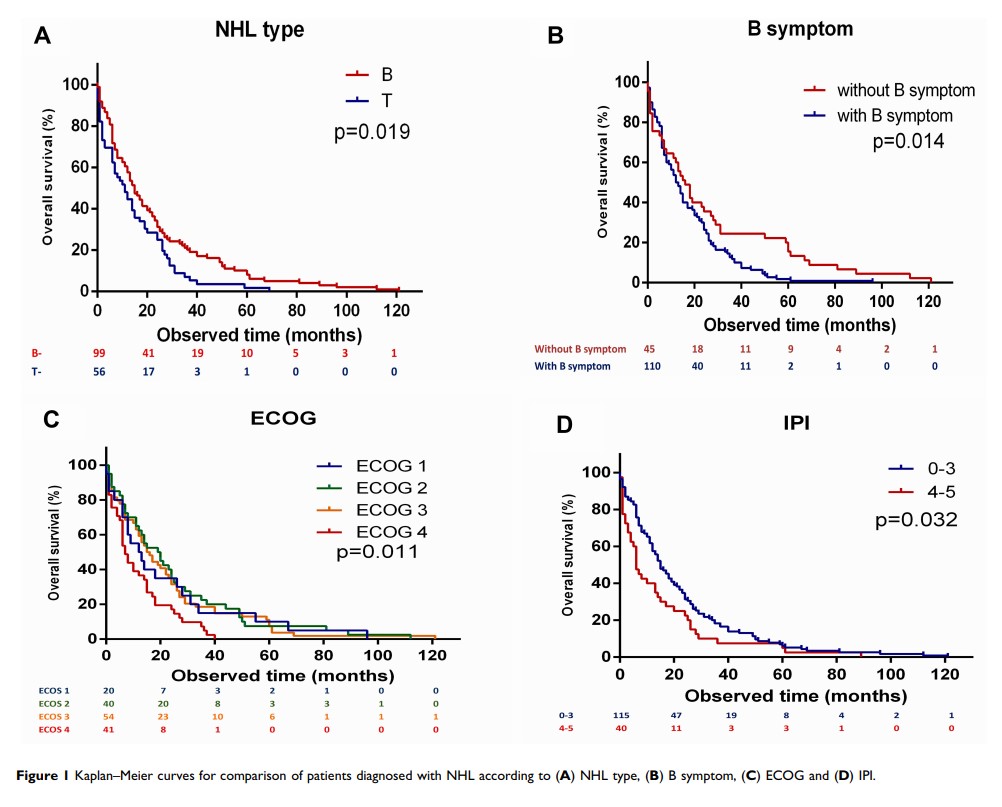
Patients and Methods: The study included patients who were diagnosed from January 2006 to January 2018. Grouped by sex, Ann Arbor stage, date of diagnosis, age, B symptom, NHL type, international prognostic index, and Eastern Cooperative Oncology Group (ECOG) performance score, the Log-rank test was performed, and survival curves were drawn using the Kaplan–Meier method. The competing-risks regression model was used to analyze the specific causes of death.
Results: T-cell lymphoma, B symptoms and worse performance were associated with a lower survival. Mortality from NHL accounted for most and other common causes that contributed to death included circulatory and respiratory diseases. Patients diagnosed with T-cell lymphoma were more likely to die of NHL rather than other causes. Moreover, patients with B symptoms on admission were more likely to die of diseases of the circulatory system. Lastly, patients diagnosed at an earlier age suffered more from diseases of the digestive system and immune mechanism or other uncommon causes.
Conclusion: Classifications of subtypes, age and occurrence of B symptoms were factors providing references for a specific cause of death owing to NHL, which might enable physicians to decrease cause-specific mortality rates.
Keywords: NHL, competing-risks regression, survival analysis, overall survival, ECOG score, cause-specific mortality