115195
论文已发表
注册即可获取德孚的最新动态
IF 收录期刊
- 3.6 Breast Cancer (Dove Med Press)
- 4.3 Clin Epidemiol
- 2.6 Cancer Manag Res
- 3.2 Infect Drug Resist
- 4.1 Clin Interv Aging
- 6.1 Drug Des Dev Ther
- 4.1 Int J Chronic Obstr
- 8.7 Int J Nanomed
- 2.5 Int J Women's Health
- 3.2 Neuropsych Dis Treat
- 2.4 OncoTargets Ther
- 2.6 Patient Prefer Adher
- 2.6 Ther Clin Risk Manag
- 3.1 J Pain Res
- 3.5 Diabet Metab Synd Ob
- 4.5 Psychol Res Behav Ma
- 3.4 Nat Sci Sleep
- 2.4 Pharmgenomics Pers Med
- 2.6 Risk Manag Healthc Policy
- 4.6 J Inflamm Res
- 2.3 Int J Gen Med
- 3.9 J Hepatocell Carcinoma
- 3.3 J Asthma Allergy
- 2.5 Clin Cosmet Investig Dermatol
- 3.0 J Multidiscip Healthc

通过生物信息学数据鉴定小鼠胶质母细胞瘤放疗过程中异常表达的基因
Authors Zhao X, Li C, Liu L, Zou H, Li K
Received 30 January 2020
Accepted for publication 15 April 2020
Published 6 May 2020 Volume 2020:13 Pages 3839—3851
DOI https://doi.org/10.2147/OTT.S247794
Checked for plagiarism Yes
Review by Single-blind
Peer reviewer comments 2
Editor who approved publication: Dr Federico Perche
Objective: Glioblastoma (GBM) is an aggressive tumor with a fast growth rate. Radioresistance of GBM can lead to high recurrence. In general, due to the protection of the blood–brain barrier, the immune environment of the central nervous system is unique. The immune response induced by radiotherapy is weak in GBM. In the present study, aberrantly expressed genes during radiotherapy were assessed in murine models based on microarray RNA data.
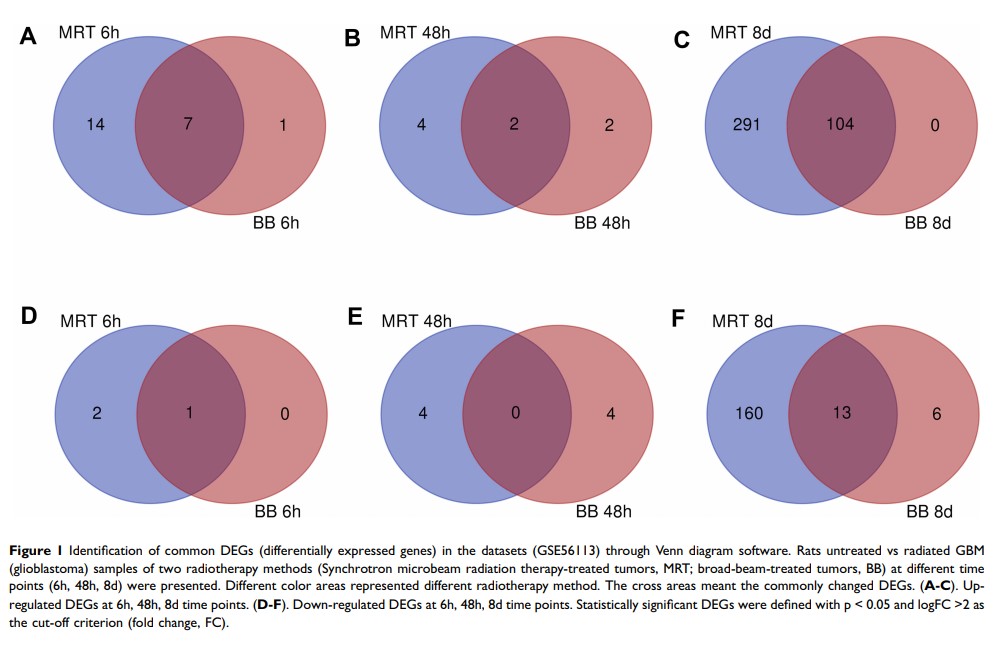
Methods: The microarray data were extracted from the Intergovernmental Group on Earth Observations and differentially expressed genes (DEGs) screened out. Gene expression profiles of 115 samples in GSE56113 were analyzed and 104 genes were identified as aberrantly expressed based on GEO2R 8 d after radiotherapy. Then, the Database for Annotation, Visualization, and Integrated Discovery was used to analyze Genome Kyoto Encyclopedia of Gene pathways and Gene Ontology (GO) terms. The 20 core candidate genes were identified using protein–protein interaction network analysis and Cytoscape software with Molecular Complex Detection plug-in.
Results: Post-irradiated tumor tissues expressed significantly more immune-associated genes than contralateral brain tissues. GO and pathway analyses showed core DEGs were mainly enriched in the chemokine signaling and IL-6 signaling pathways, which could lead to immunosuppressive inflammatory monocyte infiltration and radioresistance. Chemokine signaling and IL-6 signaling pathway-associated genes were increased in the irradiated U87 cell strain.
Conclusion: Chemokine signaling and IL-6 signaling pathways were activated after radiation in murine glioma and human glioma cell lines which could lead to changes in the immune microenvironment and treatment failure. The results of the present study could provide potential therapeutic targets especially when immune therapy and radiotherapy are combined to treat GBM patients.
Keywords: glioblastoma, immune microenvironment, radiotherapy, bioinformatic data mining