115195
论文已发表
注册即可获取德孚的最新动态
IF 收录期刊
- 3.6 Breast Cancer (Dove Med Press)
- 4.3 Clin Epidemiol
- 2.6 Cancer Manag Res
- 3.2 Infect Drug Resist
- 4.1 Clin Interv Aging
- 6.1 Drug Des Dev Ther
- 4.1 Int J Chronic Obstr
- 8.7 Int J Nanomed
- 2.5 Int J Women's Health
- 3.2 Neuropsych Dis Treat
- 2.4 OncoTargets Ther
- 2.6 Patient Prefer Adher
- 2.6 Ther Clin Risk Manag
- 3.1 J Pain Res
- 3.5 Diabet Metab Synd Ob
- 4.5 Psychol Res Behav Ma
- 3.4 Nat Sci Sleep
- 2.4 Pharmgenomics Pers Med
- 2.6 Risk Manag Healthc Policy
- 4.6 J Inflamm Res
- 2.3 Int J Gen Med
- 3.9 J Hepatocell Carcinoma
- 3.3 J Asthma Allergy
- 2.5 Clin Cosmet Investig Dermatol
- 3.0 J Multidiscip Healthc

氟化银纳米粒子的合成、表征及其作为不着色防龋剂的潜力
Authors Yin IX, Zhao IS, Mei ML, Lo ECM, Tang J, Li Q, So LY, Chu CH
Received 20 December 2019
Accepted for publication 14 April 2020
Published 6 May 2020 Volume 2020:15 Pages 3207—3215
DOI https://doi.org/10.2147/IJN.S243202
Checked for plagiarism Yes
Review by Single-blind
Peer reviewer comments 2
Editor who approved publication: Dr Mian Wang
Objectives: The first objective of this study was to prepare sodium fluoride (NaF) solution with various concentrations of polyethylene glycol-coated silver nanoparticles (PEG-AgNPs). The second objective was to study the antibacterial activity against Streptococcus mutans and the tooth-staining effect of the solution.
Methods: PEG-AgNPs were prepared via the one-step chemical reduction of silver acetate with thiolated polyethylene glycol. The PEG-AgNPs were characterized with ultraviolet-visible spectrometry and transmission electron microscopy. The half maximal inhibitory concentration (IC50) for the PEG-AgNPs against Streptococcus mutans and human gingival fibroblasts (HGF-1) were determined. The staining effect on dentin and enamel for the 2.5% NaF solutions with PEG-AgNPs at 12,800, 6400, 1600, and 400 ppm was investigated using digital spectrophotometry. The IC50 of the fluoridated silver nanoparticles against Streptococcus mutans were measured.
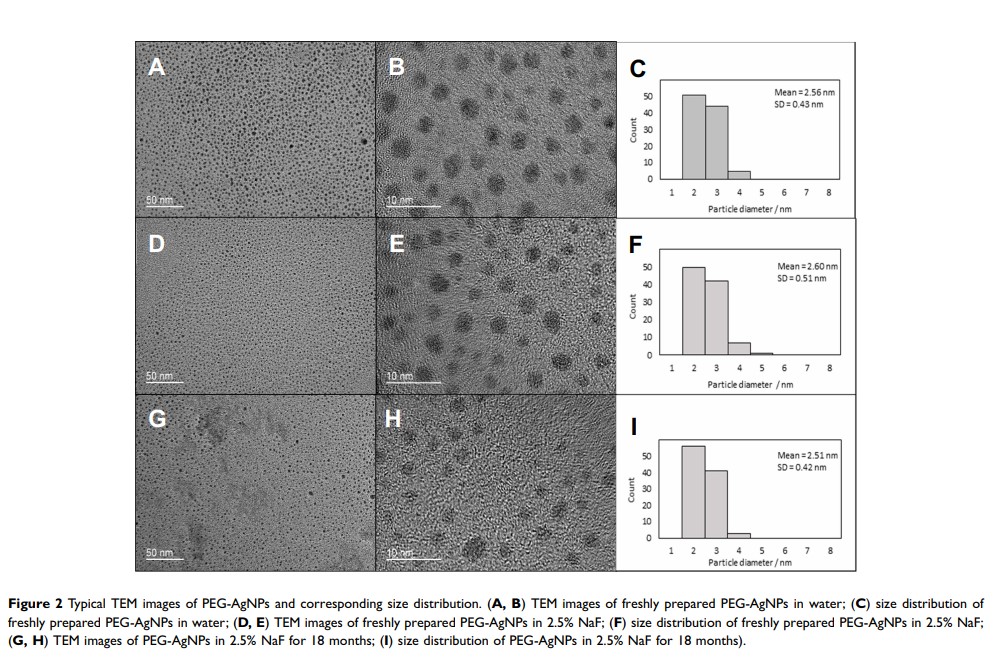
Results: The PEG-AgNPs have an average diameter of 2.56± 0.43 nm and showed excellent stability at high ionic strength (2.5% NaF) for 18 months. The IC50 of PEG-AgNPs against Streptococcus mutans was found to be 21.16± 1.08 ppm silver, which was half of IC50 against HGF-1 cells (42.36± 1.12 ppm), providing a working range to kill bacteria with no harm to human cells. The formulations with different concentrations of PEG-AgNPs showed no significant staining of teeth. Combining PEG-AgNPs with NaF significantly expanded the therapeutic window against Streptococcus mutans by reducing its IC50.
Conclusion: A biocompatible solution of NaF with PEG-AgNPs was developed. Because it has antibacterial activity against Streptococcus mutans and no tooth-staining effect, it can be used as an anti-caries agent.
Keywords: silver, nanoparticles, fluoride, dentin, caries, antibacterial