115195
论文已发表
注册即可获取德孚的最新动态
IF 收录期刊
- 3.6 Breast Cancer (Dove Med Press)
- 4.3 Clin Epidemiol
- 2.6 Cancer Manag Res
- 3.2 Infect Drug Resist
- 4.1 Clin Interv Aging
- 6.1 Drug Des Dev Ther
- 4.1 Int J Chronic Obstr
- 8.7 Int J Nanomed
- 2.5 Int J Women's Health
- 3.2 Neuropsych Dis Treat
- 2.4 OncoTargets Ther
- 2.6 Patient Prefer Adher
- 2.6 Ther Clin Risk Manag
- 3.1 J Pain Res
- 3.5 Diabet Metab Synd Ob
- 4.5 Psychol Res Behav Ma
- 3.4 Nat Sci Sleep
- 2.4 Pharmgenomics Pers Med
- 2.6 Risk Manag Healthc Policy
- 4.6 J Inflamm Res
- 2.3 Int J Gen Med
- 3.9 J Hepatocell Carcinoma
- 3.3 J Asthma Allergy
- 2.5 Clin Cosmet Investig Dermatol
- 3.0 J Multidiscip Healthc

中国甘肃省维生素 D 状况及其与糖脂代谢的相关性
Authors Yang K, Liu J, Fu S, Tang X, Ma L, Sun W, Niu Y, Jing G, Niu Q
Received 10 February 2020
Accepted for publication 17 April 2020
Published 7 May 2020 Volume 2020:13 Pages 1555—1563
DOI https://doi.org/10.2147/DMSO.S249049
Checked for plagiarism Yes
Review by Single-blind
Peer reviewer comments 2
Editor who approved publication: Prof. Dr. Juei-Tang Cheng
Objective: To investigate the relationship between serum 25-hydroxyvitamin D [25(OH)D] levels and blood glucose and lipid levels in people over 18 years of age in Gansu, China.
Subjects and Methods: A total of 1928 volunteers (958 males and 970 females) were selected. The prevalence of abnormal glucose metabolism and lipid metabolism in the vitamin D deficiency group (< 20 ng/mL) and the non-vitamin D deficiency group (≥ 20 ng/mL) were compared. The correlations between serum 25(OH)D and blood glucose and lipid were analyzed.
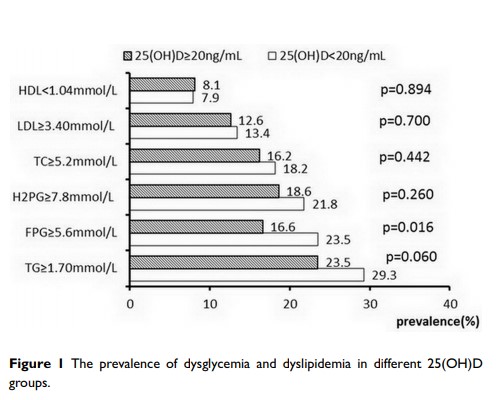
Results: A total of 1681 patients had 25(OH)D deficiency, with an overall prevalence of 87.2% (82.9% in males and 91.4% in females). The levels of 25(OH)D in the diabetic group and the IGT/IFG group were significantly lower than that in the normal group. The level of 25(OH)D was significantly lower in the dyslipidemia group than that in the normal group, and was significantly lower in the fasting plasma glucose (FPG) ≥ 5.6 mmol/L group than that in the FPG < 5.6 mmol/L group (p =0.002). The 25(OH)D level in the serum triglyceride (TG) ≥ 1.7 mmol/L group was significantly lower than that of the TG < 1.7 mmol/L group (p =0.0274). The age, heart rate, TG, TC, FPG and H2PG levels in the vitamin D deficiency group were significantly higher than those in the non-vitamin D deficiency group (p < 0.05). The prevalence of FPG ≥ 5.6 mmol/L in the vitamin D deficiency group was higher than that in the non-vitamin D deficiency group (23.5% vs 16.6%, p =0.016). Multiple linear regression analysis suggested that serum 25(OH)D levels were independently correlated with gender, age, FPG, TG and heart rate (β=− 0.218, − 0.129, − 0.075, β=− 0.103, − 0.058, all p < 0.05).
Conclusion: The incidences of dyslipidemia and dysglycemia were higher in the vitamin D deficiency group. The vitamin D level was independently and negatively correlated with FPG and TC, but not with waist circumference, BMI and blood pressure.
Keywords: 25(OH)D, lipid metabolism, glucose metabolism