115195
论文已发表
注册即可获取德孚的最新动态
IF 收录期刊
- 3.6 Breast Cancer (Dove Med Press)
- 4.3 Clin Epidemiol
- 2.6 Cancer Manag Res
- 3.2 Infect Drug Resist
- 4.1 Clin Interv Aging
- 6.1 Drug Des Dev Ther
- 4.1 Int J Chronic Obstr
- 8.7 Int J Nanomed
- 2.5 Int J Women's Health
- 3.2 Neuropsych Dis Treat
- 2.4 OncoTargets Ther
- 2.6 Patient Prefer Adher
- 2.6 Ther Clin Risk Manag
- 3.1 J Pain Res
- 3.5 Diabet Metab Synd Ob
- 4.5 Psychol Res Behav Ma
- 3.4 Nat Sci Sleep
- 2.4 Pharmgenomics Pers Med
- 2.6 Risk Manag Healthc Policy
- 4.6 J Inflamm Res
- 2.3 Int J Gen Med
- 3.9 J Hepatocell Carcinoma
- 3.3 J Asthma Allergy
- 2.5 Clin Cosmet Investig Dermatol
- 3.0 J Multidiscip Healthc

在纳米形貌自组装聚苯乙烯纳米坑表面,hADSCs 的定向骨分化作用
Authors Zhao C, Song X, Lu X
Received 27 November 2019
Accepted for publication 10 March 2020
Published 8 May 2020 Volume 2020:15 Pages 3281—3290
DOI https://doi.org/10.2147/IJN.S240300
Checked for plagiarism Yes
Review by Single-blind
Peer reviewer comments 2
Editor who approved publication: Dr Yan Shen
Introduction: Cells exhibit high sensitivity and a diverse response to the nanotopography of the extracellular matrix, thereby endowing materials with instructive performances formerly reserved for growth factors. This finding leads to opportunities for improvement. However, the interplay between the topographical surface and cell behaviors remains incompletely understood.
Methods: In the present study, we showed nanosurfaces with various dimensions of nanopits (200– 750 nm) fabricated by self-assembling polystyrene (PS) nanospheres. Human adipose-derived stem cell behaviors, such as cell morphology, adhesion, cytoskeleton contractility, proliferation, and differentiation, were investigated on the prepared PS nanopit surface.
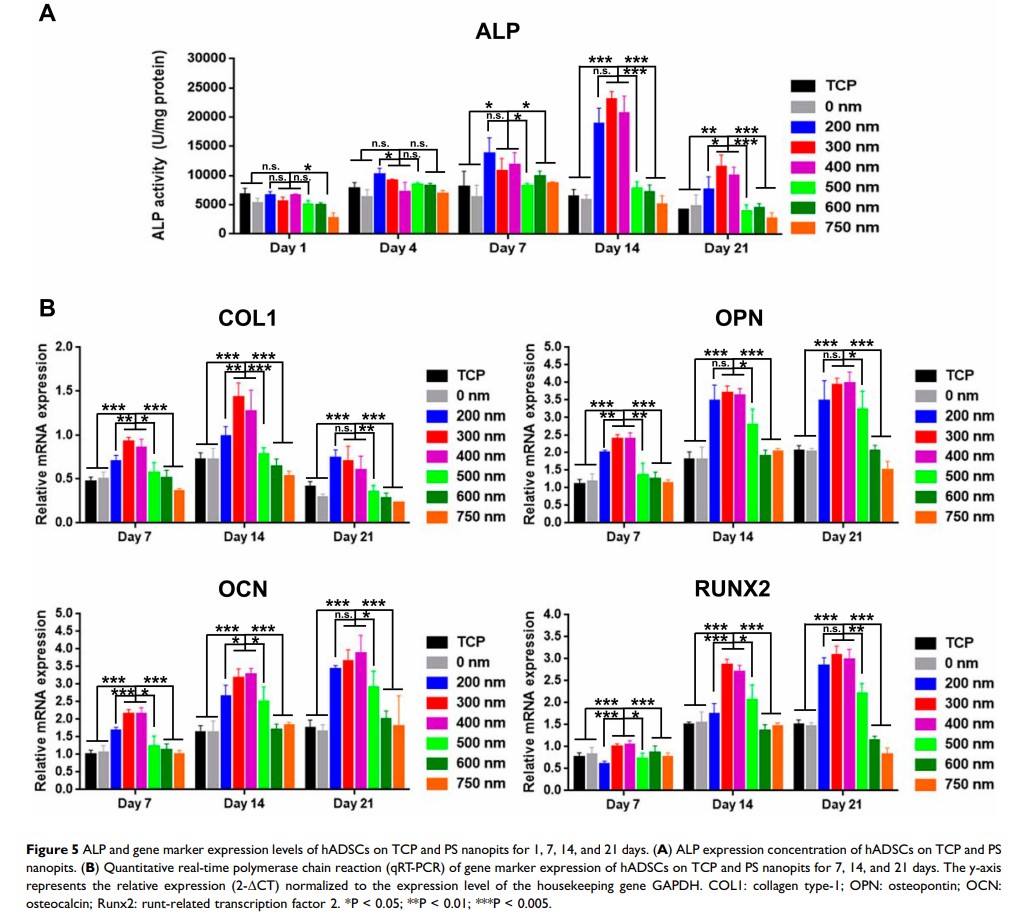
Results: The osteogenic differentiation can be enhanced by nanopits with a diameter of 300– 400 nm.
Discussion: The present study provided exciting new avenues to investigate cellular responses to well-defined nanoscale topographic features, which could further guide bone tissue engineering and stem cell clinical research. The capability to control developing biomaterials mimicking nanotopographic surfaces promoted functional tissue engineering, such as artificial joint replacement, bone repair, and dental applications.
Keywords: osteo-differentiation, nanotopography, polystyrene