115195
论文已发表
注册即可获取德孚的最新动态
IF 收录期刊
- 3.6 Breast Cancer (Dove Med Press)
- 4.3 Clin Epidemiol
- 2.6 Cancer Manag Res
- 3.2 Infect Drug Resist
- 4.1 Clin Interv Aging
- 6.1 Drug Des Dev Ther
- 4.1 Int J Chronic Obstr
- 8.7 Int J Nanomed
- 2.5 Int J Women's Health
- 3.2 Neuropsych Dis Treat
- 2.4 OncoTargets Ther
- 2.6 Patient Prefer Adher
- 2.6 Ther Clin Risk Manag
- 3.1 J Pain Res
- 3.5 Diabet Metab Synd Ob
- 4.5 Psychol Res Behav Ma
- 3.4 Nat Sci Sleep
- 2.4 Pharmgenomics Pers Med
- 2.6 Risk Manag Healthc Policy
- 4.6 J Inflamm Res
- 2.3 Int J Gen Med
- 3.9 J Hepatocell Carcinoma
- 3.3 J Asthma Allergy
- 2.5 Clin Cosmet Investig Dermatol
- 3.0 J Multidiscip Healthc

尼妥珠单抗联合诱导化疗、同期放化疗治疗无法切除的局部晚期咽喉癌:中国的单一机构经验
Authors Tian X, Xuan Y, Wu R, Gao S
Received 5 February 2020
Accepted for publication 21 April 2020
Published 11 May 2020 Volume 2020:12 Pages 3323—3329
DOI https://doi.org/10.2147/CMAR.S248392
Checked for plagiarism Yes
Review by Single-blind
Peer reviewer comments 2
Editor who approved publication: Professor Rudolph Navari
Objective: To investigate the curative and adverse effects (AEs) of additional use of nimotuzumab combined with induction chemotherapy and concurrent chemoradiotherapy in unresectable locoregionally advanced hypopharyngeal carcinoma.
Patients and Methods: We retrospectively evaluated 36 patients with stage III or IVA hypopharyngeal carcinoma who received induction chemotherapy followed by concurrent chemoradiotherapy with or without nimotuzumab. The induction chemotherapy included two or three cycles of TPF regimen. The intensity-modulated radiation therapy (IMRT) dose was 70 Gy to the planning target volume. Concurrent with radiotherapy, patients received chemotherapy consisting of cisplatin q3w. Adjuvant chemotherapy consisting of TPF regimen was administered 1 month later after concurrent chemoradiotherapy. Nimotuzumab (200 mg day 1, q3w) was given to patients concurrently with induction chemotherapy and was administered concurrently with IMRT at a weekly dose of 200 mg.
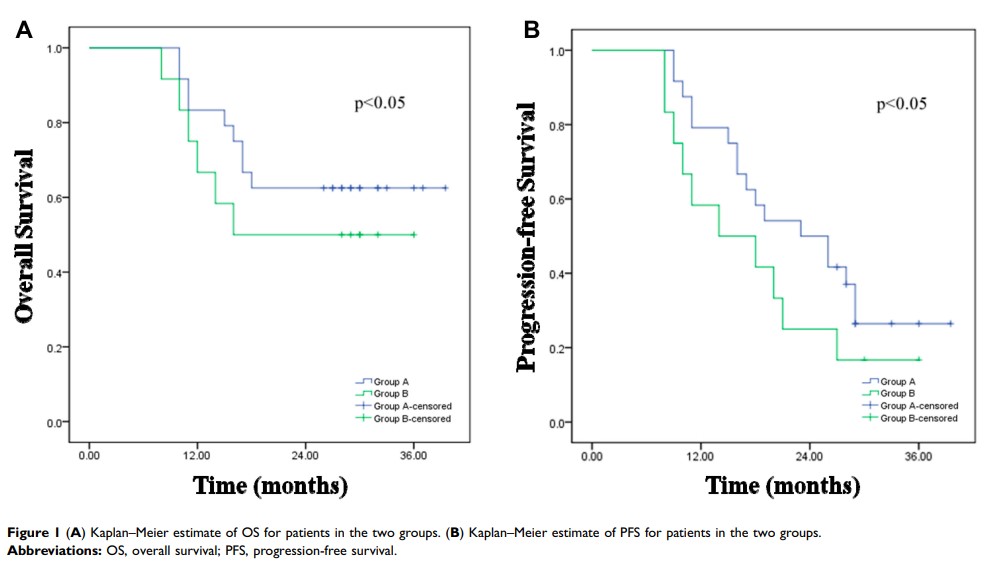
Results: After induction chemotherapy, the objective response rate in patients treated with nimotuzumab (group A) versus those treated without nimotuzumab (group B) was 91.7% versus 58.3% (p=0.029). After concurrent chemoradiotherapy, the objective response rate was 95.8% in group A versus 83.3% in group B (p=0.253). The median follow-up was 22.6 months (range 8.9– 39.5 months). The 2-year OS rate in group A and group B were 62.5% (95% CI 55– 70%) and 51.8% (95% CI 45– 59%), respectively, the 2-year OS rate in group A was better than group B, P < 0.05. PFS was 23 months (95% CI 19– 27) in group A versus 18 months (95% CI 12– 22) in group B, PFS was longer in group A than group B, P < 0.05. There was no significant difference in AEs between the two groups.
Conclusion: Additional use of nimotuzumab combined with induction chemotherapy and concurrent chemoradiotherapy in unresectable locoregionally advanced hypopharyngeal carcinoma yielded better short-term efficacy, also may improve overall survival and progression-free survival than patients without using nimotuzumab. The toxicity was tolerable.
Keywords: nimotuzumab, induction chemotherapy, chemoradiotherapy, unresectable, locoregionally advanced, hypopharyngeal carcinoma