115195
论文已发表
注册即可获取德孚的最新动态
IF 收录期刊
- 3.6 Breast Cancer (Dove Med Press)
- 4.3 Clin Epidemiol
- 2.6 Cancer Manag Res
- 3.2 Infect Drug Resist
- 4.1 Clin Interv Aging
- 6.1 Drug Des Dev Ther
- 4.1 Int J Chronic Obstr
- 8.7 Int J Nanomed
- 2.5 Int J Women's Health
- 3.2 Neuropsych Dis Treat
- 2.4 OncoTargets Ther
- 2.6 Patient Prefer Adher
- 2.6 Ther Clin Risk Manag
- 3.1 J Pain Res
- 3.5 Diabet Metab Synd Ob
- 4.5 Psychol Res Behav Ma
- 3.4 Nat Sci Sleep
- 2.4 Pharmgenomics Pers Med
- 2.6 Risk Manag Healthc Policy
- 4.6 J Inflamm Res
- 2.3 Int J Gen Med
- 3.9 J Hepatocell Carcinoma
- 3.3 J Asthma Allergy
- 2.5 Clin Cosmet Investig Dermatol
- 3.0 J Multidiscip Healthc

接受溶栓治疗的中风患者颅内出血的危险因素和用于预测的诺模图
Authors Zhou Z, Yin X, Niu Q, Liang S, Mu C, Zhang Y
Received 20 February 2020
Accepted for publication 20 April 2020
Published 11 May 2020 Volume 2020:16 Pages 1189—1197
DOI https://doi.org/10.2147/NDT.S250648
Checked for plagiarism Yes
Review by Single-blind
Peer reviewer comments 2
Editor who approved publication: Dr Yuping Ning
Purpose: Identifying stroke patients at risk of postthrombolysis intracranial hemorrhage (ICH) in the clinical setting is essential. We aimed to develop and evaluate a nomogram for predicting the probability of ICH in acute ischemic stroke patients undergoing thrombolysis.
Patients and Methods: A retrospective observational study was conducted using data from 345 patients at a single center. The patients were randomly dichotomized into training (2/3; n=233) and validation (1/3; n=112) sets. A prediction model was developed by using a multivariable logistic regression analysis.
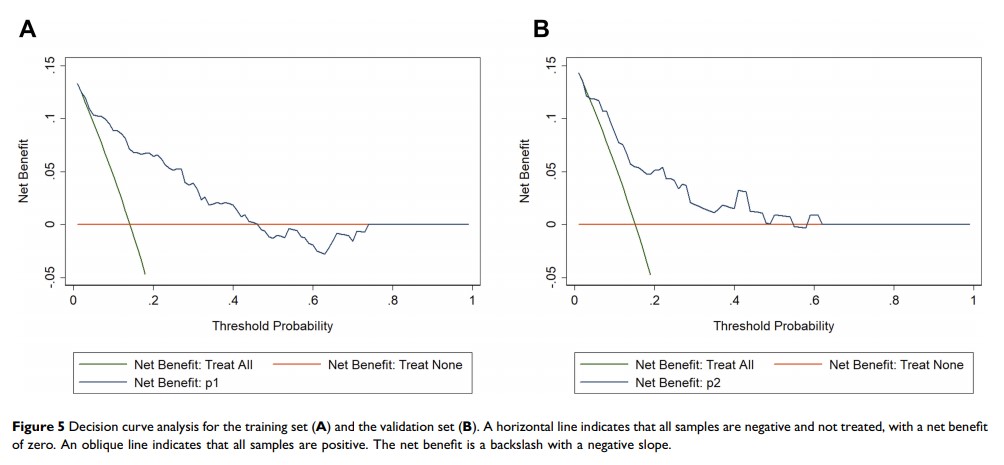
Results: The nomogram comprised three variables: the presence of atrial fibrillation (odds ratio [OR]: 4.92, 95% confidence interval [CI]: 2.09– 11.57), the National Institutes of Health Stroke Scale (NIHSS) score (OR: 1.11, 95% CI: 1.04– 1.18) and the glucose level on admission (OR: 1.27, 95% CI: 1.08– 1.50). The areas under the receiver operating characteristic curve of the nomogram for the training and validation sets were 0.828 (0.753– 0.903) and 0.801 (0.690– 0.911), respectively. The Hosmer–Lemeshow test revealed good calibration in both the training and validation sets (P = 0.509 and P = 0.342, respectively). The calibration plot also demonstrated good agreement. A decision curve analysis demonstrated that the nomogram was clinically useful.
Conclusion: We developed an easy-to-use nomogram model to predict ICH, and the nomogram may provide risk assessments for subsequent treatment in stroke patients undergoing thrombolysis.
Keywords: stroke, intracranial hemorrhage, thrombolysis, nomogram, prognosis