115195
论文已发表
注册即可获取德孚的最新动态
IF 收录期刊
- 3.6 Breast Cancer (Dove Med Press)
- 4.3 Clin Epidemiol
- 2.6 Cancer Manag Res
- 3.2 Infect Drug Resist
- 4.1 Clin Interv Aging
- 6.1 Drug Des Dev Ther
- 4.1 Int J Chronic Obstr
- 8.7 Int J Nanomed
- 2.5 Int J Women's Health
- 3.2 Neuropsych Dis Treat
- 2.4 OncoTargets Ther
- 2.6 Patient Prefer Adher
- 2.6 Ther Clin Risk Manag
- 3.1 J Pain Res
- 3.5 Diabet Metab Synd Ob
- 4.5 Psychol Res Behav Ma
- 3.4 Nat Sci Sleep
- 2.4 Pharmgenomics Pers Med
- 2.6 Risk Manag Healthc Policy
- 4.6 J Inflamm Res
- 2.3 Int J Gen Med
- 3.9 J Hepatocell Carcinoma
- 3.3 J Asthma Allergy
- 2.5 Clin Cosmet Investig Dermatol
- 3.0 J Multidiscip Healthc

Transition from Restrictive to Obstructive Lung Function Impairment During Treatment and Follow-Up of Active Tuberculosis
Authors Allwood BW, Maasdorp E, Kim GJ, Cooper CB, Goldin J, van Zyl-Smit RN, Bateman ED, Dawson R
Received 16 December 2019
Accepted for publication 10 March 2020
Published 11 May 2020 Volume 2020:15 Pages 1039—1047
DOI https://doi.org/10.2147/COPD.S219731
Checked for plagiarism Yes
Review by Single-blind
Peer reviewer comments 2
Editor who approved publication: Dr Richard Russell
Background: Pulmonary tuberculosis (PTB) is associated with many forms of chronic lung disease including the development of chronic airflow obstruction (AFO). However, the nature, evolution and mechanisms responsible for the AFO after PTB are poorly understood. The aim of this study was to examine the progression of changes in lung physiology in patients treated for PTB.
Methods: Immunocompetent, previously healthy, adult patients receiving ambulatory treatment for a first episode of tuberculosis were prospectively followed up with serial lung physiology and quantitative computed tomography (CT) lung scans performed at diagnosis of tuberculosis, 2, 6, 12 and 18 months during and after the completion of treatment.
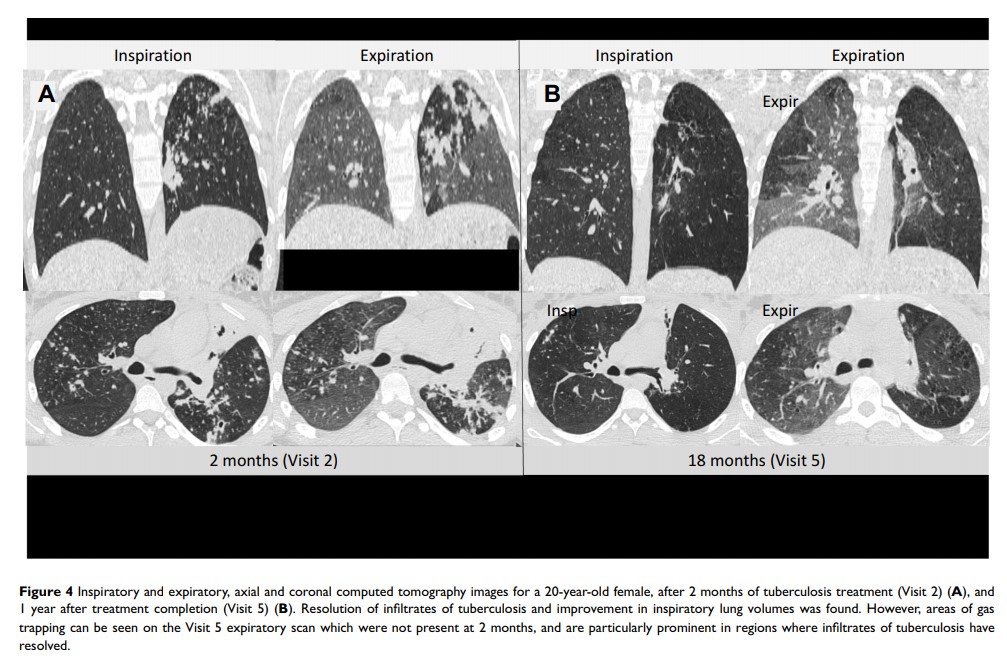
Results: Forty-nine patients (median age 26 years; 37.2% males) were included, and 43 were studied. During treatment, lung volumes improved and CT fibrosis scores decreased, but features of AFO and gas trapping emerged, while reduced diffusing capacity (DLco) seen in a majority of patients persisted. Significant increases in total lung capacity (TLC) by plethysmography were seen in the year following treatment completion (median change 5.9% pred., P< 0.01) and were driven by large increases in residual volume (RV) (median change +19%pred., P< 0.01) but not inspiratory capacity (IC; P=0.41). The change in RV/TLC correlated with significant progression of radiological gas trapping after treatment (P=0.04) but not with emphysema scores. One year after completing treatment, 18.6% of patients had residual restriction (total lung capacity, TLC < 80%pred), 16.3% had AFO, 32.6% had gas trapping (RV/TLC> 45%), and 78.6% had reduced DLco.
Conclusion: Simple spirometry alone does not fully reveal the residual respiratory impairments resulting after a first episode of PTB. Changes in physiology evolve after treatment completion, and these findings when taken together, suggest emergence of gas trapping after treatment likely caused by progression of small airway pathology during the healing process.
Keywords: tuberculosis, post-tuberculosis, chronic obstructive pulmonary disease, lung function, computed tomography, airflow obstruction