115195
论文已发表
注册即可获取德孚的最新动态
IF 收录期刊
- 3.6 Breast Cancer (Dove Med Press)
- 4.3 Clin Epidemiol
- 2.6 Cancer Manag Res
- 3.2 Infect Drug Resist
- 4.1 Clin Interv Aging
- 6.1 Drug Des Dev Ther
- 4.1 Int J Chronic Obstr
- 8.7 Int J Nanomed
- 2.5 Int J Women's Health
- 3.2 Neuropsych Dis Treat
- 2.4 OncoTargets Ther
- 2.6 Patient Prefer Adher
- 2.6 Ther Clin Risk Manag
- 3.1 J Pain Res
- 3.5 Diabet Metab Synd Ob
- 4.5 Psychol Res Behav Ma
- 3.4 Nat Sci Sleep
- 2.4 Pharmgenomics Pers Med
- 2.6 Risk Manag Healthc Policy
- 4.6 J Inflamm Res
- 2.3 Int J Gen Med
- 3.9 J Hepatocell Carcinoma
- 3.3 J Asthma Allergy
- 2.5 Clin Cosmet Investig Dermatol
- 3.0 J Multidiscip Healthc

LINC00963 通过调节 miR-766-3p/MTA1 轴在膀胱癌中起着致癌基因的作用
Received 15 February 2020
Accepted for publication 19 April 2020
Published 12 May 2020 Volume 2020:12 Pages 3353—3361
DOI https://doi.org/10.2147/CMAR.S249979
Checked for plagiarism Yes
Review by Single-blind
Peer reviewer comments 2
Editor who approved publication: Dr Sanjeev Srivastava
Purpose: Long non-coding RNAs have been found to be involved in bladder cancer development. This article studied LINC00963 effects on bladder cancer progression to provide a novel treatment target.
Patients and Methods: Totally 56 bladder cancer patients participated in this research. Bladder cancer cells were transfected. Cell counting kit 8 assay and clone formation experiment were used for cell viability and colony formation detection. Cell migration and invasion were determined by Transwell experiment. LINC00963 distribution was explored by cytoplasmic and nuclear extract isolation and quantitative real-time polymerase chain reaction. Luciferase reporter experiment and RNA pulldown experiment were performed to detect the relationship between these two genes. The cancer genome atlas analysis was used for the detection of metastasis-associated protein 1 (MTA1) expression in bladder cancer.
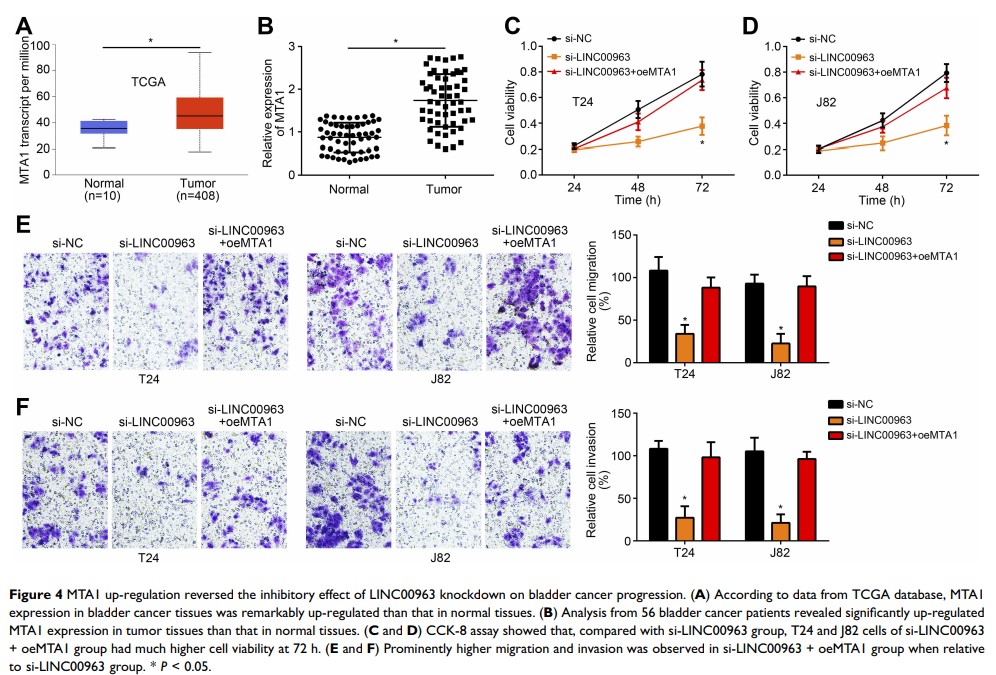
Results: LINC00963 was seriously up-regulated in bladder cancer patients. High LINC00963 expression indicated high histological grade and low survival. LINC00963 was obviously up-regulated in bladder cancer cells. Knockdown of LINC00963 significantly reduced bladder cancer cells viability, colony formation, migration and invasion. Luciferase reporter experiment and RNA pulldown experiment revealed that LINC00963 promoted MTA1 expression via directly inhibiting miR-766-3p. MTA1 was up-regulated in bladder cancer patients. MTA1 up-regulation reversed the inhibitory effect of LINC00963 knockdown on bladder cancer cell viability, migration and invasion.
Conclusion: LINC00963 functions as an oncogene in bladder cancer by regulating the miR-766-3p/MTA1 axis.
Keywords: bladder cancer, LINC00963, miR-766-3p, MTA1, progression