115195
论文已发表
注册即可获取德孚的最新动态
IF 收录期刊
- 3.6 Breast Cancer (Dove Med Press)
- 4.3 Clin Epidemiol
- 2.6 Cancer Manag Res
- 3.2 Infect Drug Resist
- 4.1 Clin Interv Aging
- 6.1 Drug Des Dev Ther
- 4.1 Int J Chronic Obstr
- 8.7 Int J Nanomed
- 2.5 Int J Women's Health
- 3.2 Neuropsych Dis Treat
- 2.4 OncoTargets Ther
- 2.6 Patient Prefer Adher
- 2.6 Ther Clin Risk Manag
- 3.1 J Pain Res
- 3.5 Diabet Metab Synd Ob
- 4.5 Psychol Res Behav Ma
- 3.4 Nat Sci Sleep
- 2.4 Pharmgenomics Pers Med
- 2.6 Risk Manag Healthc Policy
- 4.6 J Inflamm Res
- 2.3 Int J Gen Med
- 3.9 J Hepatocell Carcinoma
- 3.3 J Asthma Allergy
- 2.5 Clin Cosmet Investig Dermatol
- 3.0 J Multidiscip Healthc

丹酚酸 B 改善大鼠慢性轻度应激诱导的抑郁行为:AMPK/SIRT1 信号通路的参与
Authors Liao D, Chen Y, Guo Y, Wang C, Liu N, Gong Q, Fu Y, Fu Y, Cao L, Yao D, Jiang P
Received 11 February 2020
Accepted for publication 18 April 2020
Published 12 May 2020 Volume 2020:13 Pages 195—206
DOI https://doi.org/10.2147/JIR.S249363
Checked for plagiarism Yes
Review by Single-blind
Peer reviewer comments 3
Editor who approved publication: Dr Ning Quan
Introduction: Depression is one of the most common neuropsychiatric illnesses which leads to a huge social and economic burden on modern society. So, it is necessary to develop an effective and safe pharmacological intervention for depression. Accumulating evidence has shown that adenosine monophosphate-activated protein kinase/sirtuin 1 (AMPK/SIRT1) signaling pathway plays a pivotal role in the development of depression. Our present study aimed to investigate the antidepressant effect and possible mechanisms of salvianolic acid B (SalB) in a chronic mild stress (CMS)-induced depression model in rats.
Materials and Methods: The rats were randomly divided into three groups: control group with no stressor, CMS group and CMS+SalB (30 mg/kg/d) group. After administration for 28 consecutive days, the behavior tests were performed. The rats were sacrificed after behavior tests, and the brain tissues were collected for biochemical analysis.
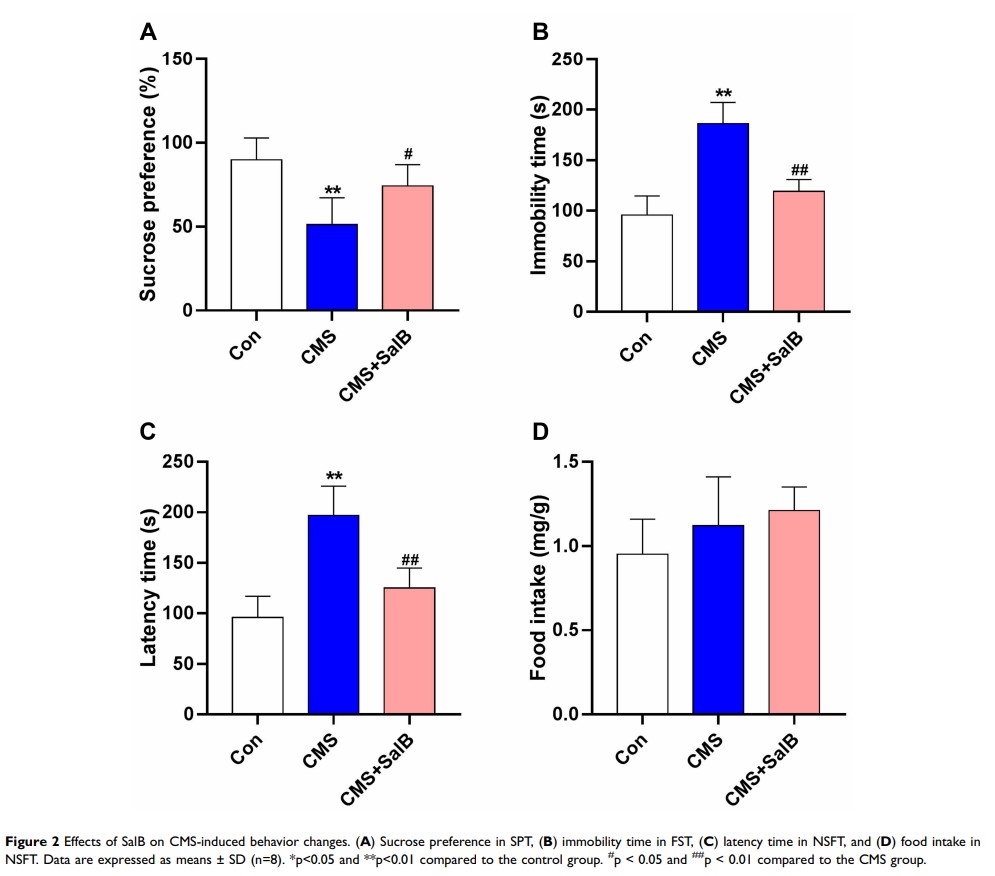
Results: It was observed that the administration of SalB for 28 consecutive days successfully corrected the depressive-like behaviors in CMS-treated rats. SalB could effectively reduce the gene expression of pro-inflammatory cytokines such as interleukin-6 (IL-6), interleukin-1β (IL-1β) and tumor necrosis factor α (TNF-α), as well as nuclear factor-kappa B (NF-κB) p65 protein. In addition, inhibitor of NF-κB (IκB) protein expression was significantly increased after the administration of SalB. Moreover, SalB could effectively decrease protein expression of oxidative stress markers such as 4-hydroxynonenal (4-HNE) and malondialdehyde (MDA) and increase the activity of catalase (CAT). SalB treatment also reversed CMS-induced inhibition of Nrf2 signaling pathway, along with increasing the mRNA expression of NAD(P)H:quinone oxidoreductase (NQO-1) and heme oxygenase 1 (HO-1). Regarding the endoplasmic reticulum (ER) stress markers, the protein expressions of C/EBP-homologous protein (CHOP) and glucose-regulated protein 78 kD (GRP78) were also significantly reduced after SalB administration. Furthermore, the supplementation of SalB could effectively activate the AMPK/SIRT1 signaling pathway, which indicated significant increase in pAMPK/AMPK ratio and SIRT1 protein expression.
Conclusion: Our study demonstrated that SalB relieved CMS-induced depressive-like state through the mitigation of inflammatory status, oxidative stress, and the activation of AMPK/SIRT1 signaling pathway.
Keywords: SalB, depression, CMS, AMPK/SIRT1