115195
论文已发表
注册即可获取德孚的最新动态
IF 收录期刊
- 3.6 Breast Cancer (Dove Med Press)
- 4.3 Clin Epidemiol
- 2.6 Cancer Manag Res
- 3.2 Infect Drug Resist
- 4.1 Clin Interv Aging
- 6.1 Drug Des Dev Ther
- 4.1 Int J Chronic Obstr
- 8.7 Int J Nanomed
- 2.5 Int J Women's Health
- 3.2 Neuropsych Dis Treat
- 2.4 OncoTargets Ther
- 2.6 Patient Prefer Adher
- 2.6 Ther Clin Risk Manag
- 3.1 J Pain Res
- 3.5 Diabet Metab Synd Ob
- 4.5 Psychol Res Behav Ma
- 3.4 Nat Sci Sleep
- 2.4 Pharmgenomics Pers Med
- 2.6 Risk Manag Healthc Policy
- 4.6 J Inflamm Res
- 2.3 Int J Gen Med
- 3.9 J Hepatocell Carcinoma
- 3.3 J Asthma Allergy
- 2.5 Clin Cosmet Investig Dermatol
- 3.0 J Multidiscip Healthc

小檗碱通过灭活 AKT/mTORC1 信号传导诱导急性淋巴细胞白血病的自噬细胞死亡
Authors Liu J, Liu P, Xu T, Chen Z, Kong H, Chu W, Wang Y, Liu Y
Received 19 November 2019
Accepted for publication 21 April 2020
Published 12 May 2020 Volume 2020:14 Pages 1813—1823
DOI https://doi.org/10.2147/DDDT.S239247
Checked for plagiarism Yes
Review by Single-blind
Peer reviewer comments 4
Editor who approved publication: Dr Sukesh Voruganti
Introduction: Berberine has been reported to inhibit cancer cell growth by apoptosis induction and exhibits a protective role against cancer progression. The current study aims to investigate the effects of berberine on acute lymphoblastic leukemia (ALL) and the mechanism beyond apoptosis.
Methods: Cell viability was determined in ALL cell lines EU-6 and SKW-3 using trypan blue staining. Cell autophagy was determined by immunofluorescence and Western blot. ALL xenograft mice were established to investigate the anti-tumor effects of BBR. The molecular mechanism was explored in ALL cell lines using siRNA and signaling inhibitors.
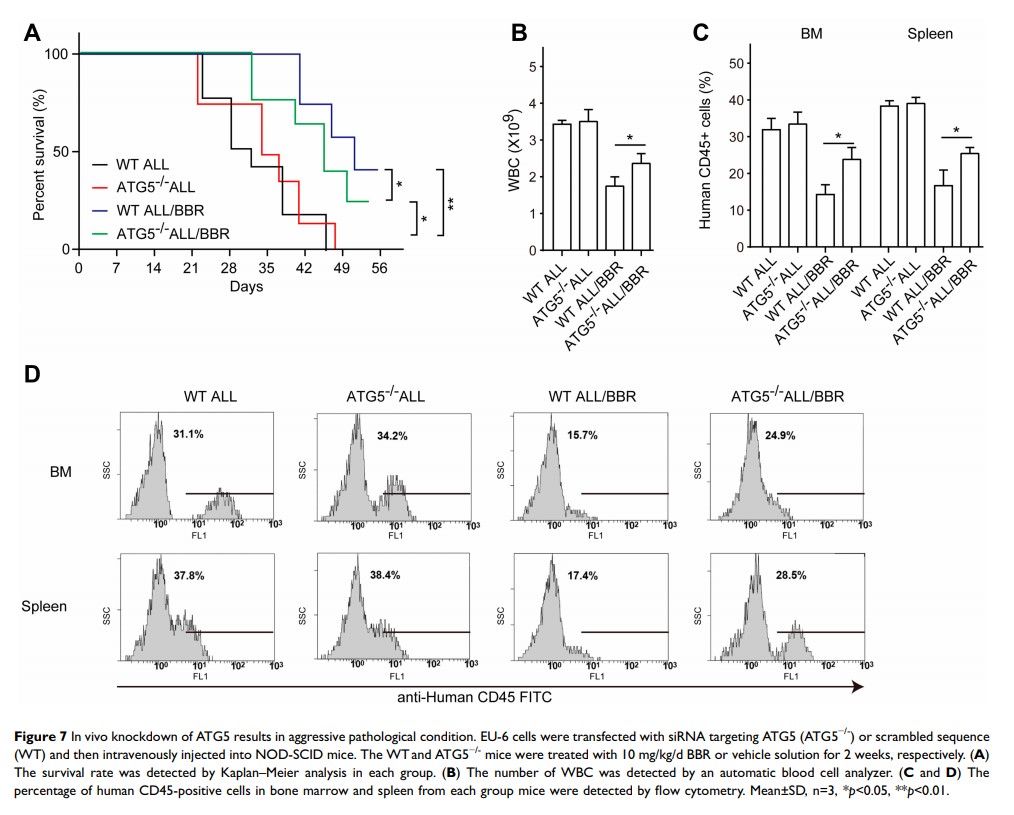
Results: Herein, we show that berberine treatment significantly inhibits ALL cell viability and promotes cell death by inducing autophagy in a dose-dependent manner. Moreover, berberine significantly alleviates the aggressive pathological condition in ALL xenograft mice. Mechanistic studies exhibit that berberine induces autophagic death in ALL cells by inactivating AKT/mTORC1 signaling. Chemically targeting AKT/mTORC1 signaling controls berberine-induced cell autophagy in vitro, and blockade of autophagic process blunts berberine-alleviated pathological condition in vivo.
Discussion: In conclusion, our study reveals that berberine could induce ALL cell autophagic death by inactivating AKT/mTORC1 signaling that could be used to develop small molecule drug for ALL treatment.
Keywords: acute lymphoblastic leukemia, berberine, AKT/mTORC1, autophagy