115195
论文已发表
注册即可获取德孚的最新动态
IF 收录期刊
- 3.6 Breast Cancer (Dove Med Press)
- 4.3 Clin Epidemiol
- 2.6 Cancer Manag Res
- 3.2 Infect Drug Resist
- 4.1 Clin Interv Aging
- 6.1 Drug Des Dev Ther
- 4.1 Int J Chronic Obstr
- 8.7 Int J Nanomed
- 2.5 Int J Women's Health
- 3.2 Neuropsych Dis Treat
- 2.4 OncoTargets Ther
- 2.6 Patient Prefer Adher
- 2.6 Ther Clin Risk Manag
- 3.1 J Pain Res
- 3.5 Diabet Metab Synd Ob
- 4.5 Psychol Res Behav Ma
- 3.4 Nat Sci Sleep
- 2.4 Pharmgenomics Pers Med
- 2.6 Risk Manag Healthc Policy
- 4.6 J Inflamm Res
- 2.3 Int J Gen Med
- 3.9 J Hepatocell Carcinoma
- 3.3 J Asthma Allergy
- 2.5 Clin Cosmet Investig Dermatol
- 3.0 J Multidiscip Healthc

使用靶向纳米颗粒联合递送替莫唑胺和 siPLK1,以增强胶质瘤对替莫唑胺敏感性
Authors Shi H, Sun S, Xu H, Zhao Z, Han Z, Jia J, Wu D, Lu J, Liu H, Yu R
Received 27 December 2019
Accepted for publication 15 April 2020
Published 12 May 2020 Volume 2020:15 Pages 3347—3362
DOI https://doi.org/10.2147/IJN.S243878
Checked for plagiarism Yes
Review by Single-blind
Peer reviewer comments 2
Editor who approved publication: Dr Mian Wang
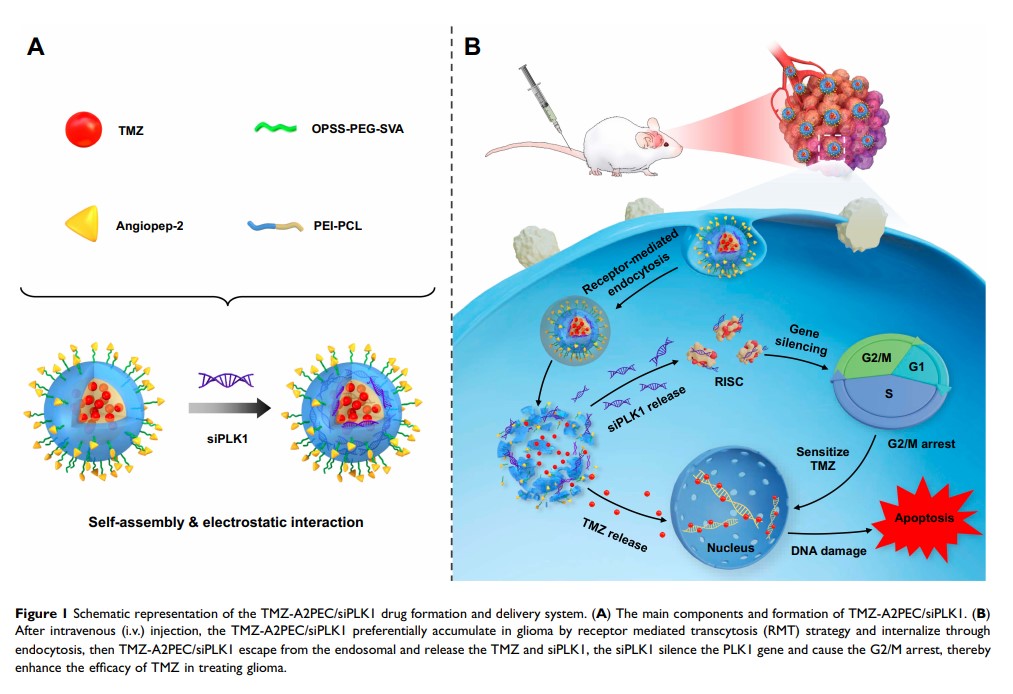
Introduction: Temozolomide (TMZ) is the first-line chemotherapeutic option to treat glioma; however, its efficacy and clinical application are limited by its drug resistance properties. Polo-like kinase 1 (PLK1)-targeted therapy causes G2/M arrest and increases the sensitivity of glioma to TMZ. Therefore, to limit TMZ resistance in glioma, an angiopep-2 (A2)-modified polymeric micelle (A2PEC) embedded with TMZ and a small interfering RNA (siRNA) targeting PLK1 (siPLK1) was developed (TMZ-A2PEC/siPLK).
Materials and Methods: TMZ was encapsulated by A2-PEG-PEI-PCL (A2PEC) through the hydrophobic interaction, and siPLK1 was complexed with the TMZ-A2PEC through electrostatic interaction. Then, an angiopep-2 (A2) modified polymeric micelle (A2PEC) embedding TMZ and siRNA targeting polo-like kinase 1 (siPLK1) was developed (TMZ-A2PEC/siPLK).
Results: In vitro experiments indicated that TMZ-A2PEC/siPLK effectively enhanced the cellular uptake of TMZ and siPLK1 and resulted in significant cell apoptosis and cytotoxicity of glioma cells. In vivo experiments showed that glioma growth was inhibited, and the survival time of the animals was prolonged remarkably after TMZ-A2PEC/siPLK1 was injected via their tail vein.
Discussion: The results demonstrate that the combination of TMZ and siPLK1 in A2PEC could enhance the efficacy of TMZ in treating glioma.
Keywords: co-delivery, polymeric micelle, siPLK1, TMZ, drug resistance, glioma