115195
论文已发表
注册即可获取德孚的最新动态
IF 收录期刊
- 3.6 Breast Cancer (Dove Med Press)
- 4.3 Clin Epidemiol
- 2.6 Cancer Manag Res
- 3.2 Infect Drug Resist
- 4.1 Clin Interv Aging
- 6.1 Drug Des Dev Ther
- 4.1 Int J Chronic Obstr
- 8.7 Int J Nanomed
- 2.5 Int J Women's Health
- 3.2 Neuropsych Dis Treat
- 2.4 OncoTargets Ther
- 2.6 Patient Prefer Adher
- 2.6 Ther Clin Risk Manag
- 3.1 J Pain Res
- 3.5 Diabet Metab Synd Ob
- 4.5 Psychol Res Behav Ma
- 3.4 Nat Sci Sleep
- 2.4 Pharmgenomics Pers Med
- 2.6 Risk Manag Healthc Policy
- 4.6 J Inflamm Res
- 2.3 Int J Gen Med
- 3.9 J Hepatocell Carcinoma
- 3.3 J Asthma Allergy
- 2.5 Clin Cosmet Investig Dermatol
- 3.0 J Multidiscip Healthc

手掌参治疗的高海拔缺氧所致脑损伤小鼠长非编码 RNA 的表达谱 (L.) R. Br.
Authors Zhang Y, Liu L, Liang C, Zhou L, Tan L, Zong Y, Wu L, Liu T
Received 18 January 2020
Accepted for publication 15 April 2020
Published 12 May 2020 Volume 2020:16 Pages 1239—1248
DOI https://doi.org/10.2147/NDT.S246504
Checked for plagiarism Yes
Review by Single-blind
Peer reviewer comments 2
Editor who approved publication: Dr Yuping Ning
Background: The unique geographical environment at high altitudes may cause a series of diseases, such as acute altitude reaction, cerebral edema, and pulmonary edema. Gymnadenia conopsea (L.) R. Br. has been reported to have an effect on high-altitude hypoxia. However, the molecular mechanism, especially the expression of long noncoding RNAs (lncRNAs), is not yet clear.
Methods: The expression profiles of lncRNAs in high-altitude hypoxia-induced brain injury mice treated with Gymnadenia conopsea (L.) R. Br. by using a microarray method.
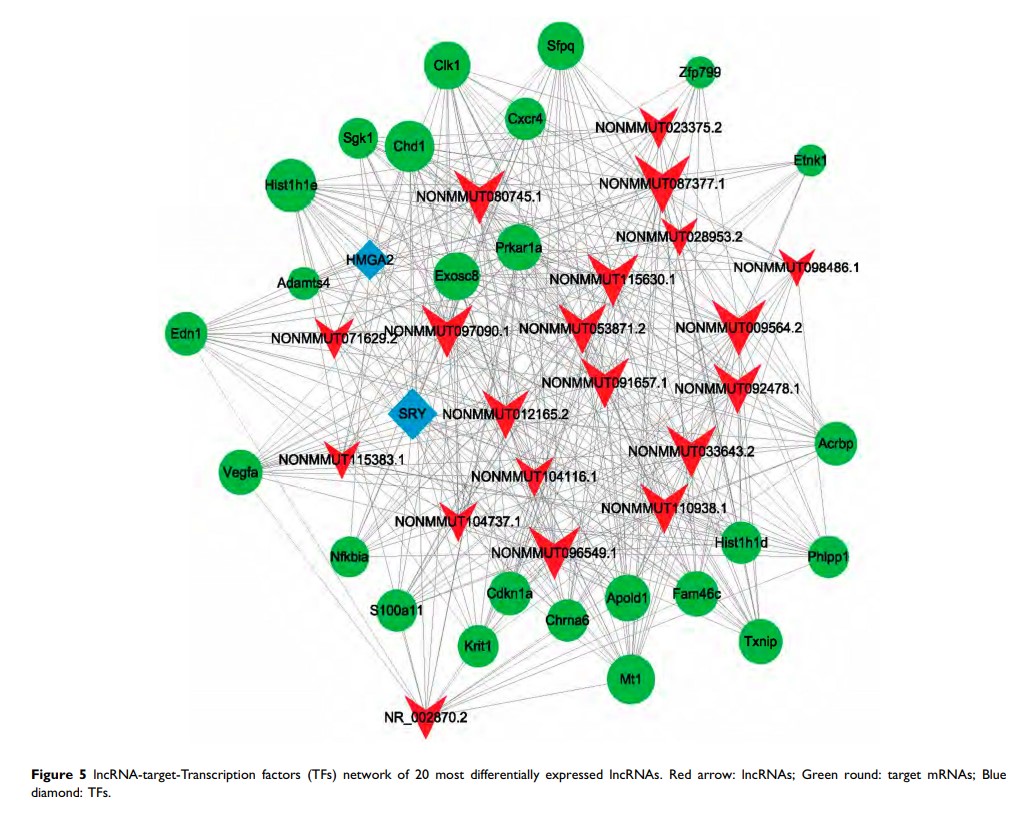
Results: A total of 226 differentially expressed lncRNAs, 126 significantly dysregulated mRNAs and 23 differentially expressed circRNAs were detected (> 2.0-fold, p< 0.05). The expression of selected lncRNAs, mRNAs and circRNAs was validated by qRT-PCR. KEGG analysis showed that the mRNAs coexpressed with lncRNAs were involved in inflammation and hypoxia pathways, including the HIF-1, PI3K-Akt, and NF-kappa B signaling pathways. The lncRNA-TF network analysis results indicated that the lncRNAs were regulated mostly by HMGA2, SRY, GATA4, SOX5, and ZBTB16.
Conclusion: This study is the first to report the expression profiles of lncRNAs, mRNAs and circRNAs in mice with high-altitude hypoxia-induced brain injury treated with Gymnadenia conopsea (L.) R. Br. and may improve the understanding of the molecular mechanism of Gymnadenia conopsea (L.) R. Br. in treating high altitude hypoxia-induced brain injury.
Keywords: expression profile, noncoding RNAs, high-altitude hypoxia, Gymnadenia conopsea (L.) R. Br