115195
论文已发表
注册即可获取德孚的最新动态
IF 收录期刊
- 3.6 Breast Cancer (Dove Med Press)
- 4.3 Clin Epidemiol
- 2.6 Cancer Manag Res
- 3.2 Infect Drug Resist
- 4.1 Clin Interv Aging
- 6.1 Drug Des Dev Ther
- 4.1 Int J Chronic Obstr
- 8.7 Int J Nanomed
- 2.5 Int J Women's Health
- 3.2 Neuropsych Dis Treat
- 2.4 OncoTargets Ther
- 2.6 Patient Prefer Adher
- 2.6 Ther Clin Risk Manag
- 3.1 J Pain Res
- 3.5 Diabet Metab Synd Ob
- 4.5 Psychol Res Behav Ma
- 3.4 Nat Sci Sleep
- 2.4 Pharmgenomics Pers Med
- 2.6 Risk Manag Healthc Policy
- 4.6 J Inflamm Res
- 2.3 Int J Gen Med
- 3.9 J Hepatocell Carcinoma
- 3.3 J Asthma Allergy
- 2.5 Clin Cosmet Investig Dermatol
- 3.0 J Multidiscip Healthc

铜绿假单胞菌对亚胺培南的异质性耐药和耐药性机制
Authors Xu Y, Zheng X, Zeng W, Chen T, Liao W, Qian J, Lin J, Zhou C, Tian X, Cao J, Zhou T
Received 12 February 2020
Accepted for publication 21 April 2020
Published 14 May 2020 Volume 2020:13 Pages 1419—1428
DOI https://doi.org/10.2147/IDR.S249475
Checked for plagiarism Yes
Review by Single-blind
Peer reviewer comments 2
Editor who approved publication: Professor Suresh Antony
Background: Heteroresistance is a phenomenon that occurs in all bacteria and can cause treatment failure. Yet, the exact mechanisms responsible for heteroresistance still remain unknown. The following study investigated the mechanisms of imipenem-heteroresistance and -resistance in Pseudomonas aeruginosa clinical isolates from Wenzhou, China.
Methods: Imipenem resistance was detected by the agar dilution method; heteroresistance was determined by population analysis profiles. Biofilm formation assay and modified carbapenem inactivation methods were also performed. Polymerase chain reaction (PCR) was conducted to detect oprD , and quantitative real-time PCR was used to determine expression levels of oprD , ampC and four efflux pump coding genes (mexB, mexD, mexE and mexY ).
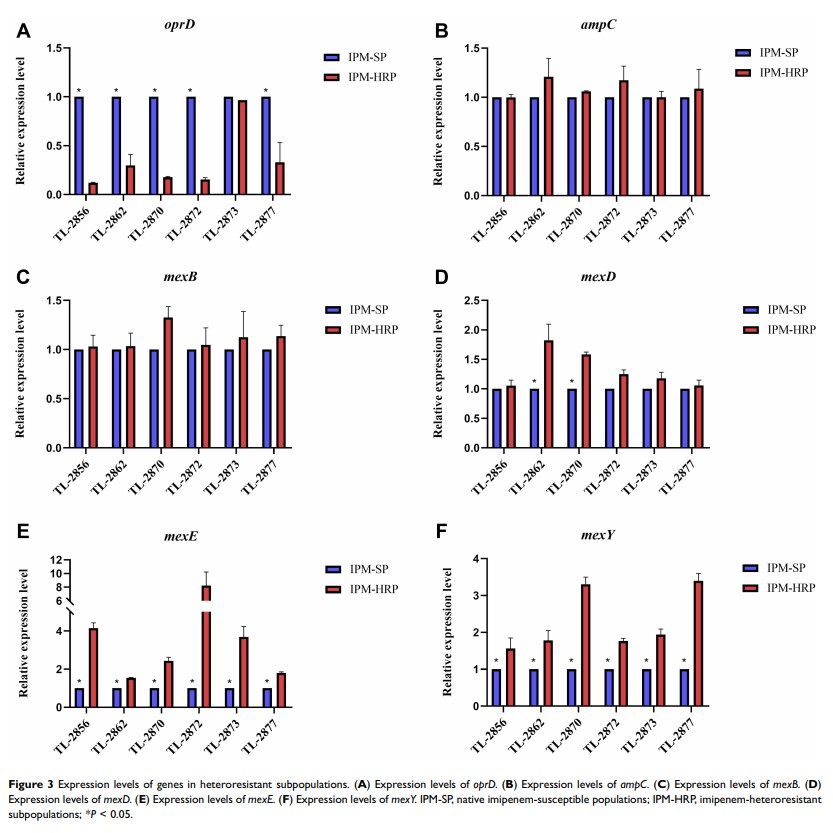
Results: Six imipenem-heteroresistant and -resistant P. aeruginosa isolates were selected respectively. Deficient oprD was detected in all resistant isolates and two heteroresistant isolates. No strains produced carbapenemases. Expression levels of oprD were down-regulated in heteroresistant isolates. Transcription levels of the mexE and mexY were significantly increased in all heterogeneous subpopulations compared with their respective native ones. Compared with the susceptible group, increased mean relative expression levels of mexE and mexY or the decreased mean relative expression levels of oprD were observed in the resistant group (P < 0.05), whereas transcription levels of the mexB and mexD remained unchanged.
Conclusion: Down-regulation of oprD contributed to the resistance and heteroresistance of imipenem in our P. aeruginosa clinical isolates. In addition, the marginal up-regulation of efflux systems may indirectly affect imipenem resistance. Contrarily, defective oprD was less common in our experimental heteroresistant strains than resistant strains.
Keywords: Pseudomonas aeruginosa , imipenem, resistance, heteroresistance, molecular mechanism, oprD