115195
论文已发表
注册即可获取德孚的最新动态
IF 收录期刊
- 3.6 Breast Cancer (Dove Med Press)
- 4.3 Clin Epidemiol
- 2.6 Cancer Manag Res
- 3.2 Infect Drug Resist
- 4.1 Clin Interv Aging
- 6.1 Drug Des Dev Ther
- 4.1 Int J Chronic Obstr
- 8.7 Int J Nanomed
- 2.5 Int J Women's Health
- 3.2 Neuropsych Dis Treat
- 2.4 OncoTargets Ther
- 2.6 Patient Prefer Adher
- 2.6 Ther Clin Risk Manag
- 3.1 J Pain Res
- 3.5 Diabet Metab Synd Ob
- 4.5 Psychol Res Behav Ma
- 3.4 Nat Sci Sleep
- 2.4 Pharmgenomics Pers Med
- 2.6 Risk Manag Healthc Policy
- 4.6 J Inflamm Res
- 2.3 Int J Gen Med
- 3.9 J Hepatocell Carcinoma
- 3.3 J Asthma Allergy
- 2.5 Clin Cosmet Investig Dermatol
- 3.0 J Multidiscip Healthc

经皮椎体成形术治疗脊柱转移瘤患者的骨水泥注射量的第一个算法计算
Authors Cui Y, Pan Y, Lei M, Mi C, Wang B, Shi X
Received 9 March 2020
Accepted for publication 17 April 2020
Published 14 May 2020 Volume 2020:16 Pages 417—428
DOI https://doi.org/10.2147/TCRM.S253046
Checked for plagiarism Yes
Review by Single-blind
Peer reviewer comments 3
Editor who approved publication: Professor Deyun Wang
Purpose: This study aims to develop an algorithm to predict cement injection volumes in patients with spine metastases treated with percutaneous vertebroplasty (PVP). Risk factors were also analyzed for intra-spinal canal cement leakages.
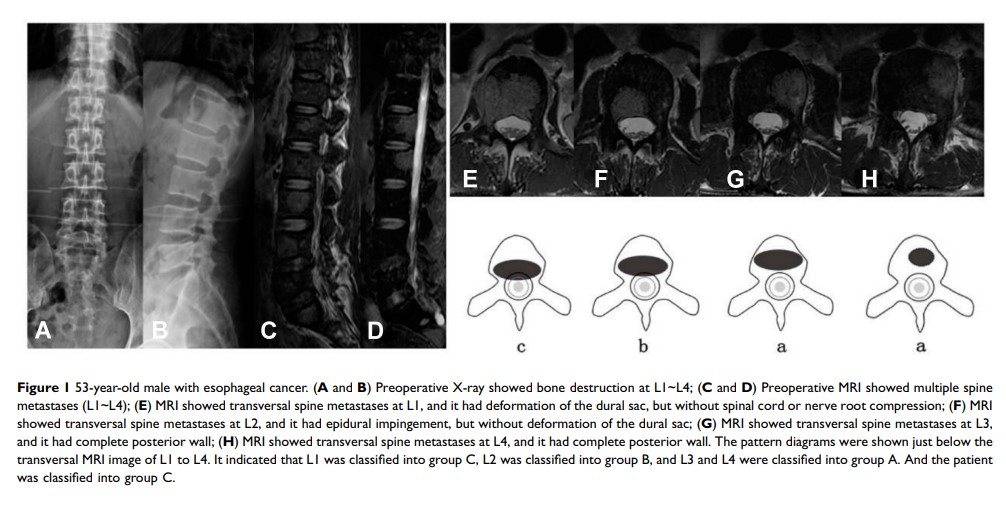
Patients and Methods: A retrospective analysis of 584 vertebrae in 251 patients. Patients and vertebrae were divided into three groups based on grades of tumor invasion to the spinal cord. Patients with the complete posterior wall of vertebrae were classified into group A, patients without the complete posterior wall of vertebrae but with normal Dural sac were classified into group B, and patients with deformation of the Dural sac but without neurological symptom were classified into group C. We systematically reviewed demographic data, clinical parameters, radiology features, and cement leakages among the three groups. The multiple linear regressions were used to screen potential risk factors and develop the algorithm to predict injected cement volumes in vertebrae. Significant factors were included in the algorithm. Potential risk factors for intra-spinal canal cement leakage were analyzed using the multiple logistic regressions.
Results: In the study, 17.1% (100/584) of vertebrae occurred cement leakages. Vertebrae in group C (28.6%, 8/28) had the highest cement leakage rate than patients in group A (14.4%, 61/424) and B (23.5%, 31/132) (P=0.014). Vertebrae in group C (14.3%, 4/28) were also more prone to intra-spinal canal leakages (P=0.003). The multiple logistic analysis showed that the Bilsky scale was significantly associated with intra-spinal canal cement leakages (P< 0.001). The multiple linear regression analysis showed that intercept (P< 0.001), treated vertebrae level (P< 0.001), cortical osteolytic destruction in posterior wall (P< 0.001), and Bilsky scale (P=0.014) were significant and those variables were included in the algorithm. The algorithm was Y=3.1627-0.8677×treated vertebrae level-0.6182×cortical osteolytic destruction in the posterior wall-0.2819×Bilsky scale.
Conclusion: An algorithm is proposed and can be used to calculate cement injection volumes in spine metastases treated with PVP. This algorithm can facilitate surgical planning and guide cement injections. Bilsky scale is an independent risk factor for intra-spinal canal cement leakages. We do not recommend PVP treated in patients with a Bilsky scale of 2 and 3 mainly due to a high rate of intra-spinal canal cement leakages.
Keywords: spinal metastases, percutaneous vertebroplasty, algorithm, intra-spinal canal leakages, risk factors